USB Charger Buying Guide for Businesses: Everything You Need to Know
Article Navigation
- Introduction
- Business vs Consumer Buying
- Step 1 — Define Your Use Case
- Step 2 — Choose the Right Charger Type
- Step 3 — Understand Key Specifications
- Step 4 — Match Port Type
- Step 5 — Verify Certification
- Step 6 — Total Cost of Ownership
- Step 7 — Assess Supplier Capability
- Buying Checklist
- FAQ
- Contact
USB Charger Buying Guide for Businesses: Everything You Need to Know
Buying a USB charger for personal use takes five minutes. Buying USB chargers for a business — whether you're bundling them with a product, equipping an office, or sourcing for resale — is a fundamentally different exercise.
The wrong unit price decision costs you margin. The wrong certification decision costs you market access. The wrong supplier decision costs you production delays, warranty claims, and brand reputation.
This guide is written for business buyers: procurement managers, product managers, brand owners, and OEM engineers who need to get the decision right the first time.
Business Charger Buying Is Different From Consumer Buying
When an individual buys a charger, they evaluate: Does it fit my device? Is it fast enough? Does it look good?
When a business buys chargers, the evaluation is more complex:
| Decision Dimension | Consumer | Business |
|---|---|---|
| Quantity | 1–3 units | Hundreds to millions |
| Certification | Nice to have | Legally mandatory by market |
| Customization | Not applicable | Logo, color, plug type, packaging |
| Supplier continuity | Irrelevant | Critical — same components across batches |
| Total cost | Unit price | Unit price + warranty cost + replacement rate |
| Lead time | Next-day delivery | 4–8 weeks production + shipping |
| Liability | Personal | Brand liability for product failures |
Each of these dimensions changes the decision criteria and the questions you need to ask. This guide addresses all of them.
Step 1 — Define Your Use Case
Before comparing specifications, define exactly how the charger will be used. Three primary business use cases drive very different product requirements.
Bundled with a Product (OEM / Private Label)
You are manufacturing or importing a device — a speaker, a smart home product, a medical instrument, a power tool — and need a charger that ships inside the box.
Key requirements:
- Exact output voltage and current matched to your device
- Your brand name or logo on the charger
- Certification specific to your target export market (CE for EU, FCC for US, etc.)
- Consistent component specification across production batches (no substitution)
- Co-ordinated retail packaging design
This is the highest-specification use case. The charger is part of your product, and its failure is your brand's liability.
Employee / Workplace Deployment
You are equipping offices, retail locations, hotels, hospitals, or other facilities with charging infrastructure.
Key requirements:
- Compatibility with a wide range of devices (USB-A + USB-C multi-port preferred)
- Durability for continuous use environments
- Safety certification appropriate to the installation environment
- Consistent supply for ongoing replacements
Retail Resale or Distribution
You are sourcing chargers as finished goods for resale under your own or a third-party brand.
Key requirements:
- Retail-ready packaging
- Certification for every target sale market
- Competitive unit economics at your target retail price point
- Reliable reorder supply with consistent product specification
Step 2 — Choose the Right Charger Type
USB Wall Charger
The standard category: AC mains input, one or more USB output ports, fixed or protocol-based output.
Best for: Consumer electronics bundles, workplace deployment, cost-sensitive applications. Typical wattage: 5W–65W per unit. Port options: USB-A, USB-C, or combination.
PD Wall Charger
A wall charger that supports the USB Power Delivery (USB PD) protocol, enabling intelligent voltage/current negotiation with compatible devices.
Best for: Laptop charging bundles, premium consumer electronics, any application where fast charging performance is a selling point. Typical wattage: 18W–140W. Requirement: Both the charger and the device must support USB PD for protocol benefits; non-PD devices will charge at standard rates.
→ Full explanation: //www.hechobo.com/blog/what-is-usb-power-delivery.html
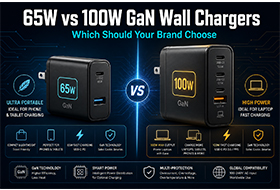
GaN Charger
A charger built with Gallium Nitride transistors rather than silicon, achieving higher efficiency and significantly smaller form factor at equivalent wattages.
Best for: Premium product bundles where compact form factor is a design requirement, travel charger products, high-wattage applications (65W+) where a silicon charger would be too large. Key advantage: 40–50% smaller than equivalent silicon charger; runs 15–25°C cooler under load.
→ Full comparison: //www.hechobo.com/blog/gan-charger-vs-traditional-charger.html
Desktop Multi-Port Charging Station
A desktop unit with multiple USB-A and/or USB-C ports, designed for charging several devices simultaneously from a single power source.
Best for: Office desks, hotel rooms, retail counters, airport lounges, healthcare waiting areas. Key consideration: How does the unit distribute power across ports when multiple devices are connected? Intelligent power distribution (IPD) dynamically allocates wattage based on device demand; fixed-split designs halve the per-port power when both ports are active.
→ Full guide: //www.hechobo.com/blog/65w-vs-100w-gan-wall-chargers.html
Lithium Battery Charger
A dedicated charger with a CC-CV (Constant Current / Constant Voltage) charging profile, designed for direct charging of lithium battery packs.
Best for: Products with integrated lithium batteries that charge externally — e-bikes, power tools, medical devices, portable energy storage. Key requirement: Must match battery chemistry (Li-ion vs LiFePO4), cell count (output voltage), and capacity (charge current). Not interchangeable with general-purpose USB chargers.
→ Full selection guide: //www.hechobo.com/blog/how-to-choose-lithium-battery-charger.html
Step 3 — Understand the Key Specifications
Every charger spec sheet contains these parameters. Here is what each one means for a business buyer:
| Specification | What It Means | Business Implication |
|---|---|---|
| Input voltage | AC voltage range accepted (e.g., 100–240V) | Universal input = single SKU for global markets; single-voltage = cheaper but market-limited |
| Output voltage | DC voltage delivered (e.g., 5V, 9V, 12V, 20V) | Must match your device's charging input spec exactly |
| Output current | Maximum current in Amps (e.g., 3A) | Determines maximum wattage at a given voltage |
| Rated power | Output voltage × current at full load (e.g., 65W) | Should be continuous, not peak; confirm under what conditions it is measured |
| Output tolerance | Accuracy of output voltage (e.g., ±1%) | Critical for battery charging; wider tolerance = higher risk at pack voltage limits |
| Standby power | Power consumed when plugged in but no device connected | EU Ecodesign requires <0.5W no-load; relevant for always-on workplace deployments |
| Efficiency | Useful output power ÷ input power (e.g., 92%) | Higher efficiency = less heat, lower energy cost, easier thermal certification |
| Operating temperature | Ambient temperature range for safe operation | Standard: 0–40°C for consumer; industrial applications may require -20°C to 70°C |
The number most business buyers underspecify: output voltage tolerance.
A charger with ±5% tolerance on a 12.6V output can deliver anywhere from 11.97V to 13.23V. For a 3-cell lithium battery pack with a 12.6V full-charge target, the upper end causes overcharge. Specify ±1% or tighter for any battery-charging application.
Step 4 — Match the Port Type to Your Device Ecosystem
Port type determines physical compatibility and protocol capability. For multi-device or multi-market deployments, mismatched ports are one of the most common and avoidable sourcing errors.
| Port Type | Max Power | Protocol | Compatible Devices |
|---|---|---|---|
| USB-A (Standard) | 12W (2.4A @ 5V) | Apple 2.4A, Samsung AFC | Older smartphones, accessories |
| USB-A with QC | 18W–36W | Qualcomm Quick Charge | QC-compatible Android devices |
| USB-C (Basic) | 15W (3A @ 5V) | USB-C default | Most modern smartphones, tablets |
| USB-C with PD | Up to 240W | USB Power Delivery 3.0/3.1 | Laptops, tablets, smartphones, USB-PD devices |
| USB-C with PD + PPS | Up to 100W | USB PD 3.0 + Programmable Power Supply | Samsung, Xiaomi, OPPO adaptive charging |
For new product designs in 2026: Default to USB-C with PD 3.0 + PPS. The EU Common Charger Directive mandates USB-C for all new consumer electronics sold in Europe, and the global market is following. Designing a new product around USB-A only is a near-term roadmap liability.
For workplace deployment: A combination charger (USB-A × 2 + USB-C PD × 1 or × 2) covers the widest device range without requiring employees to manage cable types. The USB-A ports handle older devices and accessories; the USB-C PD ports handle laptops and modern smartphones.
Step 5 — Verify Certification Requirements for Your Market
Certification is non-negotiable for business buyers. A charger without the appropriate certification cannot legally be sold in most major markets, and a shipment of uncertified products can be seized at customs.
| Market | Required | Commonly Expected |
|---|---|---|
| European Union | CE (LVD + EMC + Ecodesign) + RoHS | UL or equivalent third-party safety test |
| United States | FCC Part 15 | UL 62368-1 (required by major retailers) |
| United Kingdom | UKCA | — |
| Japan | PSE (Diamond mark for chargers) | — |
| South Korea | KC | — |
| Australia / NZ | RCM | — |
| India | BIS | — |
The verification step most buyers skip: Confirming that the certification covers your specific product model, not just a similar model from the same manufacturer. Request the original certificate and match the model number exactly.
→ Full certification guide: //www.hechobo.com/blog/usb-charger-certifications-explained.html
Step 6 — Evaluate Total Cost of Ownership, Not Unit Price
Unit price is the most visible number and the least complete measure of charger procurement cost. For business buyers, total cost of ownership (TCO) includes:
- Unit price × quantity The baseline. Subject to volume discount negotiation — typically 5–15% reduction from standard pricing at 1,000+ units, and more significant breaks at 5,000+ and 10,000+.
- Certification cost For a new OEM design requiring CE + FCC + RoHS, third-party certification testing typically costs USD 3,000–8,000 per certification across all required standards. For a charger priced at USD 8/unit at 1,000 units, CE certification alone adds USD 3–8/unit to the first batch cost. Amortizes significantly at scale.
- Warranty and field replacement cost A charger with a 1% annual field failure rate at 10,000 units deployed means 100 replacements per year, plus customer service cost per claim. A more reliable charger at 10% higher unit price pays for itself if it reduces field failures by 50%.
- Non-recurring engineering (NRE) cost Custom housing tooling, firmware development, and packaging design are one-time costs that must be amortized across the production volume. A USD 5,000 tooling cost at 1,000 units adds USD 5/unit; at 10,000 units it adds USD 0.50/unit.
- Logistics and lead time cost A supplier with 45-day lead times requires more safety stock than one with 25-day lead times, increasing working capital requirement. Calculate the inventory carrying cost as part of TCO.
The business case for GaN: A GaN charger at 20% unit price premium over silicon typically breaks even when:
- The product is positioned above USD 50 retail (charger premium is proportionally small)
- The form factor benefit translates to packaging cost reduction or product differentiation value
- The EU Ecodesign efficiency tier is met without additional engineering cost
Step 7 — Assess Supplier Capability Before Ordering
The difference between a good first order and a good ongoing supply relationship is supplier capability — not just sample quality. Evaluate:
- Manufacturing: Own factory vs. trading company. Own factory = direct quality control. Trading company = additional margin layer with less visibility into production.
- Engineering: Can the supplier modify specifications for your application, or are they limited to catalog items? In-house circuit design capability is a meaningful differentiator for OEM buyers.
- Certification: Does the supplier hold current, verifiable certifications for your target markets? Can they provide original documents (not just logos on spec sheets)?
- Component consistency: Does the supplier have a formal Engineering Change Notice (ECN) policy requiring buyer approval before substituting any specified component? Without this, the component mix in batch 5 may differ significantly from the approved sample.
- Capacity and lead time: Is their stated capacity realistic for your order volume? Request production schedule visibility for your first order.
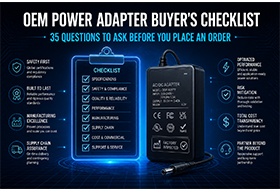
→ Full supplier evaluation framework: //www.hechobo.com/blog/oem-power-adapter-buyers-checklist
Business Charger Buying Checklist (Quick Reference)
Use this before finalizing any business charger order:
Specification
- Output voltage and tolerance defined (±1% for battery charging)
- Output current and rated power confirmed at continuous load
- Input voltage range confirmed (universal or single-market)
- Protocol support confirmed (USB PD version, PPS, QC compatibility)
- Port type and count matched to device ecosystem
Certification
- Certifications required for all target markets identified
- Original certification documents (not logos) requested and received
- Certificate model numbers matched to ordered product
- RoHS compliance documentation confirmed
Supplier
- Own factory confirmed (address matches certification documents)
- Samples built to spec (not pulled from standard stock)
- Golden Sample process agreed
- ECN policy confirmed in writing
- Pre-shipment inspection arranged
Commercial
- Unit price confirmed including all customization
- MOQ confirmed for standard and custom configurations
- NRE (tooling, firmware) costs agreed and invoiced separately
- Lead time confirmed in writing with milestone schedule
- Warranty period and claims process confirmed
Frequently Asked Questions
Q: What is the minimum order quantity for business charger procurement?
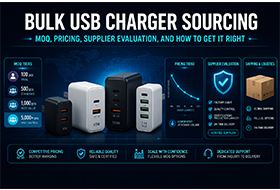
A: For standard catalog products with logo printing: from 500 units. For custom housing color or plug type localization: typically 1,000–2,000 units. For fully custom designs with new tooling: 2,000–5,000 units. Exact MOQ depends on product category and customization scope.
Q: How long does it take to receive a bulk charger order?
A: Standard products with minor customization: 15–25 working days production, plus shipping (typically 15–30 days sea freight or 5–7 days air). First orders with new tooling: 35–50 working days production. Allow additional time for certification testing if new certifications are required.
Q: Can I get USB chargers certified for multiple markets from one manufacturer?
A: Yes. Experienced OEM manufacturers coordinate multi-market certification (CE, FCC, UKCA, PSE, KC, RCM) as part of the OEM project. Certification testing is conducted by accredited third-party laboratories; the manufacturer manages the process and provides original documents. Budget for each certification separately — costs and timelines vary by market.
Q: Is it cheaper to buy finished chargers or have them manufactured to spec?
A: For standard specifications at volume, the per-unit cost is similar. Custom manufacturing (your spec, your branding) adds NRE cost amortized over the run, but delivers a product matched to your exact requirements with consistent certification scope. For resale at scale, private label manufacturing typically offers better margin than sourcing branded finished goods.
Q: What should I check when evaluating a charger sample?
A: Measure output voltage accuracy under full continuous load (not just at light load). Measure surface temperature at full load after 30+ minutes. Test charging speed with your actual target device. For PD products, verify all PDO profiles with a USB-PD tester. Compare the sample's internal component labeling against the supplier's stated component specification.
Q: How do I protect against component substitution in production?
A: Three mechanisms: (1) Specify critical components (power IC, GaN chipset, capacitor brand/rating) in writing in the purchase order. (2) Retain a Golden Sample as the production reference standard. (3) Arrange pre-shipment inspection by a third-party inspector who compares production units against the Golden Sample and performs spot electrical testing.
Shenzhen LvXiangYuan Technology Co., Ltd.
Has supplied OEM power adapters and USB chargers to brands across consumer electronics, industrial equipment, and smart home categories since 2009. Our product range covers every category in this guide:
- USB Wall Chargers — 5W to 65W, USB-A and USB-C, single and multi-port
- PD Wall Chargers — 20W to 140W, USB PD 3.0 with PPS, CE/FCC certified
- GaN Chargers — GaN II and GaN III platforms, 30W to 140W
- Desktop Charging Stations — multi-port with intelligent power distribution
- Lithium Battery Chargers — CC-CV profile, Li-ion and LiFePO4, 12V to 84V
All products are CE, FCC, and RoHS certified. OEM customization available from 500 units: logo, housing color, plug localization, retail packaging.
👉 //www.hechobo.com/products.html 👉 //www.hechobo.com/contact-us.html
LvXiangYuan Technology — Professional Power Adapter Solutions Since 2009 | //www.hechobo.com
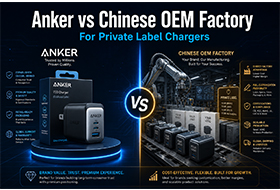
Anker vs Chinese OEM Factory for Private Label Chargers
65W vs 100W GaN Wall Chargers: Which Should Your Brand Choose