GaN Charger vs Traditional Charger: Is the Upgrade Really Worth It?
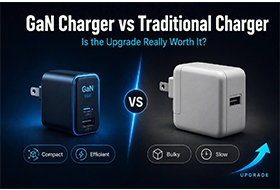
GaN Charger vs Traditional Charger: Is the Upgrade Worth It?
Every few years, a new technology enters the charger market claiming to change everything. Most don't. GaN (Gallium Nitride) is the rare exception that genuinely has.
But "better" is relative — and in B2B sourcing, it's never just about performance. It's about whether the improvement justifies the cost, the supply chain change, and the certification process. This article answers that question directly, from the perspective of a manufacturer that has worked with both silicon and GaN designs for over a decade.
What Makes a Charger "Traditional"?
When we say "traditional charger," we mean any charger built around a silicon (Si) MOSFET transistor in its power conversion circuit. Silicon has been the dominant semiconductor material in consumer electronics since the 1960s, and it works perfectly well — up to a point.
The limitation of silicon is physical. Silicon transistors have a relatively low breakdown voltage, generate significant heat during high-frequency switching, and require additional components (larger heatsinks, more capacitors, bigger transformer cores) to manage that heat safely. The result: traditional chargers are larger, heavier, and less efficient than their potential wattage would suggest they need to be.
This is not a flaw in silicon chargers. It is simply the ceiling of the material.
What Makes GaN Different at the Hardware Level?
Gallium Nitride (GaN) is a compound semiconductor with fundamentally different electrical properties than silicon:
- Higher electron mobility: GaN electrons move faster, enabling higher switching frequencies with lower energy loss
- Higher breakdown voltage: GaN can handle higher voltages without requiring the same protective overhead as silicon
- Lower on-resistance: Less resistance during conduction means less heat generated per watt delivered
The practical result: a GaN transistor can do the same power conversion job as a silicon transistor, but in a fraction of the space, at a higher frequency, and with less wasted energy converted to heat.
GaN doesn't replace silicon everywhere in a charger — it specifically replaces the switching transistors in the power stage. The rest of the circuit (controller, filter, isolation) may still use conventional components. But the transistors are where the physics bottleneck lived, and GaN solves it.
The Real-World Differences: A Direct Comparison
Size and Weight
This is where GaN's advantage is most immediately visible.
| Power Output | Traditional Silicon Charger | GaN Charger |
|---|---|---|
| 20W | ~60g, palm-sized | ~35g, 40% smaller |
| 65W | ~150g, fist-sized | ~80g, about 50% smaller |
| 100W | ~250g+, large brick | ~120g, roughly laptop-plug size |
| 140W | Uncommon; very large | ~150g, compact |
A 65W GaN charger can fit in a shirt pocket. A 65W silicon charger typically cannot. For travel chargers, multi-port desktop chargers, and devices where form factor is a selling point, this difference is substantial.
Thermal Performance
Traditional silicon chargers convert a meaningful portion of input power to heat rather than usable output. At high power levels (65W+), this heat must go somewhere — which is why silicon chargers get warm to hot during use, and why high-power silicon chargers require ventilation grilles or internal fans.
GaN chargers run cooler under load. Most GaN designs maintain surface temperatures 15–25°C lower than equivalent silicon units at the same wattage. This matters for:
- Product safety: Lower surface temperature reduces burn risk and improves UL/CE thermal compliance margins
- Component longevity: Lower operating temperature directly extends the lifespan of capacitors, connectors, and PCB solder joints
- Enclosed product integration: GaN chargers can be safely integrated into tight enclosures where a silicon charger would require thermal management features
Charging Efficiency
| Metric | Traditional Silicon | GaN |
|---|---|---|
| Conversion efficiency | 75–85% | 90–95% |
| Wasted energy (at 65W load) | ~10–17W lost as heat | ~3–7W lost as heat |
| Energy cost over 1 year (8hrs/day) | Higher | Meaningfully lower |
For a single charger, the efficiency difference translates to a modest energy saving. At scale — a manufacturer bundling chargers with products, or a business deploying charging stations — the aggregate saving becomes significant, and so does the reduction in standby power draw.
Power Output Range
Traditional silicon charger designs become disproportionately large and expensive above 65W. GaN scales cleanly:
- GaN at 100W remains compact (roughly equivalent to a traditional 45W silicon unit in volume)
- GaN at 140W is practical; silicon at 140W is unwieldy
- GaN at 200W+ is now commercially viable; silicon at this level requires industrial-grade hardware
Cost
This is where "worth it" depends on your context.
| Factor | Traditional Silicon | GaN |
|---|---|---|
| BOM cost (per unit) | Lower | Higher (declining ~10–15% year-on-year) |
| Retail / wholesale price premium | — | Typically 20–40% above silicon equivalent |
| MOQ sensitivity | More accessible at low MOQ | Better value at higher volumes |
GaN components are more expensive than silicon at equivalent specifications. However, the gap has narrowed considerably since 2020, and for wattages above 65W, GaN is now competitive on total manufacturing cost when you account for the reduced size of passive components, smaller PCB area, and lower heatsinking requirements.
Is a GaN Charger Worth It? It Depends Who's Asking
For End Users
Yes — with minimal caveats. If you charge a laptop, tablet, and phone simultaneously, a single 100W GaN multi-port charger replaces three separate adapters. The convenience and space saving alone justify the price premium for most users.
For B2B Buyers and OEM Manufacturers
The calculus is more nuanced. GaN is worth the upgrade when:
1. Your product competes on form factor. If you're building a premium charging product, a compact GaN design is a genuine differentiator. A silicon charger of equivalent power will always be larger — that's physics, not engineering.
2. Your target market is EU or the UK. The EU Common Charger Directive, combined with increasing regulatory pressure on energy efficiency (ErP Directive Lot 26), favors GaN's efficiency profile. Products with higher standby and active efficiency are easier to certify and future-proof against tightening regulations.
3. You're above 65W. Below 65W, silicon remains cost-competitive and perfectly capable. Above 65W, GaN's advantages in thermal management and size become more pronounced, and the cost premium compresses.
4. You're bundling chargers with branded devices. The charger is part of your product experience. A compact, cool-running GaN charger communicates quality. A warm, bulky silicon charger does not.
When a Traditional Charger Still Makes Sense
GaN is not always the right answer. Consider sticking with silicon when:
- Your power requirement is ≤30W and cost efficiency is the priority — silicon at low wattages is reliable, cheap, and well-understood
- You're in a highly price-sensitive market where a 20–40% charger cost premium directly impacts competitiveness
- Your supply chain is already optimized around silicon and the switching cost (new certifications, new tooling, new supplier qualification) outweighs the benefit
- Your application is industrial/fixed-location where size and portability are irrelevant — a wall-mounted industrial adapter does not benefit from GaN miniaturization
A good manufacturing partner will tell you this honestly, rather than upselling GaN in every context.
GaN Generation Guide: GaN I, GaN II, and GaN III
Not all GaN chargers are equal. The technology has evolved through three generations:
| Generation | Key Characteristic | Typical Use Case |
|---|---|---|
| GaN I | First-gen GaN FETs; efficiency improvement over silicon but limited power density | Early GaN consumer chargers (2018–2020) |
| GaN II | Improved gate driver integration; better efficiency and higher switching frequency | Mid-range 65–100W consumer and prosumer chargers |
| GaN III | Integrated GaN power stage + controller; highest efficiency (95%+), smallest footprint | Premium 100W+ chargers; current industry benchmark |
When evaluating suppliers, ask specifically which GaN generation their design uses — and request efficiency measurement data at your target load points (not just peak efficiency at optimal load).
What to Look for When Sourcing GaN Chargers at Scale
If you're evaluating GaN charger suppliers for OEM or wholesale purposes, these are the questions that matter:
1. GaN generation and chipset
Ask which GaN IC they use (e.g., Navitas, Power Integrations, Infineon, Innoscience). The chipset determines real-world efficiency, and reputable manufacturers will disclose this.
2. Full efficiency curve, not peak efficiency
A charger rated "95% efficiency" may achieve that only at 50% load. Ask for efficiency at 25%, 50%, 75%, and 100% of rated load. This gives a realistic picture of real-world performance.
3. Multi-port power distribution behavior
How does a 2-port 100W GaN charger behave when both ports are loaded? Does it drop to 50W/50W, or intelligently allocate based on device need? The latter requires more sophisticated firmware.
4. Thermal validation data
Request thermal imaging or surface temperature test data at full load in a 40°C ambient environment. This reveals real thermal management quality beyond the marketing spec.
5. Certification scope
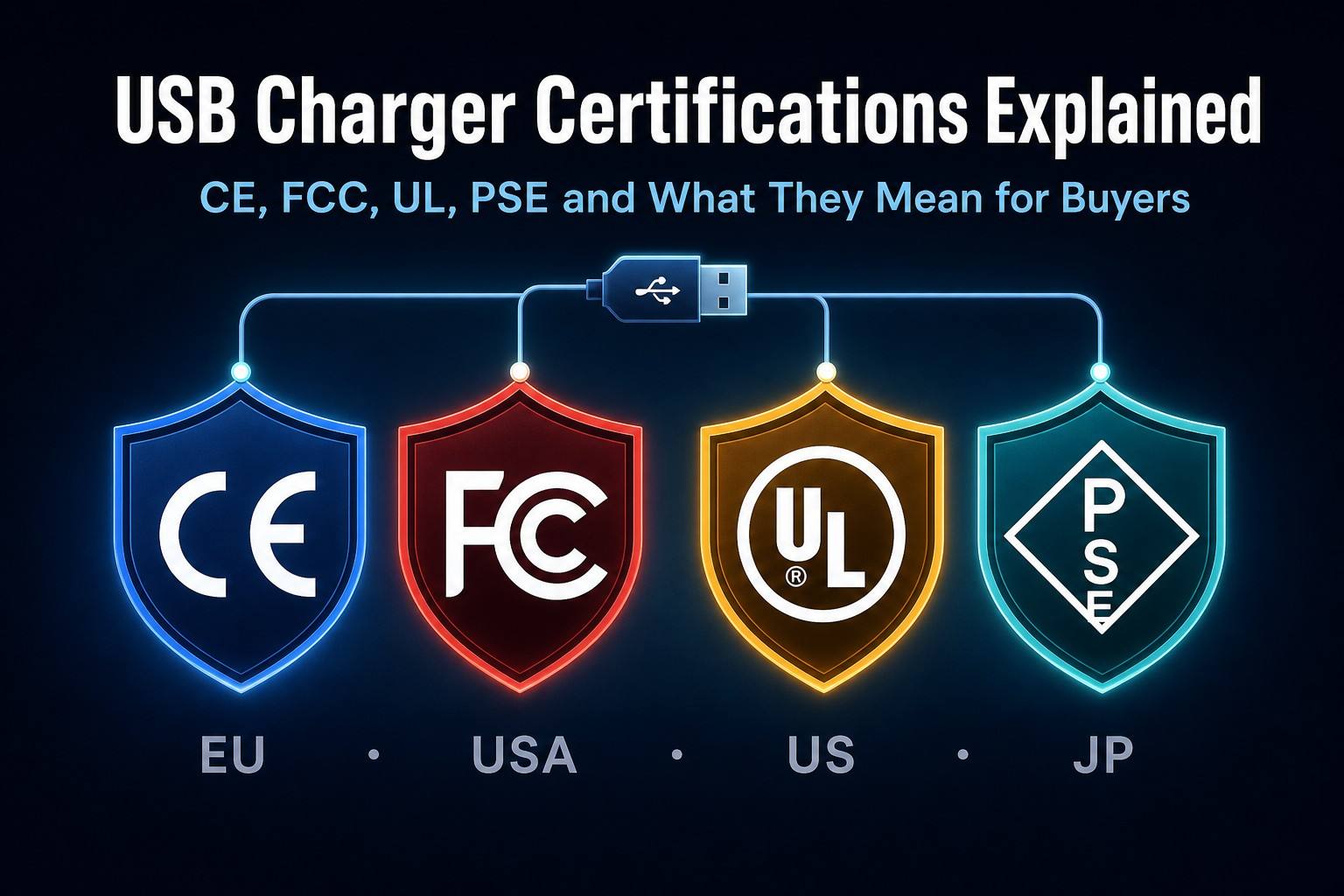
Which markets is the charger certified for? CE covers EU; FCC covers the US; PSE covers Japan. A charger certified for one market is not automatically compliant in another. Budget for multi-market certification if you're selling internationally.
6. MOQ and customization range
What is the minimum order quantity for your wattage tier? Can they accommodate plug localization (US/EU/UK/AU), custom housing color, logo engraving, and retail packaging within that MOQ?
Shenzhen LvXiangYuan Technology Co., Ltd. manufactures GaN chargers across GaN II and GaN III platforms, from 30W single-port to 140W multi-port designs. Our products are CE, FCC, and RoHS certified, with OEM customization available from 500 units.
We work with brands and procurement teams who need a manufacturing partner, not just a catalog supplier. That means honest advice on whether GaN is the right choice for your specific application — and competitive pricing when it is.
👉 View Our PD GaN Charger Range
👉 Read: GaN Charger vs PD Charger — What's the Difference?
👉 Request a Sample or Custom Quote
Frequently Asked Questions
Q: Are GaN chargers safe?
Yes. GaN chargers certified by recognized bodies (CE, FCC, UL) have passed the same electrical safety standards as silicon chargers. In some respects, GaN chargers are safer — lower operating temperatures reduce thermal stress on components and extend product life. Always verify certifications directly with the manufacturer.
Q: Will a GaN charger charge my devices faster than a silicon charger?
If both chargers support the same USB PD protocol at the same wattage, charging speed will be identical. GaN's advantage is not speed — it is delivering the same speed from a smaller, cooler, more efficient form factor. A 65W GaN charger and a 65W silicon PD charger charge a compatible laptop at the same rate.
Q: Do GaN chargers work with all devices?
GaN chargers are compatible with any device that accepts the voltage/current they output. A GaN charger with USB PD will work with any USB-C PD device. A GaN charger with USB-A output works with any USB-A device. There is no GaN-specific incompatibility.
Q: How long do GaN chargers last compared to silicon chargers?
GaN chargers typically have longer operational lifespans than silicon chargers at equivalent wattages because lower operating temperatures reduce capacitor degradation and solder joint fatigue. Industry experience suggests 30–50% longer mean time between failure (MTBF) at full-load conditions, though this depends heavily on design quality and component selection.
Q: Is the price gap between GaN and silicon chargers closing?
Yes. GaN component costs have fallen approximately 50–60% since 2020 and continue to decline as production volume increases and more chipset manufacturers enter the market. The premium for GaN vs. silicon at equivalent wattages is now 20–40%, down from 80–100% in 2019. For wattages above 65W, the effective cost gap is narrower when total component count is considered.
Q: At what wattage does GaN become the clear winner over silicon?
Most engineers and procurement teams draw the line at 45–65W. Below that range, silicon remains cost-competitive and the size advantage of GaN is less dramatic. At 65W and above, GaN's thermal management, size reduction, and total component efficiency make it the preferred design choice in virtually all consumer and prosumer applications.
LvXiangYuan Technology — Professional Power Adapter Solutions Since 2009 | www.hechobo.com
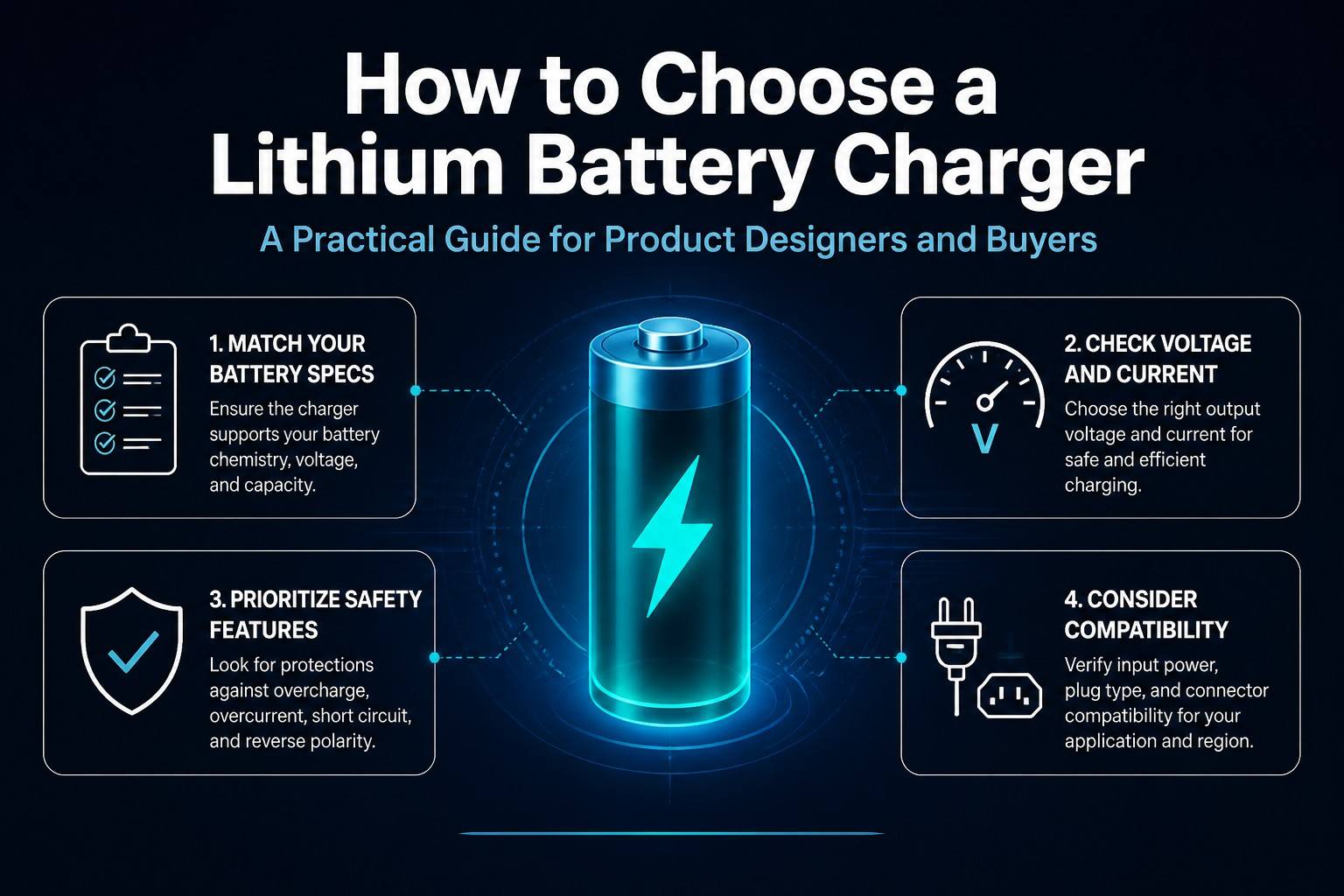
How to Choose a Lithium Battery Charger: A Practical Guide for Product Designers and Buyers
What Is USB Power Delivery? A Complete Beginner's Guide (2026)