Bulk USB Charger Sourcing: MOQ, Pricing, Supplier Evaluation, and How to Get It Right
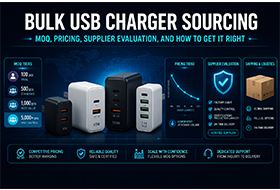
Bulk USB Charger Sourcing: MOQ, Pricing, Supplier Evaluation, and How to Get It Right
Sourcing USB chargers in bulk for the first time is straightforward in principle and complicated in practice. The products exist, the suppliers are easy to find, and the prices look attractive. The complexity lies in ensuring that what arrives in your warehouse three months later matches what you ordered, is certified for your target market, and will perform reliably in the field.
This guide covers the full sourcing process — from defining your specification through supplier evaluation, sampling, negotiation, and ongoing supply management — with the specificity that first-time and experienced buyers both need.
Before You Start: Define What You're Actually Buying
The single most common sourcing mistake is going to market with an incomplete specification. Suppliers will fill the gaps — not always in your favor. Before contacting any supplier, define:
Product specification:
- Charger type (USB wall charger / PD charger / GaN charger / desktop station)
- Output: voltage, current, wattage (see: Charger Wattage Calculator Guide)
- Protocol support (USB PD version, PPS, Quick Charge compatibility)
- Port configuration (USB-A count, USB-C count, total ports)
- Input voltage range (universal 100–240V or single-market)
- Plug type (US Type A/B, EU Type C/F, UK Type G, AU Type I, interchangeable)
- Cable: included or not; if yes, length, gauge, connector type
Branding and packaging:
- Logo on housing: yes/no; method (print, engrave, pad print)
- Custom housing color: yes/no
- Retail packaging: manufacturer standard, custom sleeve, full custom box
- Multi-language labeling requirements
Certification:
- Target markets and required certifications (CE, FCC, UKCA, PSE, KC, RCM, BIS, RoHS)
- Are current certifications acceptable, or is new certification required?
Commercial:
- Target quantity (initial order and expected annual volume)
- Delivery timeline requirement
- Target unit price (or budget range)
- Incoterms preference (FOB, CIF, DDP)
Suppliers who receive a complete specification return accurate, comparable quotes. Suppliers who receive a vague brief return quotes built around assumptions — which leads to disputes at production stage.
MOQ: What to Expect at Different Order Volumes
Minimum order quantity (MOQ) varies by product type, customization level, and supplier type. Here is what to expect:
| Order Type | Typical MOQ | Notes |
|---|---|---|
| Standard catalog product, no customization | 100–500 units | Some suppliers accept smaller quantities at premium pricing |
| Standard product + logo print only | 500–1,000 units | Logo setup charge typically USD 50–150 one-time |
| Custom housing color (existing mold) | 1,000–2,000 units | Color change may require mold modification fee |
| Custom plug type localization | 500–1,000 per plug variant | Per-variant MOQ; multi-market orders can be split |
| Full custom housing (new tooling) | 2,000–5,000 units | Tooling (mold) cost: USD 3,000–8,000 one-time NRE |
| Custom circuit / firmware | 3,000–10,000 units | Engineering cost amortized across initial run |
Negotiating MOQ below published minimums:
MOQ is a cost-recovery mechanism, not an arbitrary rule. Suppliers set MOQ to ensure the order covers setup costs (line changeover, material minimum buys, QC overhead). You can negotiate below published MOQ by:
- Accepting a higher unit price to compensate for setup costs
- Committing to a higher total annual volume with smaller initial order
- Accepting standard packaging instead of custom
- Combining multiple SKUs into a single order to reach the aggregate MOQ
For first orders with a new supplier, accepting a slightly higher unit price to keep MOQ manageable is usually the right trade-off — you are buying a validation opportunity, not just inventory.
Pricing Structure: What Drives the Per-Unit Cost
USB charger pricing is more structured than it appears. Understanding the cost drivers helps you evaluate quotes accurately and negotiate intelligently.
Primary cost drivers:
| Cost Component | Share of Unit Cost | Negotiability |
|---|---|---|
| GaN / power IC and key components | 35–50% | Low — set by component market |
| PCB and passive components | 15–20% | Low–medium |
| Housing / enclosure | 10–15% | Medium (at volume) |
| Cable (if included) | 5–15% | Medium |
| Certification amortization | 3–8% at low volume; <1% at high volume | Reduces with scale |
| Assembly labor | 5–10% | Low (factory-dependent) |
| Packaging | 3–8% | Medium |
| Supplier margin | 10–20% | Medium |
Volume pricing tiers — typical structure:
| Quantity | Price Index |
|---|---|
| 500 units | 100% (baseline) |
| 1,000 units | 88–93% |
| 3,000 units | 80–87% |
| 5,000 units | 75–83% |
| 10,000 units | 70–78% |
| 50,000+ units | 63–72% |
The steepest price breaks occur between 500–5,000 units. Above 10,000 units, incremental breaks are smaller because the main cost drivers (components, certification) are already fully amortized.
GaN vs silicon pricing differential:
GaN chargers carry a 15–30% unit price premium over silicon equivalents at the same wattage and certification level. This premium compresses as volume increases and as GaN component costs continue to decline (approximately 8–12% year-on-year historically). For wattages above 65W, GaN is now competitive on total cost when the reduced heatsinking and housing size requirements are factored in.
Where to Find Bulk USB Charger Suppliers
Direct manufacturer websites (recommended first step)
Searching "[product type] manufacturer China" and evaluating direct manufacturer websites gives you visibility into factory capability, product range, and certification status before any contact. A well-documented manufacturer website with genuine product specifications and verifiable certification documentation is a meaningful quality signal.
B2B platforms (Alibaba.com, Global Sources, Made-in-China)
Useful for initial market scanning and price benchmarking. Limitations: platform listings mix manufacturers and trading companies; certification claims are frequently unverified; the lowest-price listings are disproportionately likely to involve uncertified or substandard products.
Trade shows (Hong Kong Electronics Fair, Canton Fair, Electronica)
Face-to-face evaluation is the most efficient way to assess a supplier's breadth of product range and sales team quality. Bring your specification document and collect physical samples. Follow up with factory verification after the show.
Industry referrals
If you source other electronic products from China, ask your existing suppliers for referrals to charger manufacturers. Cross-industry referrals carry implicit quality vetting that platform searches do not.
Key filter: Always distinguish manufacturer from trading company. A trading company adds a margin layer and has limited ability to manage production quality or accommodate specification customization. Ask directly: "Is this product manufactured in your own factory?" and verify the answer against the factory address on certification documents.
How to Evaluate a Supplier Before Placing an Order
Step 1 — Verify Manufacturing Status
Request the factory's business license (营业执照) and confirm the registered address matches the address on certification documents. Ask for factory photos or a video tour if an in-person visit is not possible. Legitimate manufacturers will provide this without hesitation.
Check whether the supplier has held consistent Alibaba.com or Global Sources verified status for multiple years — tenure on these platforms, while imperfect, correlates with operational stability.
Step 2 — Confirm Certification Coverage
Request original certification documents for your target markets — not photocopies of logos, but the actual certificates with issuing body name, certificate number, product model, and expiry date.
Verify each certificate independently using the relevant database (FCC: fccid.io; UL: iq.ul.com; KC: rra.go.kr; RCM: eess.gov.au). A certificate number that does not appear in the database is not a valid certificate.
Confirm that the certificate model number matches the exact product you are ordering — not a similar product from the same factory.
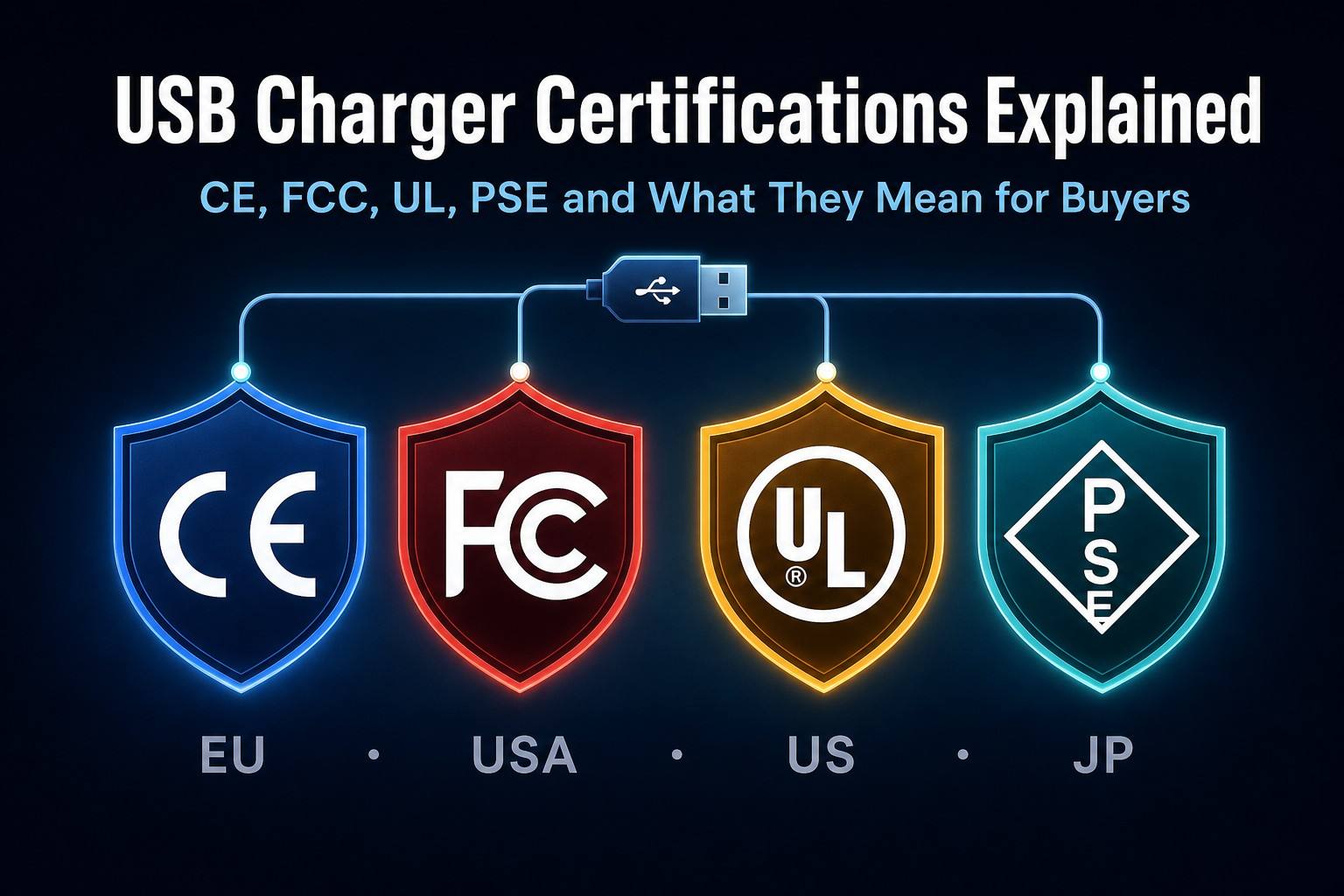
→ Full certification verification guide: USB Charger Certifications Explained
Step 3 — Assess Product Consistency
Ask for the supplier's quality control process documentation: What parameters are tested on every unit? What is the AQL level for visual inspection? What happens to failed units?
Ask specifically about component sourcing: Which brands of key ICs (power controller, GaN FET) are used? Is there a formal Engineering Change Notice (ECN) process that requires buyer approval before component substitution?
The ECN question is the most revealing. A supplier without an ECN process cannot guarantee that the components in batch 10 match those in the approved sample — a common source of field failures in bulk orders.
Step 4 — Evaluate Communication and Responsiveness
Response speed and quality during the inquiry phase is a proxy for production-phase communication. Specific signals to evaluate:
- Response time: Within 24 hours for initial inquiry; within 4 hours for follow-up on specific technical questions
- Specificity: Do they answer your actual questions, or deflect with generic product descriptions?
- Technical depth: Can they answer questions about charging protocol implementation, simultaneous output specifications, and certification scope without escalating to "I'll check with our engineer"?
- English quality: For export-focused suppliers, business-level English in written communication is a reasonable expectation
A supplier who is evasive during the inquiry phase will be more evasive when a production problem needs resolving.
The Sample Stage: What to Test and How
Never place a bulk order without receiving and testing production-representative samples. For standard catalog products, request 3–5 samples. For custom products, insist on samples built to your specification — not pulled from standard stock.
Minimum testing protocol for USB charger samples:
Electrical testing:
- Output voltage accuracy under full rated load (verify ±1% or as specified)
- Output voltage accuracy at light load (10% of rated) — voltage should not spike above rated maximum
- Charging speed validation with your actual target device(s)
- For USB PD products: test all PDO profiles using a USB-PD tester (e.g., ChargerLAB POWER-Z or similar)
- Protection circuit test: verify overcurrent protection triggers at rated limit; verify charger recovers normally after fault clearance
Thermal testing:
- Connect at full rated load in a 25–35°C ambient environment
- Run continuously for 2 hours minimum (4 hours preferred)
- Measure housing surface temperature at hottest point — should not exceed 75°C (EU safety threshold); below 60°C is preferred for consumer touch surfaces
- Verify no thermal throttling (output voltage or current drop) during sustained operation
Physical inspection:
- Housing finish consistency, logo quality, plug fit
- Cable quality if included: flex test, connector insertion force, jacket material
- Weight comparison across all 3–5 samples (significant variation indicates inconsistent assembly)
Compliance check:
- Confirm markings on housing match certification requirements for your target market
- Confirm model number on housing matches certificate
Document your test results with photos and measurements. Return any samples that fail and request explanation and corrected samples before proceeding to order placement.
Pricing Negotiation: What Is and Isn't Negotiable
What is negotiable:
- Unit price (with volume commitment)
- Payment terms (T/T ratio, LC option at high volume)
- Lead time (premium production scheduling)
- Packaging cost (simpler packaging = lower cost)
- Tooling cost amortization (spread across multiple orders rather than charged upfront)
- Sample cost (waived for qualified buyers at meaningful volumes)
What is not negotiable (and should not be):
- Certification scope — do not accept a lower price that comes with reduced certification coverage
- Component specification — do not accept component downgrades to hit a price target; this is the most common quality-compromise path
- QC protocol — 100% electrical testing should be non-negotiable for any production volume
- Payment before shipment — for new supplier relationships, avoid full payment before goods have passed pre-shipment inspection
The right negotiation posture:
Lead with volume commitment, not price pressure. A supplier who sees a credible long-term volume commitment will offer better pricing and prioritize your production schedule. A buyer who negotiates purely on unit price — without volume commitment or relationship signal — gets the catalog price with no service priority.
State your target unit price, explain the volume basis for it, and ask the supplier what they can do. This gives them a clear target without creating adversarial dynamics.
Purchase Order Terms That Protect Your Bulk Order
These clauses should be in every bulk charger purchase order, regardless of supplier relationship maturity:
1. Product specification reference "Product shall conform to the approved sample [sample ID, date] and the specification document [document ID, revision date] attached hereto."
2. Component lock clause "Supplier shall not substitute any specified component without prior written approval from Buyer. Any substitution without approval constitutes a material breach of this order."
3. Inspection rights "Buyer reserves the right to conduct pre-shipment inspection (PSI) through a third-party inspection agency. Supplier shall provide 5 working days' notice access and shall not ship goods until PSI is passed or Buyer provides written waiver."
4. Certification warranty "Supplier warrants that all units in this order comply with the certifications specified herein and that original certificate documents will be provided with shipment documentation."
5. Defect remedy "For defects identified within [warranty period], Supplier shall replace or credit defective units at Supplier's cost, including return shipping if Supplier requires physical return."
6. Shipment milestone "Production completion and shipment shall occur no later than [date]. Delay beyond [grace period, e.g., 5 working days] without Buyer's prior written consent entitles Buyer to [remedy: price reduction / cancellation / alternative fulfillment]."
Logistics and Customs: What Bulk Charger Buyers Need to Know
HS Code: USB chargers and power adapters typically classify under HS 8504.40 (Static converters) for customs purposes. Confirm the correct 10-digit HS code with your customs broker for your specific jurisdiction — classification affects duty rate.
Import duties (approximate, subject to change):
| Market | General MFN Duty Rate (HS 8504.40) |
|---|---|
| European Union | 0–3.7% |
| United States | 0% (most chargers) + Section 301 tariffs on China-origin goods (verify current rate) |
| United Kingdom | 0–3.7% |
| Australia | 0–5% |
| India | 10–20% (BCD) + GST |
US Section 301 tariffs: China-origin chargers have been subject to additional Section 301 tariffs that have fluctuated since 2018. Verify the current applicable rate with your customs broker before calculating landed cost — the rate affects the economic viability of China-origin sourcing for US-market goods.
Incoterms selection:
| Incoterms | Buyer's Control | Risk Transfer | Recommended For |
|---|---|---|---|
| FOB (Free on Board) | High | At port of loading | Experienced importers with freight forwarder relationships |
| CIF (Cost, Insurance, Freight) | Medium | At destination port | Mid-experience buyers; supplier arranges freight |
| DDP (Delivered Duty Paid) | Low | At destination | First-time importers; all logistics handled by supplier |
For first bulk orders, DDP reduces logistics complexity at the cost of visibility and control. As the relationship matures and you develop freight forwarder relationships, transitioning to FOB typically reduces total landed cost by 5–15%.
Packaging for air vs. sea freight:
Chargers shipped by air must comply with IATA Dangerous Goods regulations for lithium batteries if the product includes a built-in battery. Standard USB wall chargers without batteries are not subject to lithium battery restrictions. Confirm with your freight forwarder before booking.
Building a Long-Term Supplier Relationship
A bulk charger supplier is not a transaction — it is a supply chain dependency. Managing it well determines whether your second and tenth orders go as smoothly as your first.
Set clear KPIs from the first order:
- On-time delivery rate (target: >95%)
- First-pass inspection pass rate (target: >98%)
- Field defect rate / DPPM (establish baseline; target improvement over time)
- Lead time adherence (production completion vs. committed date)
Establish a quarterly review cadence: Review KPI performance, upcoming order forecast, and any product change requirements. Suppliers who receive advance demand visibility can plan production more efficiently and offer better service.
Protect against single-source dependency: For critical products at significant volumes, maintain a qualified second supplier in case of primary supplier disruption (factory issues, component shortage, geopolitical events). Qualification takes 3–6 months — start it before you need it.
Reward performance explicitly: If a supplier consistently meets or exceeds commitments, say so — and increase the volume you route to them. Suppliers allocate production capacity and service attention based on which customers they most want to keep. Being a preferred customer is a strategic advantage.
Shenzhen LvXiangYuan Technology Co., Ltd. supplies USB chargers in bulk to brands, importers, and OEM buyers globally. We manufacture USB wall chargers, PD chargers, GaN chargers, and desktop charging stations from our own factory in Shenzhen, with CE, FCC, and RoHS certification across our standard product range.
What we offer bulk buyers specifically:
- Catalog products from 500 units; custom designs from 2,000 units
- Full simultaneous output specification for all multi-port products
- 100% electrical testing on every production unit as standard
- ECN (Engineering Change Notice) process — no component substitution without buyer approval
- Pre-shipment inspection accommodation — third-party inspectors welcome
- Original certification documents provided with every shipment
- Samples available for evaluation before commitment
We are a manufacturer, not a trading company. Your order is produced in our factory, and our engineering team can answer technical questions directly.
👉 View Our Full Charger Range
👉 Read Our OEM Buyer's Checklist — 35 Questions to Ask Any Supplier
👉 Request a Bulk Quote or Free Evaluation Samples
Frequently Asked Questions
Q: What is a realistic minimum order for a first bulk charger order from China? For standard catalog products, most reputable manufacturers accept 500–1,000 units as a minimum for a first order. Quantities below 500 units are often handled as sample orders at higher per-unit pricing. Custom designs (housing, color, plug type) typically require 1,000–2,000 units minimum to justify setup costs.
Q: How long does a bulk charger order take from inquiry to delivery? Allow 6–10 weeks for a standard product order: 1–2 weeks for inquiry, sample, and order confirmation; 3–4 weeks production; 1–2 weeks quality inspection and documentation; 2–4 weeks sea freight (or 1 week air freight at higher cost). First orders with new tooling or new certification add 4–8 weeks. Build your procurement timeline around 10–14 weeks for first orders with any customization.
Q: Is it cheaper to source through a trading company or direct from a manufacturer? Direct from manufacturer is almost always lower unit cost — trading companies add a 10–25% margin. The trade-off is that trading companies offer lower MOQ, more flexible product mix, and easier communication for buyers without sourcing experience. For recurring bulk orders above 1,000 units, direct manufacturer sourcing is economically justified. For one-off mixed orders below 500 units, a trading company may be more practical.
Q: How do I protect against receiving a different product than what I sampled? Three mechanisms in combination: (1) A written component lock clause in the purchase order prohibiting substitution without approval; (2) A Golden Sample retained at the factory as production reference; (3) Pre-shipment inspection by a third-party inspector who compares production units against the Golden Sample and performs electrical testing. None of the three alone is sufficient — use all three.
Q: What payment terms should I expect for bulk orders? Standard terms for new supplier relationships: 30% deposit (T/T advance) + 70% balance before shipment (after PSI). At higher volumes and established relationships: 30/70 with balance against Bill of Lading, or 30-day net terms via Letter of Credit (LC). Avoid 100% advance payment to any new supplier regardless of apparent credibility.
Q: Can I order multiple charger SKUs in one bulk order to reach the aggregate MOQ? Yes, and this is a common and legitimate approach. A supplier with a 1,000-unit MOQ per SKU may accept a combined order of 300 units × SKU A + 400 units × SKU B + 300 units × SKU C = 1,000 total. Confirm with the supplier that aggregate MOQ applies — not all suppliers have this flexibility, but most will accommodate it for established product families.
LvXiangYuan Technology — Professional Power Adapter Solutions Since 2009 | www.hechobo.com
OEM Power Adapter Buyer's Checklist: 35 Questions to Ask Before You Place an Order