How to Choose a Lithium Battery Charger: A Practical Guide for Product Designers and Buyers
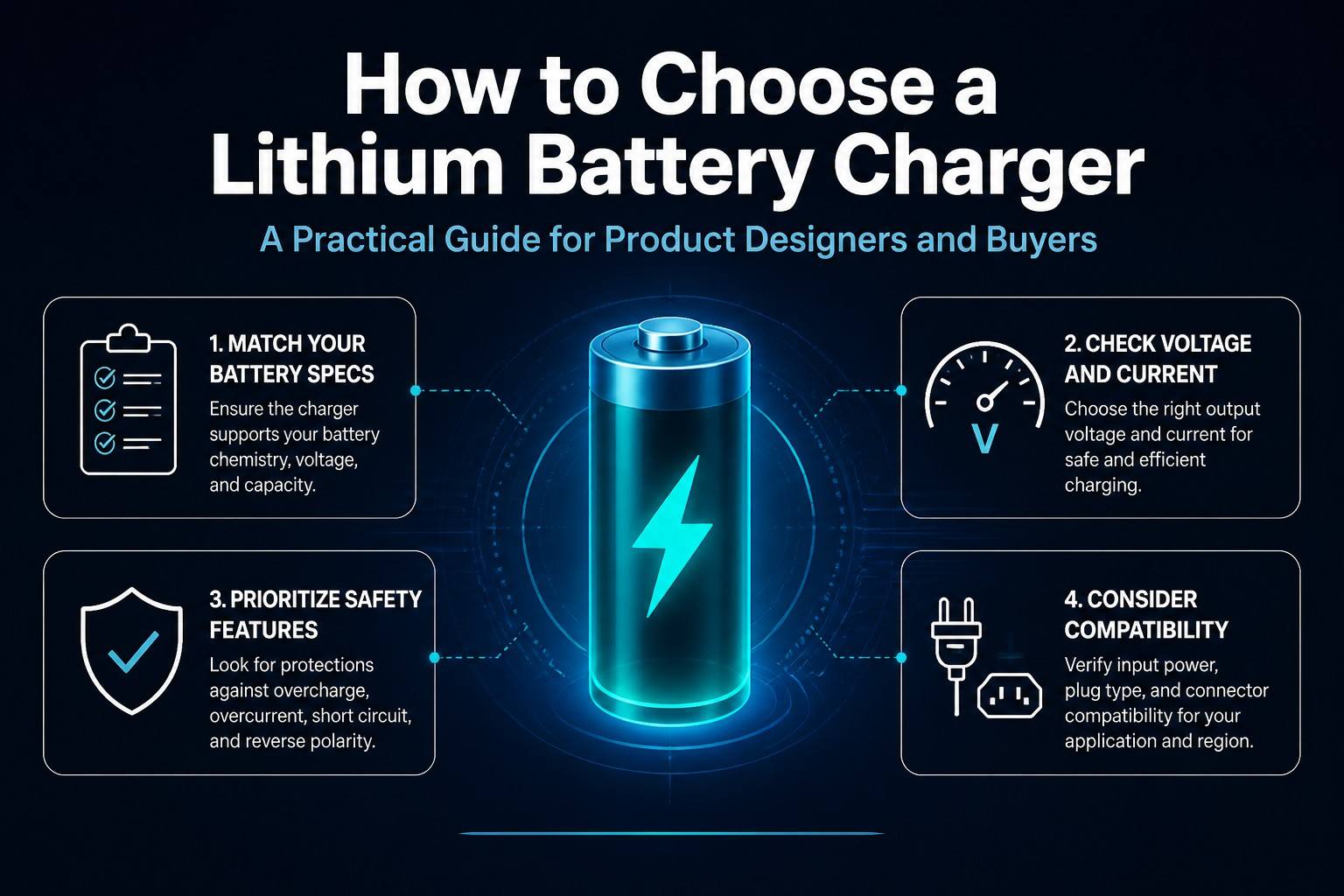
How to Choose a Lithium Battery Charger: Everything That Matters
A lithium battery charger is not a commodity. Get it wrong — mismatched voltage, missing protection circuitry, wrong chemistry profile — and the consequences range from degraded battery life to thermal runaway. Get it right, and your product ships with a charging solution that is safe, efficient, and regulatory-compliant from day one.
This guide walks through the seven decisions that determine whether a lithium battery charger is right for your application.
Why Charger Selection Matters More Than Most People Realize
Most buyer attention goes to the battery cell — capacity, energy density, form factor. The charger is treated as an afterthought. This is a mistake, for two reasons:
1. The charger defines how long your battery lasts. Overcharging, charging at incorrect voltage, or failing to taper current at end-of-charge all accelerate electrolyte degradation. A well-matched charger can extend battery cycle life by 30–50% compared to a poorly specified one at the same wattage.
2. The charger is a safety-critical component. Lithium cells store substantial energy in a chemically reactive state. A charger that fails to detect a damaged cell, over-temperature condition, or communication failure with the BMS can trigger dangerous outcomes. Most lithium battery fire incidents in consumer products involve charger-battery mismatch, not battery cell defects.
Step 1 — Know Your Battery Chemistry
This is the most fundamental decision. Different lithium chemistries require different charge voltages, different termination criteria, and different temperature management approaches. Using the wrong charger profile for your chemistry is the single most common sourcing error.
Li-ion (Lithium-ion)
The most common chemistry in consumer electronics, power tools, and EVs.
- Nominal voltage: 3.6V or 3.7V per cell
- Full charge voltage: 4.2V per cell (±0.05V)
- Discharge cutoff: 2.5–3.0V per cell
- Charging profile: CC-CV (see Step 2)
- Temperature sensitivity: Moderate — charge inhibited below 0°C on most BMS designs
LiFePO4 (Lithium Iron Phosphate)
Preferred for stationary storage, solar applications, RV/marine, and applications where cycle life and safety are priorities over energy density.
- Nominal voltage: 3.2V per cell
- Full charge voltage: 3.6–3.65V per cell
- Discharge cutoff: 2.5V per cell
- Key characteristic: Extremely flat discharge curve; very thermally stable; tolerates mild overcharge better than Li-ion
- Do not use a Li-ion charger on LiFePO4 cells. The 4.2V termination voltage of a Li-ion charger will severely overcharge LiFePO4 cells (rated at 3.65V max), causing permanent damage and potential hazard.
LiPo (Lithium Polymer)
Structural variant of Li-ion using a gel electrolyte in a flexible pouch. Electrically similar to Li-ion but more sensitive to mechanical damage and overcharge.
- Full charge voltage: 4.2V per cell (same as Li-ion)
- Critical requirement: Must never be discharged below ~3.0V and never overcharged above 4.25V. LiPo cells are more prone to puffing and thermal runaway on abuse than cylindrical Li-ion.
NMC and LCO
NMC (Nickel Manganese Cobalt) and LCO (Lithium Cobalt Oxide) are high energy density chemistries used in premium consumer electronics and EVs.
- Full charge voltage: Typically 4.2V, some designs 4.35V or 4.4V
- Important: Confirm the exact target voltage with your cell supplier. A charger specified for 4.2V termination may undercharge a 4.35V cell by 5–7% capacity.
Quick reference:
| Chemistry | Nominal V/cell | Max charge V/cell | Notes |
|---|---|---|---|
| Li-ion | 3.6–3.7V | 4.2V | Most common; standard CC-CV |
| LiFePO4 | 3.2V | 3.6–3.65V | Safest; longest cycle life |
| LiPo | 3.7V | 4.2V | Sensitive to abuse; requires careful BMS |
| NMC | 3.6–3.7V | 4.2–4.35V | Confirm target voltage with cell spec |
| LCO | 3.6V | 4.2V | High energy density; less stable |
Step 2 — Understand the Three Charging Stages
A properly designed lithium battery charger operates in three distinct stages. Any charger that cannot execute all three is not suitable for production use.
Stage 1: Pre-charge (Trickle)
Applied when the cell voltage is below a safe threshold (typically <3.0V for Li-ion). The charger delivers a very small current (usually C/10 or lower) to gently bring the cell to a safe voltage level before full charging begins.
Why it matters: Attempting full CC charging on a deeply discharged cell can cause lithium plating, which permanently damages the anode and can create internal short circuit paths.
Stage 2: Constant Current (CC)
Once cell voltage is above the pre-charge threshold, the charger delivers a steady current — typically between 0.5C and 1C (where C = capacity in Ah). This is the fast-charging phase, where the bulk of charge (roughly 80%) is delivered.
The appropriate CC rate depends on:
- Cell manufacturer's maximum charge rate specification
- Thermal management capability of the pack
- Application cycle life requirements (lower C-rate = longer cycle life)
Stage 3: Constant Voltage (CV)
When cell voltage reaches the target (e.g., 4.2V for Li-ion), the charger switches to hold that voltage constant while allowing current to taper naturally as the cell approaches full charge. Charging is considered complete when current drops to approximately C/20 or C/10.
Why CV matters: Forcing full current into a nearly-full cell would push voltage above the target, causing electrolyte oxidation and accelerated capacity degradation. The CV stage prevents this.
Voltage ▲
4.2V ─────────────────────────────── CV phase (holds 4.2V, current tapers)
         │                    ╱─────
         │              ╱────
         │        ╱─────
3.0V ────┤──────╱
         │ Pre  │        CC phase          │ CV  │
         └──────────────────────────────────────▶ Time
Step 3 — Match Voltage and Current to Your Battery Pack
Once you know your cell chemistry, calculate the correct charger specifications for your pack configuration.
Voltage:
Pack voltage = (number of cells in series) × (full charge voltage per cell)
Examples:
- 3S Li-ion pack: 3 × 4.2V = 12.6V charger output
- 4S Li-ion pack: 4 × 4.2V = 16.8V charger output
- 4S LiFePO4 pack: 4 × 3.65V = 14.6V charger output
Current (charge rate):
Charging current = desired C-rate × pack capacity (Ah)
Examples:
- 10Ah pack at 0.5C: 5A charge current
- 20Ah pack at 1C: 20A charge current
A charger rated for a higher current than required is acceptable — the BMS will regulate actual current drawn. A charger with insufficient voltage rating will fail to fully charge the pack.
Tolerance matters: Charger output voltage accuracy should be within ±1% of target. A 12.6V charger outputting 13.0V will overcharge a 3S Li-ion pack. Always request voltage accuracy specifications, not just nominal ratings.
Step 4 — Verify Protection Features
A production-grade lithium battery charger must include the following protection functions. Treat any missing item as a disqualifier:
| Protection Feature | Function | Risk if absent |
|---|---|---|
| Overvoltage protection (OVP) | Cuts off if output exceeds target voltage | Cell overcharge → thermal event |
| Overcurrent protection (OCP) | Limits current to rated maximum | Cell stress, heat, degradation |
| Short-circuit protection (SCP) | Cuts off instantly on output short | Fire, charger destruction |
| Over-temperature protection (OTP) | Monitors charger and/or battery temperature | Thermal runaway |
| Reverse polarity protection | Prevents damage from reversed connection | Charger destruction, battery damage |
| Input surge protection | Protects against line voltage transients | Charger failure in field |
For products sold in regulated markets (EU, US, Japan), OVP, OCP, and SCP are mandatory under applicable safety standards. Request the protection circuit schematic or test report — not just a checklist on a spec sheet.
Step 5 — Consider the BMS Relationship
In most battery pack designs, a Battery Management System (BMS) handles cell-level protection — individual cell balancing, temperature monitoring per cell, and communication with the charger in more sophisticated systems.
Key questions for your charger supplier:
-
Does the charger need to communicate with the BMS?
Simple packs use passive BMS with no communication — the charger charges to the pack voltage cutoff and the BMS handles cell balancing internally. More sophisticated packs (e.g., multi-cell EV or energy storage packs) use active BMS with communication protocols (SMBus, CAN bus, RS-485) that the charger must support. -
Who handles cell balancing — the charger or the BMS?
For standard consumer applications, passive balancing in the BMS is sufficient. For high-cycle industrial applications, active balancing (either in BMS or charger) significantly extends pack life. -
Is there a charge enable signal?
Many BMS designs output a charge enable signal that the charger must respect — if the BMS detects an unsafe condition (over-temp, cell fault), it pulls the enable signal low to stop charging. Your charger must support this input.
If your application uses a smart BMS, spec the charger and BMS together, not independently.
Step 6 — Check Certification Requirements by Market
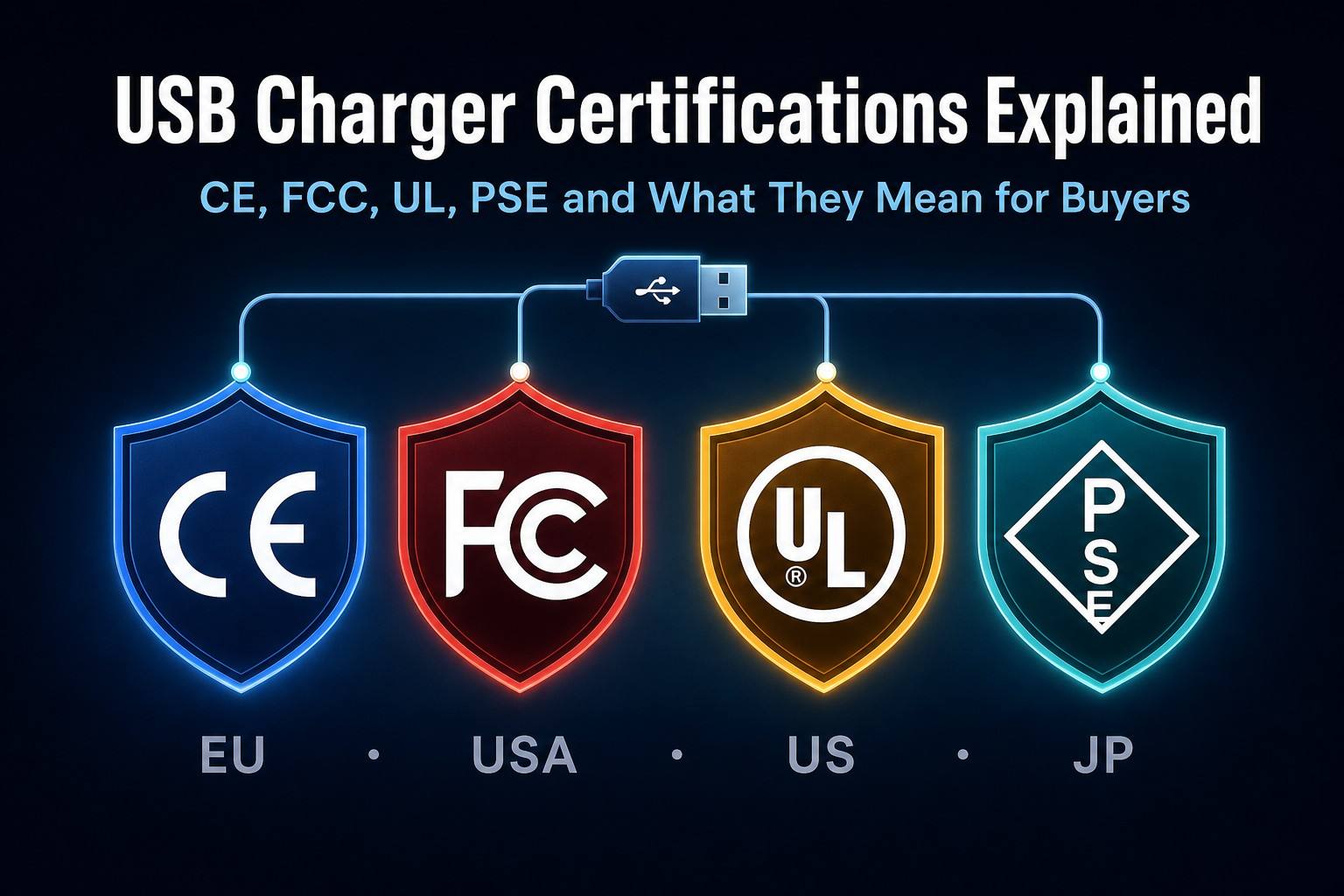
Lithium battery chargers are classified as power supplies in most regulatory frameworks and require market-specific certifications before sale:
| Market | Required Certifications |
|---|---|
| European Union | CE (LVD + EMC directives), RoHS |
| United States | FCC (Part 15), UL 60950 or UL 62368-1 |
| United Kingdom | UKCA (post-Brexit equivalent of CE) |
| Japan | PSE (Electrical Appliance and Material Safety Law) |
| South Korea | KC Mark |
| Australia / NZ | RCM (Regulatory Compliance Mark) |
| India | BIS certification |
Important: Certification requirements apply to the charger as shipped, not just the charger circuit. If you customize housing, cable, or plug type for a specific market, you may need to re-certify or obtain a separate national variant certification. Discuss this with your manufacturer before finalizing the OEM design.
For lithium battery chargers specifically, some markets (notably the EU) impose additional requirements under battery regulations for end-of-life marking, chemical content disclosure, and QR-code traceability on products sold after 2027.
Step 7 — Define Your OEM and Customization Requirements
If you're sourcing at volume for a branded product, the charger specification goes beyond electrical parameters. Define:
Physical:
- Plug type (US Type A/B, EU Type C/F, UK Type G, AU Type I, or universal)
- Cable length and gauge
- Connector type at battery end (barrel jack, XLR, Anderson, custom)
- Housing color, finish, and material
- LED indicator behavior (charging / full / fault states)
- IP rating if outdoor or industrial use is required
Branding:
- Logo printing or embossing
- Retail packaging design
- Multi-language safety labeling (required for EU/US multi-market products)
Documentation:
- CE Declaration of Conformity
- UL test report
- Product safety datasheet
- Battery chemistry compatibility statement
Production:
- MOQ for standard models vs. custom designs
- Lead time for initial order and repeat orders
- Sample availability for pre-production validation
A supplier who cannot provide all of the above is not manufacturing-ready for branded product integration.
Common Mistakes When Sourcing Lithium Battery Chargers
Mistake 1: Specifying by wattage alone.
"I need a 60W lithium charger" is not a specification. 60W at 12.6V (4.76A) vs. 60W at 29.4V (2A) are completely different products. Always specify voltage and current independently.
Mistake 2: Using a Li-ion charger on LiFePO4 cells.
The voltage mismatch (4.2V vs. 3.65V per cell) will severely damage LiFePO4 cells within a few charge cycles. Always match charger chemistry profile to cell chemistry.
Mistake 3: Ignoring charger accuracy.
A charger with ±5% voltage tolerance on a 12.6V output can output anywhere from 11.97V to 13.23V. The upper end overcharges a 3S Li-ion pack. Specify ±1% or tighter.
Mistake 4: Assuming BMS handles everything.
A BMS protects the cells — it does not replace a properly designed charger. Both are necessary. A charger with missing OVP cannot be "saved" by the BMS in all fault scenarios.
Mistake 5: Certifying only for the home market.
If your product will be sold in multiple regions, each market has its own requirements. A CE-certified charger is not automatically FCC-compliant, and vice versa. Plan multi-market certification into your development timeline.
Shenzhen LvXiangYuan Technology Co., Ltd. designs and manufactures lithium battery chargers for consumer, industrial, and OEM applications. Our chargers support Li-ion, LiFePO4, and LiPo chemistries, with CC-CV charging profiles, full protection circuit integration, and multi-market certification (CE, FCC, RoHS).
We work with product teams to define charger specifications from the ground up — matching voltage, current, protection requirements, BMS interface, and certification scope to your exact application.
👉 View Our Lithium Battery Charger Range
👉 Read: GaN Charger vs PD Charger — Understanding Modern Charging Technology
👉 Contact Our Engineering Team for a Custom Charger Quote
Frequently Asked Questions
Q: Can I use any lithium charger with my battery pack?
No. The charger must match your battery's chemistry, series cell count (voltage), and capacity (current). Using a mismatched charger risks undercharging, overcharging, or triggering protection circuits that prevent charging entirely.
Q: What does CC-CV mean on a charger spec sheet?
CC-CV stands for Constant Current / Constant Voltage — the two-stage charging algorithm used for lithium batteries. Constant Current delivers the bulk charge; Constant Voltage tops off the final capacity safely. Any charger without CC-CV is not suitable for lithium cells.
Q: What is the difference between a Li-ion charger and a LiFePO4 charger?
The key difference is the target charge voltage. Li-ion charges to 4.2V per cell; LiFePO4 charges to 3.65V per cell. Using a Li-ion charger on LiFePO4 cells will overcharge them, causing permanent damage. The chargers are not interchangeable.
Q: How do I calculate the correct charger voltage for my pack?
Multiply the number of cells in series by the full charge voltage per cell for your chemistry. For a 4-cell series Li-ion pack: 4 × 4.2V = 16.8V. For a 4-cell series LiFePO4 pack: 4 × 3.65V = 14.6V.
Q: Does my charger need to communicate with my BMS?
For simple packs with passive BMS, no — the charger charges to the pack voltage cutoff and the BMS handles balancing internally. For smart BMS designs (common in industrial, EV, and energy storage applications), the charger may need to support communication protocols such as SMBus, CAN bus, or a charge enable signal.
Q: What certifications does a lithium battery charger need?
It depends on your target market. The EU requires CE marking (LVD + EMC). The US requires FCC and typically UL 62368-1. Japan requires PSE. Most markets also require RoHS compliance. If you sell in multiple regions, each market certification must be obtained separately. Consult your manufacturer early to include certification costs and timelines in your project plan.
LvXiangYuan Technology — Professional Power Adapter Solutions Since 2009 | www.hechobo.com
USB Charger Certifications Explained: CE, FCC, UL, PSE and What They Mean for Buyers
GaN Charger vs Traditional Charger: Is the Upgrade Really Worth It?