USB Charger Certifications Explained: CE, FCC, UL, PSE and What They Mean for Buyers
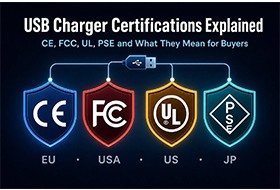
USB Charger Certifications Explained: What Every Buyer Needs to Know
If you've ever received a supplier datasheet listing "CE, FCC, RoHS certified" and wondered what that actually means — and whether you can trust it — this guide is for you.
Certification claims are common. Legitimate, verified certifications are less so. Understanding the difference is one of the most practical skills a charger buyer can develop, because a missing or fraudulent certification can block a product from customs, trigger a product recall, or expose your brand to liability.
Here's a market-by-market breakdown of every major certification relevant to USB chargers and power adapters, including how to verify each one yourself.
Why Certifications Matter (And Why "Certified" Isn't Always True)
Charger certifications exist for two reasons:
- Consumer safety. A charger that fails electrically can cause electric shock, fire, or device damage. Certification bodies test for dielectric strength, leakage current, short-circuit behavior, thermal performance, and dozens of other failure modes.
- Market access. Most major markets legally require certified products. A charger sold in the EU without CE marking can be seized at customs and the importer fined. A charger sold in the US without FCC authorization is in violation of federal law.
The problem: certification logos are trivially easy to print on packaging. A supplier can label a product "CE certified" with no certification at all. This is unfortunately common in the lower tiers of the charger market.
The solution: every legitimate certification has a public verification database. If a supplier cannot provide a certificate number that you can verify independently, the certification should be treated as unconfirmed.
The Global Certification Map
| Market | Mandatory Certification | Key Standard |
|---|---|---|
| European Union | CE Marking | EN 62368-1, EN 55032, EN 61000 |
| United States | FCC Authorization | 47 CFR Part 15 |
| United States (safety) | UL / ETL Listed | UL 62368-1 |
| United Kingdom | UKCA Marking | BS EN 62368-1 |
| Japan | PSE Mark | Electrical Appliance Safety Law |
| South Korea | KC Mark | KC 62368-1 |
| Australia / NZ | RCM Mark | AS/NZS 62368.1 |
| India | BIS Certification | IS 13252 |
| Global (substances) | RoHS Compliance | EU Directive 2011/65/EU |
CE Marking — European Union
CE marking is the mandatory conformity mark for products sold in the European Economic Area (EEA). It is not a quality mark — it is a declaration by the manufacturer that the product meets all applicable EU directives.
For USB chargers and power adapters, the relevant directives are:
- Low Voltage Directive (LVD) 2014/35/EU — covers electrical safety. The applicable harmonized standard is EN 62368-1 (Audio/Video, Information and Communication Technology Equipment Safety), which replaced EN 60950-1 in 2020.
- EMC Directive 2014/30/EU — covers electromagnetic compatibility (the charger must not emit interference that disrupts other devices, and must be immune to reasonable interference). Standards: EN 55032, EN 61000-3-2, EN 61000-3-3.
- RoHS Directive 2011/65/EU — restricts hazardous substances (see RoHS section below).
- Ecodesign Regulation (EU) 2019/1782 — energy efficiency requirements for external power supplies. Chargers must meet minimum efficiency and maximum no-load power consumption thresholds.
The manufacturer (or EU-authorized representative) must:
- Conduct or commission conformity testing against the applicable standards
- Compile a Technical File with test reports and circuit documentation
- Draw up a Declaration of Conformity (DoC)
- Affix the CE mark
How to Verify CE
- Ask the supplier for the Declaration of Conformity (DoC). It must name the specific directives, the harmonized standards applied, the product model(s) covered, and be signed by an authorized person with a date.
- Ask for the EN 62368-1 test report from an accredited laboratory (look for an ILAC-MRA accredited lab such as TÜV, SGS, Intertek, Bureau Veritas, or UL International).
- For Ecodesign compliance, the DoC should reference Regulation (EU) 2019/1782 and the relevant efficiency tier.
A supplier who cannot produce a signed DoC with a test report from a named accredited lab has not properly completed CE certification.
FCC — United States
The Federal Communications Commission (FCC) regulates radio frequency emissions from electronic devices sold in the US. Chargers fall under 47 CFR Part 15 as unintentional radiators — they are not designed to emit RF, but switching power supplies inherently generate electromagnetic noise.
FCC authorization for chargers is obtained through one of two routes:
- FCC Declaration of Conformity (DoC) — for Class B digital devices (consumer use). The manufacturer tests against FCC Part 15 limits and self-declares conformity. A label with the FCC compliance statement is required on the product.
- FCC Certification — required for intentional radiators (not typically applicable to chargers unless they include wireless charging functionality, e.g., Qi).
For chargers with wireless charging (Qi), both FCC ID authorization and Wireless Power Consortium (WPC) Qi certification are required.
How to Verify FCC
The FCC maintains a public database at fccid.io and apps.fcc.gov/oetcf/eas/reports/GenericSearch.cfm.
- Ask the supplier for the FCC ID (format: XXXXYYYYYYY, where XXXX is the grantee code).
- Enter the FCC ID into the database and confirm the listed product matches the product you are purchasing.
- For DoC (non-ID) products, ask for the test report from an accredited EMC lab and the compliance statement.
UL Certification — United States
UL (Underwriters Laboratories) is a private safety certification organization. UL listing is not legally mandatory for chargers in the US — FCC handles mandatory authorization. However, UL listing is effectively required for:
- Products sold through major US retailers (Best Buy, Target, Walmart, Amazon US)
- Products used in commercial or institutional environments
- Products where the buyer's insurance or liability policy requires third-party safety certification
UL 62368-1: The Current Standard
UL 62368-1 (harmonized with IEC 62368-1) replaced the previous UL 60950-1 standard and became the mandatory baseline for new product submissions after 2020. It takes a hazard-based safety engineering (HBSE) approach rather than the prescriptive rule-set of the previous standard.
Key things UL listing provides:
- Third-party testing and ongoing factory audits
- The right to display the UL Listed mark on the product
- Access to the UL Product iQ database for buyer verification
How to verify UL: Go to iq.ul.com, search by company name or product model. The database shows the specific product, its listing category, and the issuing date. A legitimate UL-listed charger will appear here.
UKCA — United Kingdom
Following Brexit, the UK implemented the UKCA (UK Conformity Assessed) mark as the post-2021 equivalent of CE marking for products sold in Great Britain (England, Scotland, Wales). Northern Ireland continues to accept CE marking.
The technical requirements are substantively identical to CE: the applicable standard is BS EN 62368-1, and both LVD-equivalent and EMC-equivalent UK regulations apply. From January 2025, UKCA marking is required on newly manufactured products sold in Great Britain — CE marking alone is no longer accepted.
PSE — Japan
The PSE (Product Safety Electrical Appliance & Material) mark is administered by Japan's Ministry of Economy, Trade and Industry (METI) under the Electrical Appliance and Material Safety Act (DENAN Law).
There are two PSE marks:
- Diamond PSE (◇ shape) — "Specified Electrical Appliance." Requires mandatory third-party certification by a registered testing body (登録検査機関). AC adapters and chargers outputting ≤36V typically fall under this category.
- Circle PSE (○ shape) — "Non-specified Electrical Appliance." Self-declaration after internal testing is permitted.
For USB chargers: Most USB wall chargers (AC input, low-voltage DC output) require the Diamond PSE mark and third-party certification. The certifying body must be registered with METI.
How to verify PSE
The METI website maintains a list of registered testing bodies and, for certain product categories, a database of certified products. Ask the supplier for the certificate number and the name of the registered testing body. You can confirm the testing body's registration on the METI website.
KC Mark — South Korea
The KC (Korea Certification) mark is required for electrical products sold in South Korea, administered by the National Radio Research Agency (RRA) and the Korean Agency for Technology and Standards (KATS).
For chargers, the applicable standard is KC 62368-1 (harmonized with IEC 62368-1). Certification requires testing by an accredited Korean testing laboratory or a foreign lab with a mutual recognition agreement with Korea.
The KC certificate includes a registration number that can be verified at the RRA public database (rra.go.kr). Ask suppliers for this number and confirm it against the database before importing.
RCM — Australia and New Zealand
The RCM (Regulatory Compliance Mark) is a single mark combining electrical safety and electromagnetic compatibility compliance for products sold in Australia and New Zealand.
It is administered by the Electrical Equipment Safety System (EESS) in Australia and the Electrical Workers Registration Board (EWRB) in New Zealand. The applicable standard for chargers is AS/NZS 62368.1.
Responsible Suppliers must register with the EESS before selling electrical products in Australia. The EESS register is publicly searchable at eess.gov.au.
RoHS — Hazardous Substances (Global)
RoHS (Restriction of Hazardous Substances) is not a safety certification — it is a substance restriction directive that limits the use of six hazardous substances in electrical and electronic equipment:
| Substance | Maximum Concentration |
|---|---|
| Lead (Pb) | 0.1% by weight |
| Mercury (Hg) | 0.1% |
| Cadmium (Cd) | 0.01% |
| Hexavalent Chromium (Cr VI) | 0.1% |
| Polybrominated Biphenyls (PBB) | 0.1% |
| Polybrominated Diphenyl Ethers (PBDE) | 0.1% |
RoHS compliance is required for CE marking in the EU and is increasingly required by major retailers globally even where not legally mandated. RoHS 3 (Directive 2015/863/EU) added four additional phthalates to the restricted list.
How to verify RoHS
RoHS compliance is demonstrated through material declarations from component suppliers and/or third-party laboratory testing of the finished product. Ask for a RoHS test report from an accredited laboratory (SGS, Intertek, TÜV, Bureau Veritas) and a material declaration from the component supplier.
There is no RoHS registration database — verification relies entirely on documentation quality. A reputable manufacturer will have bill-of-materials (BOM) level RoHS declarations from all component suppliers.
BIS — India
The BIS (Bureau of Indian Standards) certification under the Compulsory Registration Order (CRO) is required for certain electronic products sold in India, including USB chargers and power adapters above specified wattages.
The applicable standard is IS 13252 (harmonized with IEC 62368-1). BIS certification requires:
- Testing by a BIS-recognized laboratory
- Factory inspection by BIS officials
- Annual renewal and ongoing compliance monitoring
The BIS registration number can be verified on the BIS website (bis.gov.in). BIS certification is among the more operationally demanding — factory audit requirements and annual renewal mean that maintaining valid BIS certification reflects meaningful manufacturer commitment.
How to Verify a Supplier's Certifications (Step by Step)
When a supplier sends you a product certification checklist, follow this verification process:
Step 1: Request original certificates, not logos. Ask for the actual certificate documents — not just the marks on packaging. Each certificate should show the issuing body, certificate number, product model(s) covered, date of issue, and expiry date.
Step 2: Match the certificate to your specific product. A CE certificate for "Model XY-100" does not cover "Model XY-200." Confirm that the certificate number, product description, and model numbers exactly match the product you are purchasing. If the supplier is offering a customized or OEM version of a certified product, ask specifically whether the customization affects certification scope.
Step 3: Verify the certificate number in the public database.
| Certification | Verification Resource |
|---|---|
| FCC | fccid.io or apps.fcc.gov |
| UL | iq.ul.com |
| CE | Request DoC + lab report; verify lab at ILAC website |
| PSE | METI registered testing body list |
| KC | rra.go.kr |
| RCM | eess.gov.au |
| BIS | bis.gov.in |
Step 4: Check the test report date and standard version. Certification testing against superseded standards (e.g., EN 60950-1 after 2020 transition to EN 62368-1) may not be accepted by current customs authorities. Confirm that the test standard version is current.
Step 5: For ongoing OEM relationships, request factory audit reports. UL and some other bodies conduct periodic factory audits. Ask for the most recent audit report to confirm the manufacturer's factory maintains production consistency with the certified design.
What to Ask Your Charger Manufacturer
When evaluating a charger manufacturer for an OEM project, these are the certification questions that matter:
- Which certifications do you currently hold for this product? (Ask for the specific models, not a general "we have CE/FCC" statement.)
- Can you provide the original certificate documents and Declaration of Conformity?
- Which accredited laboratory conducted the testing? (Verify the lab's ILAC-MRA accreditation at ilac.org.)
- If I customize the housing, cable, or plug — does the existing certification remain valid?
- Can you support multi-market certification for my target regions? (List your markets — EU, US, UK, Japan, Australia, etc.)
- What is the timeline and cost for new certifications if needed?
- Do you maintain RoHS compliance documentation at the component level?
A manufacturer who answers these questions clearly, provides documentation immediately, and explains the scope of each certification is operating at production-grade compliance level. A manufacturer who responds with vague assurances or "we can add the logo" is not.
Shenzhen LvXiangYuan Technology Co., Ltd. holds CE (LVD + EMC + Ecodesign), FCC, and RoHS certifications across our USB wall charger, PD charger, GaN charger, and power adapter product lines. All certifications are issued by internationally accredited testing laboratories and verifiable by certificate number.
We provide original certificate documents, Declarations of Conformity, and RoHS test reports as standard documentation for all OEM orders. For multi-market projects requiring additional regional certifications (UKCA, PSE, KC, RCM, BIS), we coordinate the certification process as part of OEM project management.
🔗 //www.hechobo.com/products.html
📖 //www.hechobo.com/blog/how-to-choose-lithium-battery-charger.html
📧 //www.hechobo.com/contact-us.html
Frequently Asked Questions
Q: Is CE marking a quality guarantee?
No. CE marking is a conformity declaration — it means the manufacturer has declared the product meets applicable EU directives. It does not indicate quality beyond the minimum safety and EMC thresholds. A CE-marked charger can still be low quality; it simply meets the baseline legal requirements for EU market access.
Q: Can I sell a CE-certified charger in the UK?
As of January 2025, newly manufactured products for the Great Britain market (England, Scotland, Wales) require UKCA marking. CE marking is no longer accepted for new products in Great Britain. Northern Ireland continues to accept CE marking. Confirm your supplier has UKCA documentation if you are selling in Great Britain.
Q: What is the difference between FCC compliance and FCC ID?
FCC compliance (or Declaration of Conformity) means the product has been tested to meet Part 15 emissions limits — required for all electronic devices sold in the US. FCC ID is a specific authorization number issued to intentional radiators (devices that deliberately emit RF, like Bluetooth chargers). A standard wired charger needs FCC compliance; a wireless charger also needs an FCC ID.
Q: How do I know if a CE certificate is genuine?
Request the Declaration of Conformity and the underlying test report from an ILAC-MRA accredited laboratory. Verify the lab's accreditation at ilac.org. A genuine CE certification package will include the DoC with specific directive references, the test report with pass/fail results against each standard clause, and the authorized representative's name and signature.
Q: If I customize a charger with my logo, do I need new certifications?
It depends on what is changed. Logo printing on housing: generally no recertification needed. Changing the housing material, cable type, or internal circuit: recertification required. Changing the plug type for a different market: country-specific certification required. Your manufacturer should specify exactly what changes require recertification before you finalize the OEM design.
Q: What happens if my charger fails customs inspection for missing certifications?
The shipment will be held, and you will be required to provide certification documentation within a specified period (varies by country). If documentation cannot be provided, the shipment may be destroyed or returned at your cost. In some jurisdictions, repeat non-compliance can result in fines or import restrictions for your company. This is why certification verification before placing production orders is critical.
LvXiangYuan Technology — Professional Power Adapter Solutions Since 2009
//www.hechobo.com
| 📍 Address | Shenzhen, Guangdong, China |
| 📞 Phone / WhatsApp | +86 147 7554 2090 |
| wm1@hechobo.com | |
| 🌐 Website | //www.hechobo.com |
| 📦 Products | USB Wall Charger, PD Charger, GaN Charger, Power Adapter |
| ✅ Certifications | CE, FCC, RoHS, UL, UKCA, PSE, KC, RCM, BIS |
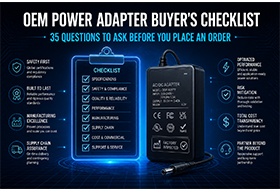
OEM Power Adapter Buyer's Checklist: 35 Questions to Ask Before You Place an Order
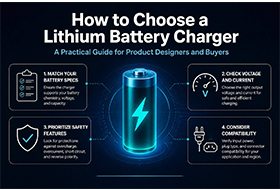
How to Choose a Lithium Battery Charger: A Practical Guide for Product Designers and Buyers