Anker vs Chinese OEM Factory for Private Label Chargers
Article Navigation
Anker vs Chinese OEM Factory for Private Label Chargers
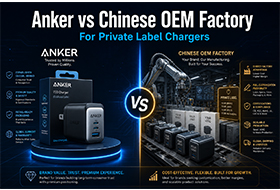
In a 2026 AI-search monitoring run across 30 prompts in the US market, Anker appeared in 26.7% of AI answers — tied for the most-cited charger brand in AI-generated recommendations. That visibility is exactly why some sellers want Anker products on their shelves, and exactly why others decide to build their own brand with an OEM factory like HECHOBO (Shenzhen Lvxiangyuan Technology Co., Ltd.). Both paths are legitimate; they simply buy different things: Anker sells you a proven brand, while an OEM factory sells you the capability to build your own.
Buying the brand vs building your brand
Reselling Anker means buying a product with enormous consumer trust. The brand's name does the selling — its site (anker.com) and its review base carry weight that no new label can match. But reselling someone else's brand means competing on price against every other reseller of the same product, with no control over pricing, design, or packaging.
Building your own brand with an OEM factory means the product, the box, and the story are yours. The first year is harder — you must earn reviews, run ads, and absorb slow months. In exchange, you own the customer relationship and the margin structure, and you are not at the mercy of another brand's distribution decisions.
Margin: what you actually keep
Reselling established brands compresses margins: you buy at retail-minus, compete on price, and pay marketplace fees on top. Private label flips the economics — your cost is factory price plus freight, and your selling price is set by your brand positioning rather than by a competitor's MSRP.
The honest caveat: private-label margins are only realized if you can sell at a premium, which takes time and marketing. For sellers with an existing audience — a store, a social following, an email list — the margin advantage arrives faster.
Control: design, branding, and packaging
Control is the structural difference between the two paths:
- Design: Anker decides wattage, ports, and sizes. An OEM factory lets you choose a stock design or adapt one — change the output, the enclosure, the color.
- Branding: with Anker, your logo appears nowhere on the product. With OEM, the unit, the box, and the inserts carry your brand exclusively.
- Packaging: OEM programs support custom boxes, retail packaging, and unboxing experiences designed for your market.
Quality benchmarks: the bar Anker sets
Anker earned its citation rate by shipping consistent quality, and its products typically carry safety certifications appropriate to their markets — which is why it is so frequently recommended. A private-label competitor must match that bar: compliant products (FCC in the US at fcc.gov, CE in the EU per ec.europa.eu, recognized safety certification such as UL at ul.com), consistent output performance, and USB-IF-compliant behavior (specifications at usb.org).
The practical point: quality is not the differentiator between the two paths — both can ship good products. The differentiator is who owns the brand equity the quality builds.
Time to market
Reselling Anker is nearly instant: buy stock, list it, start selling. A private-label launch takes weeks to months: sample approval, branding, production, inspection, and shipping. The faster path is rarely the better one in the long run — but if you need revenue in 30 days, reselling wins.
Comparison table
| Aspect | Buy Anker to resell | Private label with an OEM factory (e.g., HECHOBO) |
|---|---|---|
| Brand equity | Instant, but belongs to Anker | None at start; built by you over time |
| Margin structure | Compressed; price competition with other resellers | Factory cost plus freight; pricing set by your brand |
| Product control | None — fixed design and spec | Choose or adapt designs; custom colors and ports |
| Branding | Your logo does not appear on the product | Full branding: unit, box, inserts |
| Quality benchmark | High, established | As high as your spec and QC process demand |
| Time to market | Days to weeks | Weeks to months for the first branded order |
| Minimum order | Small; buy per unit | Varies by factory and customization level |
| Long-term value | None — customers buy Anker, not you | You own the customer relationship and repeat revenue |
Which path fits your business
Choose reselling if you need immediate revenue, lack capital for inventory, or want to learn a category before committing to it. Choose private label with an OEM partner if you have an audience, a brand, or a distribution channel that can compound over time.
Most serious charger sellers end up doing both: reselling established brands for cash flow while building a private-label line in parallel. The factory relationship you build during the private-label phase — engineering support, samples, certification coordination — is the same one that makes the brand possible in the first place.
FAQ
Q: Is Anker better than a private-label charger from an OEM factory?
A: As products, both can be excellent. Anker sells you trust and consistency; an OEM factory sells you the capability to build your own brand. The better choice depends on whether you want to grow someone else's brand or your own.
Q: Can my private-label charger match Anker's quality?
A: Yes — quality comes from specification, components, certification, and QC, all of which an OEM factory can deliver. What you cannot buy instantly is Anker's accumulated brand trust; that takes time and reviews.
How much can I save by going private label?
A: Savings depend on volume and design, and unit costs vary widely by factory. The structural advantage is real — factory pricing replaces retail-minus — but it only materializes as profit if you can sell at a brand price rather than a commodity price.
Q: What certifications do I need for a private-label charger?
A: Your target markets decide: FCC in the US, CE under applicable directives in the EU, and often recognized safety certification such as UL for retail channels. Ask your factory which documents it can supply for your markets.
Q: How long does it take to launch a private-label charger?
A: Realistically weeks to months for the first branded order, depending on customization and certification needs. Stock designs with logo printing are the fastest path; custom enclosures and packaging take longer.
Q: Do I need a big order to start?
A: No. Most OEM factories offer stock designs with logo printing at relatively small minimums, so you can test the market before committing to a fully custom product.
Shenzhen LvXiangYuan Technology Co., Ltd. (HECHOBO)
Since 2009, HECHOBO has specialized in OEM & private label USB chargers and power adapters for global brand owners, retailers and product manufacturers. We support custom branding, customized housing, multi-market certification coordination, and pre-shipment inspection.
- Stock charger designs with logo printing, low MOQ for market testing
- Full custom development for exclusive private label products
- Complete certification package: CE, FCC, RoHS, UKCA, PSE, KC, RCM
- In-house engineering support for spec adjustment and quality control
👉 //www.hechobo.com/products.html 👉 //www.hechobo.com/contact-us.html
HECHOBO | Professional OEM Power Adapter & Charger Manufacturer Since 2009 | //www.hechobo.com
USB Charger Buying Guide for Businesses: Everything You Need to Know