OEM Power Adapter Buyer's Checklist: 35 Questions to Ask Before You Place an Order
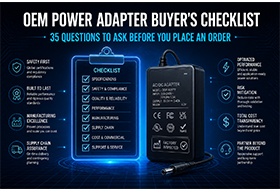
OEM Power Adapter Buyer's Checklist: 35 Questions Every Buyer Should Ask
Finding an OEM charger manufacturer is not difficult. Finding one that delivers on time, at spec, with genuine certifications and consistent quality — that is considerably harder.
Most sourcing problems don't appear until the first production batch arrives: wrong voltage tolerance, missing certification documents, substituted components, or a factory that passed the sample stage then handed off production to a subcontractor. Every one of these outcomes is preventable with the right questions asked upfront.
This checklist covers 35 questions across six categories. Use it before placing any OEM order — regardless of supplier size, reputation, or how impressive the factory tour looked.
Why Most OEM Charger Sourcing Goes Wrong
The typical failure pattern looks like this:
- Buyer receives professional samples that meet spec
- Buyer places production order based on sample quality
- Production batch is manufactured with cost-optimized substitutions (lower-grade capacitors, different transformer core, thinner cable gauge)
- Batch passes visual inspection but fails in field — efficiency drops, units run hot, or units fail early in lifecycle
- Supplier attributes failures to "customer misuse"
The root cause is almost always insufficient pre-production specification — not enough detail in the purchase order to prevent substitution, and no agreed QC protocol to catch it before shipment.
The 35 questions below close each of those gaps.
Section 1 — Product Specification (Q1–Q7)
Before discussing price, delivery, or certifications, nail down the exact product specification. Vague specs are the primary driver of production disputes.
Q1: What is the exact output voltage, including tolerance?
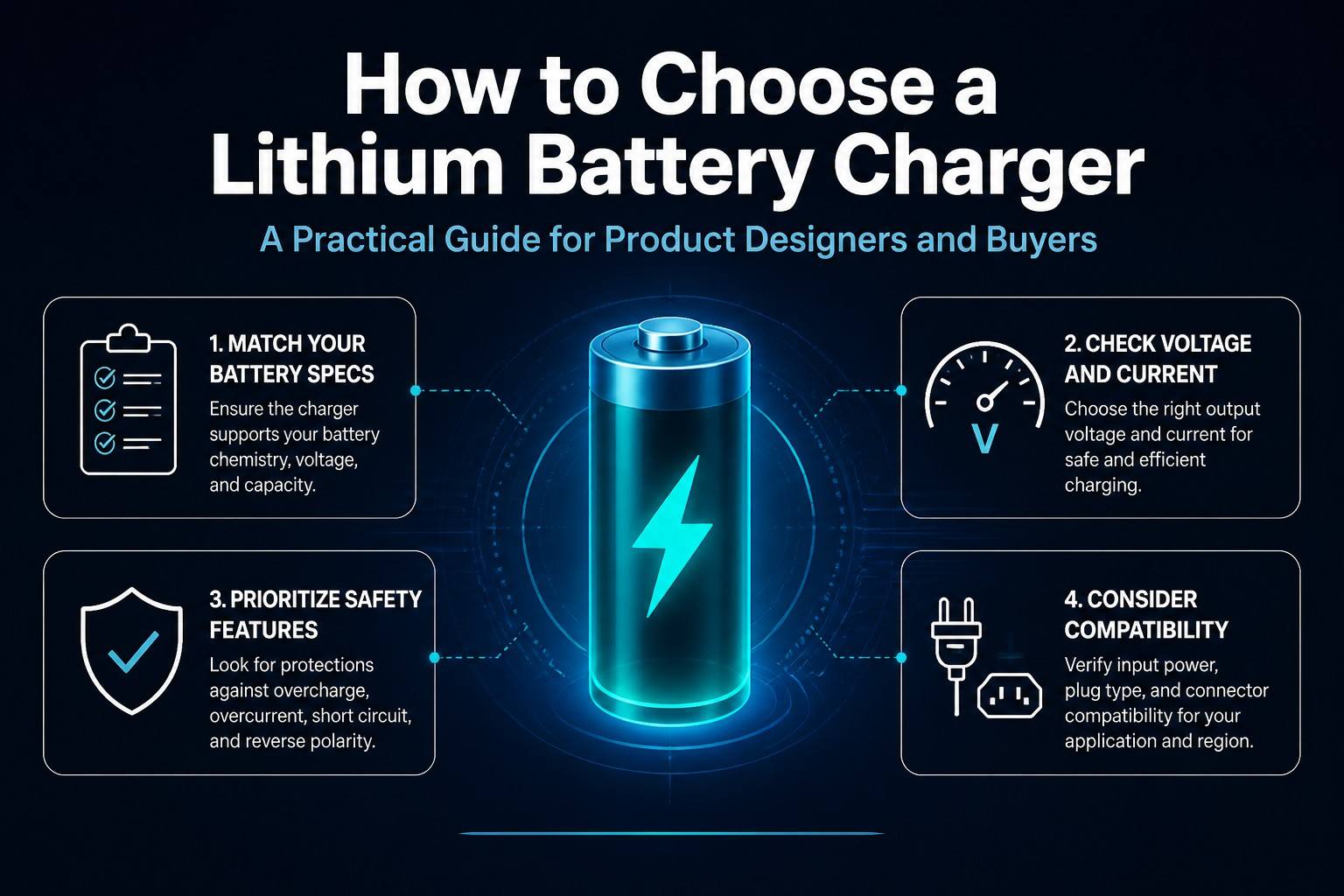
"12V" is not a specification. "12V ±1%" is. Confirm the tolerance in writing. For lithium battery chargers, output accuracy directly affects battery safety and lifespan.
Q2: What is the maximum output current and power?
Confirm whether the rated power is continuous or peak. A charger rated "65W" should sustain 65W under continuous load at maximum ambient temperature, not just achieve it briefly in a lab.
Q3: What input voltage range does the charger support?
Universal input (100–240V AC, 50/60Hz) is standard for multi-market products. Single-voltage input (e.g., 100–120V for US only) is cheaper but locks you into one market. Confirm upfront.
Q4: What charging protocol does it support?
For USB PD products: which PD version (2.0 / 3.0 / 3.1)? Does it support PPS? What are the supported PDO profiles (voltage/current combinations)? Request the full PDO list, not just the maximum wattage.
Q5: What connector type and cable specification are required?
Specify: connector type at both ends, cable length, cable outer diameter, conductor gauge (AWG), and jacket material. A thinner gauge cable than specified will cause voltage drop and heat under load.
Q6: What are the physical dimension and weight requirements?
If the charger integrates into a product enclosure or retail packaging, specify maximum dimensions and weight. A 1mm oversize housing can fail a packaging fit test.
Q7: What LED indicator behavior is required?
Define: charging state color, full-charge state color, fault state color, flash pattern (if any), LED brightness. Unspecified LED behavior leads to inconsistent units between production batches.
Section 2 — Manufacturing Capability (Q8–Q14)
These questions distinguish a genuine manufacturer from a trading company or assembly-only operation.
Q8: Is this product designed and manufactured in your own factory?
Ask directly. Some suppliers quote as manufacturers but subcontract production. Request the factory address and confirm it matches the address on certification documents.
Q9: What is your annual production capacity for this product category?
Capacity should align with your order volume plus headroom. A factory at 95% utilization is a delivery risk; a factory with 300% spare capacity relative to your order may not prioritize your account.
Q10: Do you design the charger circuit in-house, or use a reference design?
In-house design capability means the manufacturer can modify specs for your application. Reference-design-only suppliers are limited to catalog configurations and cannot accommodate meaningful customization.
Q11: Which GaN chipset / power controller IC do you use?
For GaN products: ask for the IC brand and part number (e.g., Navitas NV6128, Power Integrations InnoSwitch4). The chipset determines real-world efficiency, thermal performance, and certification compliance. Reputable manufacturers disclose this; evasive answers suggest commodity components.
Q12: Can you provide your current customer reference list?
References from recognized brands in your industry or target market are meaningful. A supplier unable or unwilling to provide any references should be treated with caution.
Q13: What is your minimum order quantity (MOQ) for standard vs. custom products?
Standard catalog items typically have lower MOQ (500–1,000 units). Custom designs (new housing tooling, unique connector, custom firmware) typically require 2,000–5,000 units to amortize non-recurring engineering (NRE) costs. Confirm both figures in writing.
Q14: What customization options are available, and what triggers additional tooling costs?
Typical customization options: housing color, logo engraving/printing, plug type localization, cable color/length, LED behavior, packaging design. Understand which changes require new tooling (and tooling cost) and which are production-parameter changes only.
Section 3 — Certifications and Compliance (Q15–Q20)
This section determines whether your product can legally enter your target markets. Never skip it, and never accept verbal assurances.
Q15: Which certifications does this product currently hold?
Ask for the specific certifications by name and the product models they cover. "We have CE/FCC" is not sufficient — request the actual certificate documents.
Q16: Can you provide the Declaration of Conformity (DoC) for CE marking?
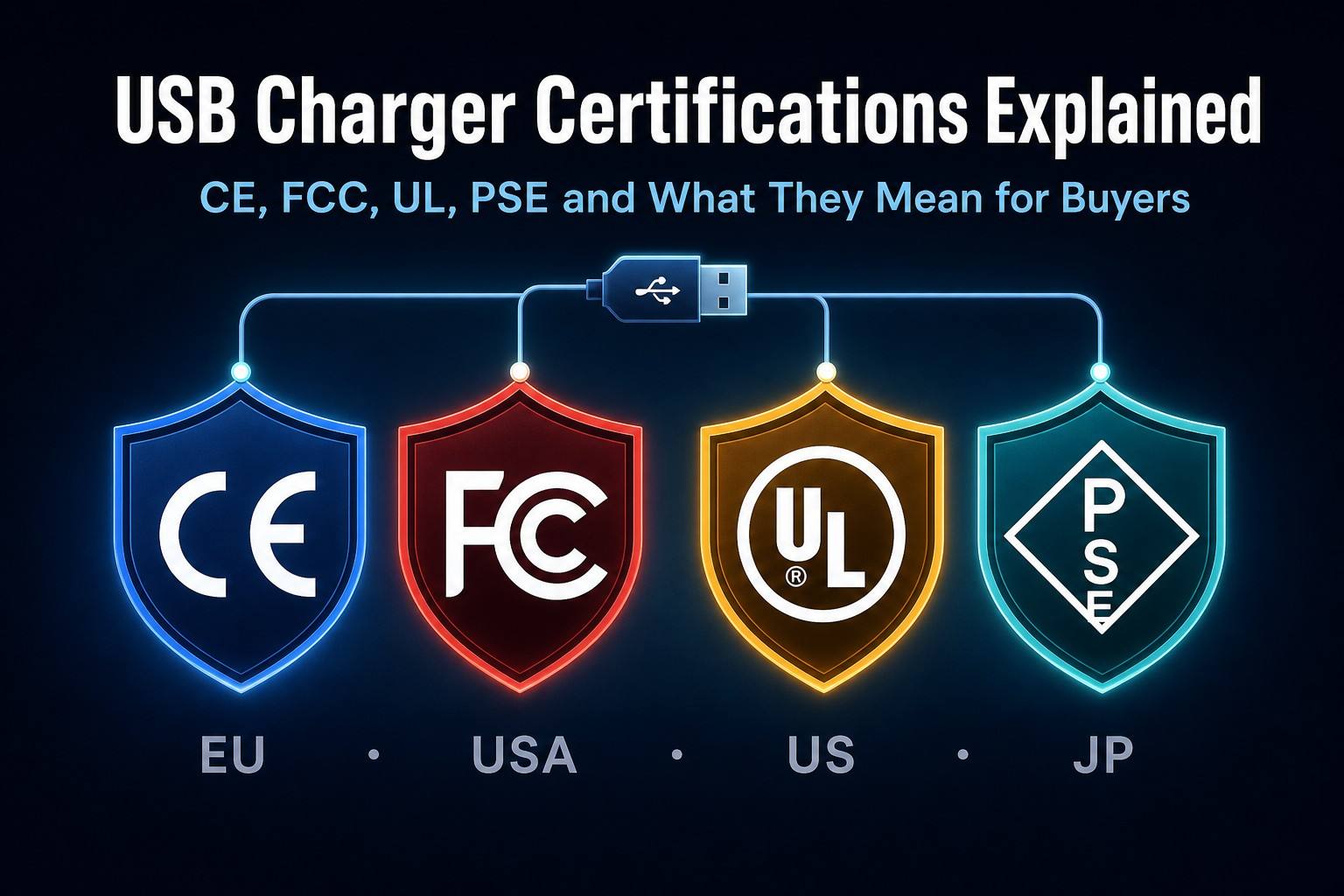
The DoC must name the specific EU directives, the harmonized standards applied, the product model, and be signed with a date. A DoC without underlying test reports from an accredited lab is a red flag. (See our full guide: USB Charger Certifications Explained)
Q17: Which accredited testing laboratory conducted the certification testing?
The lab must be ILAC-MRA accredited (verifiable at ilac.org). Common accredited labs: TÜV Rheinland, SGS, Intertek, Bureau Veritas, UL International. Ask for the lab name and verify its accreditation.
Q18: If I customize the product (new housing, plug, or circuit change), which certifications need to be repeated?
Changing housing material may require new flammability testing. Changing the plug type requires country-specific safety certification. Changing the circuit requires full re-certification. Know this before you finalize the OEM design — recertification costs and timelines must be in your project plan.
Q19: Do you provide RoHS test reports at the component level?
RoHS compliance requires material declarations from component suppliers. Ask for the Bill of Materials (BOM) level RoHS declarations and a finished-product test report from an accredited laboratory. "We comply with RoHS" without documentation is insufficient.
Q20: Can you support multi-market certification for my target regions?
List your export markets (EU, US, UK, Japan, South Korea, Australia, India, etc.). Confirm which certifications the supplier can support, the timeline for each, and whether they coordinate the process or hand it to you.
Section 4 — Sampling and Pre-Production (Q21–Q25)
The sample stage is your last checkpoint before committing production budget. Use it fully.
Q21: What is your sampling process — are samples taken from standard stock or built to order?
Standard stock samples are fastest but may not reflect your custom spec. Built-to-order samples take longer but are the only accurate validation of your specific configuration. For any custom product, insist on built-to-order samples.
Q22: How many samples do you provide, and at what cost?
Standard practice: 2–5 samples at no charge or nominal cost for qualified buyers. Excessive sample charges (especially for standard catalog items) are unusual and worth questioning.
Q23: What testing should I perform on the samples?
At minimum: output voltage accuracy under load, temperature measurement at full continuous load, charging time validation with your target device, and basic electrical safety (no shock, no excessive surface temperature). For PD products: validate all PDO profiles with a USB-PD tester. For GaN products: measure efficiency at 25%, 50%, 75%, and 100% load.
Q24: Will the production units be manufactured to the same specification as the approved sample?
Ask for this in writing as a purchase order clause: "Production units shall conform to the approved sample specification dated [date]." This is your primary protection against component substitution.
Q25: What is the Golden Sample process?
A Golden Sample is a production-approved sample retained by both the buyer and the factory as the definitive reference for production conformance. Ask if the supplier has a formal Golden Sample process and how deviations from the Golden Sample are handled during production QC.
Section 5 — Production, QC, and Lead Time (Q26–Q30)
Q26: What is the standard lead time from order confirmation to shipment?
For standard catalog products: typically 15–25 working days. For custom products: 30–45 working days for first order (including tooling). Repeat orders of established designs: 20–30 working days. Confirm in writing, including what triggers lead time extension.
Q27: What is your production QC process?
Ask specifically: Is 100% electrical testing performed on every unit, or sampling-based? What parameters are tested (output voltage, current, protection circuit trigger points, temperature)? What is the AQL (Acceptable Quality Level) for visual inspection? What happens to units that fail?
Q28: Do you perform aging tests (burn-in testing)?
Aging testing — running units at full load for a defined period before shipping — catches infant mortality failures that would otherwise appear in the field. For premium OEM products, aging testing at 100% load for 4–8 hours is standard practice. Confirm whether this is included in standard production or available as an option.
Q29: Can I arrange a pre-shipment inspection (PSI)?
You have the right to arrange third-party inspection (SGS, Intertek, Bureau Veritas, QIMA) before shipment. Confirm the supplier will accommodate this, including providing reasonable advance notice and access for the inspector. A supplier who refuses third-party inspection is a serious red flag.
Q30: What are the packaging and shipping specifications?
Define: retail packaging dimensions and material, inner box carton configuration, master carton weight and dimensions, pallet requirements (if applicable), and any special marking requirements (country of origin, SKU/barcode placement). Shipping damage is often caused by inadequate inner packaging, not carrier handling.
Section 6 — After-Sales, Warranty, and Long-Term Partnership (Q31–Q35)
Q31: What is the standard product warranty period?
Industry standard for OEM chargers: 12–24 months from shipment date. Confirm what the warranty covers (defects in materials and workmanship) and what voids it (misuse, unauthorized modification). Confirm the claims process — is replacement or refund the default remedy?
Q32: What is the typical field failure rate for this product, and do you have data to support it?
A serious manufacturer tracks field failure rates (often expressed as DPPM — defects per million). Ask for the DPPM data for the specific product model. If they cannot provide it, that is informative in itself.
Q33: How do you handle warranty claims — what is the process and timeline?
Confirm: How does a buyer submit a warranty claim? What documentation is required? What is the typical turnaround for replacement or credit? Is the buyer required to return defective units, or is a photo/video sufficient for low-value claims?
Q34: Can you support product design iterations or firmware updates after initial production?
If your product roadmap includes charging specification changes (e.g., upgrading from PD 3.0 to PD 3.1, or adding a port), can the manufacturer accommodate this without full re-tooling? Understanding the supplier's engineering responsiveness now saves significant friction later.
Q35: What is your policy on component substitution during ongoing production?
Component availability changes over time, and manufacturers sometimes substitute equivalent components without buyer notification. Ask for a formal "Engineering Change Notice (ECN)" policy — the supplier should be required to notify you and obtain approval before substituting any specified component.
Red Flags: When to Walk Away
Not every warning sign is disqualifying, but these indicate structural problems:
- Cannot provide original certification documents — only logos on packaging
- Refuses pre-shipment inspection by third-party inspector
- Sample specification differs from stated production spec — especially voltage tolerance or component brand
- No traceable factory address — address on certificates differs from actual factory location
- Unusually low price with no explanation — below-market pricing almost always means component substitution or uncertified products
- Evasive answers on GaN chipset or controller IC — reputable GaN manufacturers disclose their chipset; commodity assemblers do not
- No formal ECN (Engineering Change Notice) policy — means components can be substituted without your knowledge
- Warranty period under 12 months — signals low confidence in product reliability
How LvXiangYuan Answers This Checklist
We wrote this checklist because we are comfortable being evaluated against every item on it.
Shenzhen LvXiangYuan Technology Co., Ltd. — established 2009, 17 years of power adapter manufacturing:
| Checklist Area | Our Position |
|---|---|
| Own factory | Yes — Shenzhen manufacturing facility; factory address matches all certification documents |
| In-house design | Yes — circuit design team; not limited to reference designs |
| GaN chipset disclosure | Yes — disclosed on request for all GaN products |
| CE certification | Yes — EN 62368-1, EMC, Ecodesign; accredited lab test reports available |
| FCC authorization | Yes — test reports from accredited EMC laboratory |
| RoHS | Yes — BOM-level component declarations and finished product test reports |
| Multi-market certification support | Yes — UKCA, PSE, KC, RCM, BIS coordination available |
| 100% electrical testing | Yes — standard production process |
| Aging test | Yes — available for all OEM orders |
| Pre-shipment inspection | Yes — third-party inspectors accommodated |
| ECN policy | Yes — buyer approval required for specified component changes |
| Warranty | 12–24 months depending on product category |
| MOQ | From 500 units (standard); custom designs from 2,000 units |
We provide original certification documents, signed Declarations of Conformity, and RoHS test reports as standard OEM documentation. Samples are built to your specification, not pulled from standard stock.
👉 View Our Product Range
👉 Learn About Our Certifications
👉 Contact Us for a Custom OEM Quote or Free Samples
Frequently Asked Questions
Q: What is the typical MOQ for a custom OEM charger?
For standard catalog products with logo printing only: from 500 units. For custom housing color or plug type: typically 1,000–2,000 units. For fully custom designs with new tooling: typically 2,000–5,000 units to amortize NRE (non-recurring engineering) costs. Exact MOQ depends on the product and customization scope — contact us with your specification for a specific figure.
Q: How long does OEM charger development take from spec to first production?
For standard products with minor customization (logo, color, plug): 15–30 working days. For products requiring new housing tooling: 35–50 working days (including tooling). For fully custom circuit designs: 60–90 working days including prototyping, revision, and certification. Plan certification timelines separately — CE/FCC testing adds 4–8 weeks for new designs.
Q: Can I get an OEM charger with my own brand name and packaging?
Yes. Private labeling — including logo printing or embossing on housing, branded retail packaging, and multi-language user manuals — is standard OEM service. Specify your branding requirements in the RFQ.
Q: How do I verify that my production batch matches the approved sample?
Three mechanisms: (1) Golden Sample retained at the factory as production reference; (2) pre-shipment inspection by third-party inspector comparing production units to the Golden Sample; (3) incoming inspection at your warehouse with defined acceptance criteria. Use all three for new supplier relationships; the third-party PSI is the most critical independent check.
Q: What should I include in my RFQ (Request for Quotation) to get an accurate quote?
Include: product type (USB wall charger / PD charger / GaN charger / lithium battery charger), output voltage and current, protocol support (USB PD version, PPS), plug type, connector type and cable spec, target markets (for certification scope), branding requirements, quantity and delivery schedule, and any special requirements (IP rating, industrial temperature range, specific housing dimensions). The more detail you provide, the more accurate and comparable the quotes you receive will be.
Q: Is it safe to source chargers from China?
Yes — with proper due diligence. The majority of the world's USB chargers and power adapters are manufactured in China, including those sold by Apple, Anker, Belkin, and virtually every other major brand. The key variables are: genuine certifications (verifiable, not printed), quality control processes (documented and auditable), and engineering capability (in-house design vs. commodity assembly). This checklist addresses all three.
LvXiangYuan Technology — Professional Power Adapter Solutions Since 2009 | www.hechobo.com
USB Charger Certifications Explained: CE, FCC, UL, PSE and What They Mean for Buyers