Fast Charging Technology Explained: USB PD, GaN, QC, and PPS — What They Are and How They Work Together
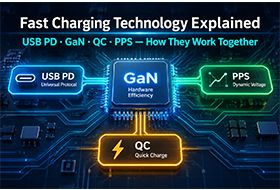
Fast Charging Technology Explained: USB PD, GaN, QC, and PPS
"Fast charging" is printed on the box of almost every USB charger sold today. What it actually means varies enormously — and understanding the difference matters whether you are designing a product, sourcing a charger, or simply trying to buy one that works with your devices.
The confusion is understandable. USB PD, GaN, Quick Charge, and PPS are four distinct technologies that are often mentioned together, sometimes conflated, and rarely explained in relation to each other. They are not synonyms, and they do not all do the same thing.
This guide maps all four clearly — what each one is, how it works, and how they combine in the chargers that actually appear in the market.
Why Fast Charging Is More Complicated Than It Looks
Standard USB charging, as defined in the original USB 2.0 specification, delivers 5V at 500mA — 2.5 watts. That is enough to very slowly charge a small phone overnight.
The devices people charge today — flagship smartphones, tablets, laptops — have batteries ranging from 15Wh to 100Wh. Charging a 100Wh laptop at 2.5W would take 40+ hours. Practical fast charging at 65W reduces this to under 2 hours.
Getting from 2.5W to 65W (or 140W, or 240W) required solving problems at three levels simultaneously:
Hardware: How do you build a charger that is small enough to be practical but powerful enough to deliver 65W+ without overheating?
Protocol: How do the charger and device agree on how much power to transfer, at what voltage, and at what current?
Battery management: How do you deliver high power to a lithium battery without damaging it or causing thermal runaway?
GaN solved problem 1. USB PD (and Quick Charge) solved problem 2. PPS addressed a key aspect of problem 3. Together, they define what a modern fast charging system looks like.
The Four Dimensions of Fast Charging
Before diving into each technology, it helps to understand what role each one plays:
| Technology | Type | What It Controls |
|---|---|---|
| GaN | Hardware (semiconductor material) | Charger size, heat, efficiency |
| USB PD | Open protocol standard | Voltage/current negotiation between charger and device |
| Quick Charge (QC) | Proprietary protocol | Voltage/current negotiation (Qualcomm-licensed devices only) |
| PPS | Protocol sub-feature | Fine-grained, continuously adjustable voltage for battery health |
A single charger can combine multiple of these — and the best current chargers do. A "65W GaN PD 3.0 charger with PPS" incorporates all four dimensions: GaN hardware, USB PD 3.0 protocol, and PPS sub-feature. It may also support QC for backward compatibility with non-PD devices.
Dimension 1 — GaN: The Hardware Revolution
GaN (Gallium Nitride) is a semiconductor material that replaced silicon in the switching transistors inside modern charger power stages. It is a hardware technology — it has nothing to do with the charging protocol used or the wattage delivered. A GaN charger can still be slow if it doesn't support fast charging protocols.
What GaN changes:
Efficiency: GaN transistors switch at higher frequencies with lower resistive losses, achieving 90–95% power conversion efficiency versus 75–85% for silicon. At 65W output, a GaN charger wastes approximately 3–7W as heat; a silicon charger wastes 10–17W.
Size: Higher switching frequency and lower heat generation mean less filtering, smaller transformer cores, and smaller or eliminated heatsinks. A 65W GaN charger is typically 40–50% smaller by volume than a 65W silicon charger.
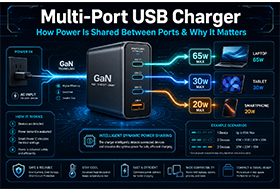
Thermal stability: Because GaN generates less heat, it can sustain full rated output for longer periods without thermal throttling — critical for multi-port chargers under simultaneous load.
What GaN does not change: The protocols the charger supports, the maximum output voltage, the number of ports, or the device compatibility. GaN is the engine; everything else is still determined by the circuit design and firmware.
→ Deep comparison: //www.hechobo.com/blog/gan-charger-vs-traditional-charger.html
Dimension 2 — USB Power Delivery: The Universal Protocol
USB Power Delivery (USB PD) is an open charging protocol standard maintained by the USB Implementers Forum (USB-IF). It defines how a USB-C charger and a connected device communicate to negotiate the optimal power level for that charging session.
How USB PD Negotiation Works
When a USB PD-capable device connects to a USB PD charger:
The charger broadcasts its available Power Data Objects (PDOs) — a list of voltage/current combinations it can supply (e.g., 5V/3A, 9V/3A, 15V/3A, 20V/3.25A)
The device reviews the PDO list and selects the profile that matches its needs
The charger switches to the requested output and delivers power
If conditions change (battery temperature rises, second device connects), re-negotiation occurs automatically
This negotiation happens in milliseconds and is transparent to the user. The result: the charger always delivers exactly what the device requests — no more, no less.
Why this matters for product design: USB PD is device-agnostic. A USB PD charger works at full speed with a Samsung Galaxy, a MacBook Pro, and a Nintendo Switch — without any proprietary adaptation. For OEM buyers, this universality eliminates compatibility risk and simplifies the certification scope.
USB PD 2.0, 3.0, and 3.1 at a Glance
| Version | Max Power | Key Addition | Recommended For |
|---|---|---|---|
| USB PD 2.0 | 100W | Fixed voltage profiles (5V/9V/15V/20V) | Legacy; avoid for new designs |
| USB PD 3.0 | 100W | PPS (Programmable Power Supply) sub-feature | Current standard for new designs |
| USB PD 3.1 | 240W | Extended Power Range (EPR): 28V, 36V, 48V profiles | Laptops, high-performance devices |
For new product designs in 2026, USB PD 3.0 with PPS is the baseline specification. USB PD 3.1 is required only for applications above 100W.
→ Full USB PD guide: //www.hechobo.com/blog/what-is-usb-power-delivery.html
Dimension 3 — Qualcomm Quick Charge: The Proprietary Standard
Quick Charge (QC) is Qualcomm's proprietary fast charging protocol, implemented in Qualcomm Snapdragon-based devices and chargers licensed by Qualcomm. Unlike USB PD, which is an open standard, QC requires a license to implement and is exclusive to the Qualcomm ecosystem.
QC Versions and What Changed
| Version | Max Power | Voltage Range | Key Feature |
|---|---|---|---|
| QC 2.0 | 18W | 5V / 9V / 12V (fixed steps) | First commercial fast charge protocol |
| QC 3.0 | 18W | 3.6–20V (200mV steps) | Finer voltage adjustment; less heat |
| QC 4.0 / 4+ | 28W / 100W | USB PD compliant + QC extensions | PPS-compatible; aligned with USB PD 3.0 |
| QC 5.0 | 100W | Multi-cell charging architecture | Very high power at reduced heat |
The critical transition: QC 4.0 was designed to be USB PD 3.0 compliant. A device supporting QC 4.0 will fast-charge from a USB PD 3.0 charger even without explicit QC support. This alignment largely resolved the QC/PD incompatibility problem for premium devices.
QC vs USB PD: The Key Differences
| Dimension | Quick Charge | USB PD |
|---|---|---|
| Standard type | Proprietary (Qualcomm licensed) | Open standard (USB-IF) |
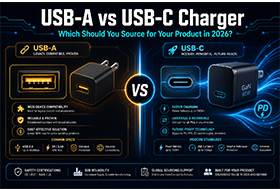
| Connector | USB-A or USB-C | USB-C only |
| Device compatibility | Qualcomm Snapdragon devices | Universal (any USB PD device) |
| Maximum power | 100W (QC 5.0) | 240W (PD 3.1) |
| Protocol alignment | QC 4.0+ compatible with USB PD | Universal baseline |
| Royalty requirement | Yes (manufacturer license) | No |
For OEM product designers: If your target device uses a Qualcomm Snapdragon processor and you want to support proprietary fast charging, you need QC support in addition to (or instead of) USB PD. However, for broad market compatibility, USB PD 3.0 is the more practical choice — it covers the widest device range without proprietary licensing.
For chargers sold as universal fast chargers (not tied to a specific device), USB PD 3.0 with PPS provides the most comprehensive compatibility, and many such chargers also include QC backward compatibility for older devices.
→ Detailed comparison: //www.hechobo.com/blog/usb-a-vs-usb-c-charger.html
Dimension 4 — PPS: The Precision Layer
PPS (Programmable Power Supply) is a sub-feature of USB PD 3.0 that enables continuously adjustable output voltage and current, rather than the fixed voltage steps (5V, 9V, 15V, 20V) of standard USB PD.
The problem PPS solves:
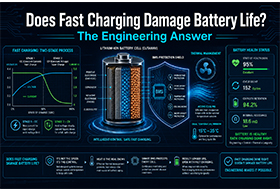
Standard USB PD charges a battery at fixed voltage steps. A nearly-full battery at 4.1V that can only receive 5V or 9V must accept 9V and then have its BMS convert the excess — generating heat inside the battery.
PPS allows the charger to supply exactly the voltage the battery needs at each moment of the charging cycle — tracking the battery's rising voltage as it charges, rather than jumping between fixed steps. The result: less heat generation inside the battery, slower electrolyte degradation, and meaningfully longer battery cycle life over time.
PPS in practice:
PPS requires both the charger (PPS-capable USB PD 3.0) and the device (PPS-compatible charging controller) to benefit from the feature
Compatible devices include Samsung Galaxy series (S21+), Xiaomi, OPPO, and other brands that implement adaptive charging on top of USB PD PPS
When both sides support PPS, charging proceeds with adaptive voltage; when only the charger supports PPS and the device does not, standard fixed-step PD negotiation is used — no performance loss, just no PPS benefit
Why PPS matters for OEM buyers:
If you are sourcing chargers for products sold in markets where Samsung Galaxy, Xiaomi, or OPPO phones are common in your customer's hands, PPS support in your bundled charger is a meaningful quality signal — it is visibly faster on PPS-compatible phones and produces less heat. Include it in your charger specification at no significant cost premium over standard PD 3.0.
→ Full PPS explanation: //www.hechobo.com/blog/65w-vs-100w-gan-wall-chargers.html
How the Four Technologies Work Together in a Single Charger
A modern premium fast charger integrates all four dimensions:
Inside the hardware:
GaN transistors in the power conversion stage deliver 65W (or 100W, or 140W) with 92%+ efficiency and minimal heat
The power stage is controlled by a dedicated GaN driver IC that manages switching frequency and thermal monitoring
In the firmware and protocol stack:
USB PD 3.0 controller manages the PD negotiation with connected devices via the CC line
PDO table is programmed with supported voltage/current profiles (5V/3A, 9V/3A, 15V/3A, 20V/3.25A, plus PPS range)
QC 3.0/4.0 compatibility layer handles legacy Qualcomm devices that do not support USB PD
During a charging session:
Device connects; PD negotiation identifies device type and power requirements
For a PPS-capable phone: charger enters PPS mode, continuously adjusts voltage in 20mV steps as battery charges from 0% to 100%
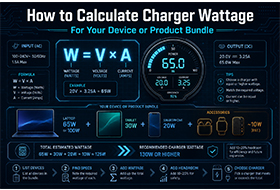
For a USB PD laptop: charger delivers fixed 20V/3.25A (65W) via standard PDO profile
For a legacy QC device: charger reverts to QC 3.0 handshake protocol
For a non-PD USB-C device: charger delivers 5V/3A (15W) default
All of this switching between modes is automatic, happens in milliseconds, and is completely transparent to the user.
Fast Charging Protocol Compatibility Matrix
Use this reference when specifying a charger for a multi-device environment:
| Device Type | USB PD 3.0 | USB PD 3.0 + PPS | QC 3.0 | QC 4.0/4+ |
|---|---|---|---|---|
| iPhone 15/16 | ✅ Fast (27W) | ✅ Fast | ❌ Basic 5W | ❌ Basic 5W |
| Samsung Galaxy S24 | ✅ Fast (45W) | ✅ Adaptive fast | ✅ Fast | ✅ Full fast |
| MacBook Air/Pro | ✅ Full speed | ✅ Full speed | ❌ Basic | ❌ Basic |
| Google Pixel 8/9 | ✅ Fast (30W) | ✅ Fast | ❌ Basic | ❌ Basic |
| Xiaomi 14 | ✅ Fast (67W PPS) | ✅ Adaptive | ✅ Fast | ✅ Full fast |
| iPad Pro (USB-C) | ✅ Fast (45W) | ✅ Fast | ❌ Basic | ❌ Basic |
| Nintendo Switch | ✅ 18W | ✅ 18W | ❌ Basic | ❌ Basic |
| Legacy Android (QC 2.0/3.0) | ✅ Standard | ✅ Standard | ✅ Fast | ✅ Fast |
| Non-PD USB-C device | ✅ 15W default | ✅ 15W default | ❌ 5W | ❌ 5W |
Reading the matrix: A USB PD 3.0 + PPS charger covers the widest range of devices at fast or full-speed charging. Adding QC 3.0/4.0 backward compatibility extends full fast charge coverage to legacy Qualcomm devices — a worthwhile addition for chargers serving mixed device environments.
What This Means for OEM Product Design
If you are designing a product with a bundled charger, or specifying a charger for a defined device ecosystem, these principles apply:
1. Protocol before wattage Determine which protocols your target device supports before selecting wattage. A 100W charger without PPS will charge a PPS-compatible Samsung slower than a 45W charger with PPS — the wattage number is secondary to protocol alignment.
2. USB PD 3.0 + PPS is the correct baseline for 2026 It covers all Apple devices, all current Android flagships, all laptops up to 100W, and legacy devices at reduced but functional speed. There is no market argument for specifying USB PD 2.0 for new designs.
3. Add QC backward compatibility for mixed-device environments If your charger will serve an environment with older Qualcomm devices (corporate fleets, hospitality, retail), QC 3.0 compatibility adds minimal cost and meaningfully improves the charging experience for that device segment.
4. GaN is the right hardware platform above 45W Below 45W, silicon remains cost-competitive and thermally manageable. At 65W and above, GaN's thermal advantage enables sustained fast charging that silicon designs of equivalent wattage cannot reliably maintain.
5. PPS is required for genuine adaptive fast charging If fast charging speed on Samsung, Xiaomi, or OPPO devices is a product marketing claim, PPS support is not optional — these devices achieve their rated fast charge speeds only with PPS.
Choosing the Right Fast Charging Specification for Your Product
A decision framework based on your primary use case:
| Use Case | Recommended Spec | Why |
|---|---|---|
| Smartphone bundle (Apple focus) | USB PD 3.0, 20–30W | iPhone max is 27W via PD |
| Smartphone bundle (Android focus) | USB PD 3.0 + PPS, 45–65W | Samsung/Xiaomi/OPPO benefit from PPS |
| Laptop bundle (ultrabook) | USB PD 3.0, 65–100W | Standard PD, no PPS needed |
| Laptop bundle (gaming/high-perf) | USB PD 3.1 EPR, 140–240W | PD 3.0 ceiling is 100W |
| Universal charger (multi-device) | USB PD 3.0 + PPS + QC 3.0, 65–100W | Widest protocol coverage |
| Office / hospitality multi-port | USB PD 3.0 + PPS + QC 3.0, 100–140W total | Dynamic power sharing required |
| Budget / basic charging | USB PD 2.0 or QC 3.0, 18–25W | Where cost is primary constraint |
Hardware selection: Apply GaN at 45W and above. Below 45W, the size and cost benefit of GaN is less compelling unless form factor is a specific design requirement.
Shenzhen LvXiangYuan Technology Co., Ltd. manufactures fast charging products across every specification tier in this guide. Our current range covers:
USB PD 3.0 Wall Chargers — 20W to 100W, with PPS on all current models
PD GaN Chargers — 30W to 140W, GaN II and GaN III platforms
Multi-Protocol Chargers — USB PD 3.0 + QC 3.0/4.0 + PPS combination
USB PD 3.1 EPR Chargers — 140W and above for high-performance laptop applications
All products are CE, FCC, and RoHS certified, with full PDO specification tables and simultaneous output documentation available for OEM buyers.
👉 //www.hechobo.com/pd-usb-c-charger-usb-pd-3.0-pps.html
👉 //www.hechobo.com/blog/gan-charger-vs-pd-charger.html
👉 //www.hechobo.com/contact-us.html
Frequently Asked Questions
Q: What is the difference between GaN and USB PD?
GaN (Gallium Nitride) is a hardware technology — it refers to the semiconductor material used inside the charger to convert AC power to DC. USB PD (Power Delivery) is a software protocol — it defines how the charger and device communicate to negotiate the right power level. A charger can use GaN hardware and support USB PD protocol simultaneously; they operate at different layers and are not alternatives to each other.
Q: Do I need a special cable for fast charging?
For USB PD up to 100W: a USB-C cable rated for 5A (E-Marked cable) is required to safely carry full current at 20V. Standard USB-C cables (3A rating) support USB PD up to 60W (20V/3A). For USB PD 3.1 above 100W: an EPR-rated cable rated for 5A at up to 48V is mandatory. Using an underpowered cable does not damage devices — the charger and device negotiate down to what the cable can safely carry — but maximum charging speed is not achieved.
Q: Can a USB PD charger damage my device's battery?
No, when the charger and device are both properly designed. USB PD negotiation ensures the device receives only the power it requests. The device's battery management system further regulates incoming power to match the battery's current state. The charging process is controlled by the device, not the charger. → Full answer: //www.hechobo.com/blog/does-fast-charging-damage-battery.html
Q: My phone supports "45W Super Fast Charging." Do I need a 45W charger?
To achieve the rated 45W speed, yes — a charger with at least 45W USB PD 3.0 + PPS output is required for Samsung's Super Fast Charging 2.0. A lower-wattage charger will charge the phone more slowly but will not cause damage. A higher-wattage charger (e.g., 65W) will still charge at 45W — the phone limits intake to its maximum accepted rate.
Q: Is Quick Charge compatible with USB-C?
QC 2.0 and 3.0 can use USB-C connectors but operate on a proprietary protocol, not USB PD. QC 4.0 and 4+ are designed to be USB PD 3.0 compliant — a QC 4.0 device will fast-charge from a USB PD 3.0 charger. For new designs, USB PD 3.0 with PPS provides QC 4.0-level compatibility without Qualcomm licensing requirements.
Q: What fast charging protocol does Apple use?
Apple devices (iPhone 12 and later, iPad Pro with USB-C, MacBook) support USB Power Delivery via USB-C. iPhone 15/16 achieves up to approximately 27W via USB PD. MacBook Pro 14/16 charges at up to 96–140W via USB PD 3.1. Apple does not implement Qualcomm Quick Charge or PPS — a USB PD 3.0 charger without PPS is fully compatible and delivers Apple's maximum charging speed.
Contact Us
Contact: Anita
Email: wm1@hechobo.com
Mobile: 0086-14775542090
Does Fast Charging Damage Battery Life? The Engineering Answer