How to Calculate the Right Charger Wattage for Your Device or Product Bundle
How to Calculate the Right Charger Wattage: A Complete Guide for Buyers and Product Teams
Wattage is the single number that most buyers use to compare chargers — and it is also the number most frequently misunderstood.
Too low: the charger cannot sustain fast charging, or cannot power the device at all under load. Too high: you've overpaid for capacity you will never use. For OEM product bundles, wrong wattage means a charger that either underperforms relative to customer expectations or adds unnecessary cost to every unit shipped.
Getting wattage right is a calculation, not a guess. This guide walks through it step by step, for single devices, multi-device setups, and OEM specifications.
Why Wattage Matching Matters (It's Not Just About Speed)
Most buyers think of wattage as a speed dial — higher wattage, faster charging. That is partly true but incomplete. Wattage matching matters for three reasons:
1. Speed: A charger below the device's maximum accepted wattage will charge more slowly. The gap can be dramatic — a laptop that accepts 65W charged from a 20W charger will charge at 20W, which may not even keep pace with active use.
2. Thermal safety: A charger operating continuously at or above its rated capacity runs hot. A charger sized with appropriate headroom runs within its thermal design point, extending component lifespan and reducing field failure rate.
3. Protocol compatibility: USB PD negotiation is wattage-dependent. A device requesting 45W from a 20W USB PD charger will receive 20W — the charger cannot exceed its rating. But the negotiation itself works correctly; there is no damage from the mismatch, just reduced performance.
The goal: a charger whose rated wattage is 10–25% above the device's maximum charging requirement, operating continuously within its design envelope.
The Basic Formula: Watts = Volts × Amps
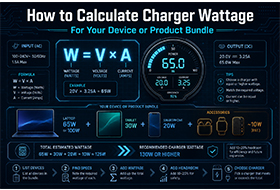
Power (Watts) = Voltage (V) × Current (A)
This formula is the foundation of all wattage calculations. In practice:
- A USB PD charger delivering 9V at 3A = 27W
- A USB PD charger delivering 20V at 3.25A = 65W
- A USB PD charger delivering 20V at 5A = 100W
On a charger spec sheet, you will typically see multiple voltage/current combinations listed — these are the USB PD "power profiles" (PDOs) the charger can deliver. The highest wattage profile is the charger's rated maximum.
For device specifications: Check the device's official charging spec, not the cable or port rating. A USB-C port rated for 5A current does not mean the device accepts 5A at 20V (100W) — the device's power management IC limits actual intake. Always find the device's maximum accepted charge wattage, not the connector's theoretical maximum.
Device Wattage Reference Table
Use this as a starting point. Actual device requirements vary by manufacturer and model — always verify against the specific device's specification.
| Device Category | Typical Max Charge Rate | Recommended Charger Wattage |
|---|---|---|
| Wireless earbuds / smartwatch | 5–15W | 10–20W |
| Smartphone (standard) | 18–25W | 25–30W |
| Smartphone (fast charge) | 45–67W | 50–80W |
| Small tablet (8–10 inch) | 18–30W | 30–45W |
| Large tablet / iPad Pro | 30–45W | 45–65W |
| Thin-and-light laptop (13 inch) | 45–65W | 65–100W |
| Standard laptop (15 inch) | 65–90W | 90–120W |
| High-performance laptop / gaming | 100–140W | 140–180W |
| Portable speaker / power bank | 10–30W | 20–45W |
| E-reader | 5–15W | 10–20W |
| Handheld gaming console (e.g., Steam Deck) | 45W | 65W |
| Desktop replacement laptop | 130–200W | Use proprietary adapter |
Note on "fast charge" smartphones: Many current flagship phones (Samsung Galaxy Ultra, Xiaomi, OPPO) accept 65–120W charging via their proprietary fast charge protocols. Via standard USB PD, maximum accepted rate is typically 45W. If bundling a charger with one of these devices, confirm whether USB PD or the proprietary protocol is the intended charging path.
How to Calculate Wattage for a Single Device
Three steps.
Step 1 — Find the Device's Maximum Charging Rate
Sources, in order of reliability:
- Device manufacturer's official spec page (most accurate)
- Device's original charger output label (indicates what the OEM supplied)
- USB PD tester connected to the device (measures actual negotiated wattage in real time)
- The device wattage reference table above (use as estimate only)
What to look for: The spec will state something like "supports 45W USB PD charging" or "maximum input: 20V/3.25A." Convert to watts if needed: 20V × 3.25A = 65W.
Step 2 — Apply the Safety Margin Rule
Rule: Charger rated wattage = Device maximum × 1.15 to 1.25
A 15–25% overhead above the device's maximum ensures:
- The charger operates within its continuous thermal design point
- The charger can sustain full-speed charging even at elevated ambient temperature (up to 40°C)
- Minor voltage fluctuations do not push the charger to its rated limit
Example: Device maximum = 65W. Charger minimum = 65W × 1.15 = 74.75W → round up to the nearest standard tier.
Step 3 — Choose the Nearest Standard Wattage Tier
Standard USB charger wattage tiers (see full table at end of article):
20W → 30W → 45W → 65W → 100W → 140W → 200W
Applying the example: 74.75W rounds up to 100W (the next standard tier above 65W with 15% margin).
Final answer for a 65W laptop: Source a 100W USB PD charger.
How to Calculate Wattage for Multiple Devices
Multi-device scenarios require a different calculation depending on the charging mode.
Scenario A — Sequential Charging (One Device at a Time)
If only one device charges at a time (users plug in, charge, unplug before the next user connects), the charger wattage is determined by the highest-demand single device.
Example: Office desk where employees charge their personal devices during the day. Devices range from smartphones (25W) to laptops (65W). Sequential use assumption.
Calculation: Highest single device = 65W × 1.20 = 78W → 100W charger
Scenario B — Simultaneous Charging (All Devices at Once)
If all devices charge simultaneously and each must receive close to its maximum rate:
Calculation: Sum of all device maximums × 1.15–1.25
Example: Hotel room charging station — smartphone (25W) + tablet (30W) + laptop (65W) simultaneously.
Sum = 25 + 30 + 65 = 120W × 1.20 = 144W → 140W charger with dynamic power sharing
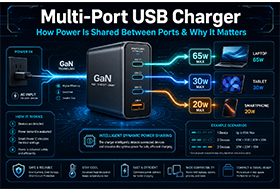
Important caveat: This calculation assumes the charger supports dynamic power sharing (IPD) and can allocate the total budget appropriately. A fixed-split charger at 140W total may not deliver 65W to the laptop port simultaneously — check the simultaneous output specification.
→ How multi-port power sharing works: Multi-Port USB Charger: How Power Is Shared
Scenario C — Mixed Use (Workplace / Hospitality)
In shared environments, not every port is occupied simultaneously and device mix varies. Use a probability-weighted approach:
Example: 4-port office charging station. Expected usage: 2 ports occupied on average, peak 3 ports. Typical devices: 1× laptop (65W) + 1–2× smartphones (25W each).
Peak demand calculation: 65W + 25W + 25W = 115W × 1.15 = 132.25W → 140W charger
Average demand calculation: 65W + 25W = 90W (most of the time)
Selection: 140W with dynamic power sharing. The charger handles peak comfortably and delivers full speed in average-use conditions.
OEM Wattage Specification: Additional Considerations
When specifying charger wattage for a product bundle (the charger ships inside the box with your product), additional factors apply beyond the device's charging requirement:
1. Regulatory minimum efficiency tiers
EU Ecodesign Regulation (EU) 2019/1782 sets minimum efficiency requirements for external power supplies. At higher wattages, the required efficiency tier (and the design cost to meet it) increases. Confirm your target wattage falls within a cost-effective efficiency tier for your product cost structure.
2. Cost-per-watt economics
Charger unit cost does not scale linearly with wattage. Moving from 65W to 100W typically adds 25–40% to BOM cost. Moving from 100W to 140W adds another 30–50%. Specify only the wattage your device genuinely requires — over-specifying adds cost without user benefit.
3. Customer perception vs. actual requirement
For consumer electronics bundles, the charger wattage printed on the box is a marketing signal. "65W Fast Charger Included" is a stronger message than "30W Charger Included" even if the device charges fully in the same time. Consider whether the wattage specification serves technical needs, marketing needs, or both.
4. Future device generations
If your product line roadmap includes higher-power future versions of the same device, specifying a slightly higher charger wattage now (e.g., 100W instead of 65W) provides forward compatibility without requiring a charger redesign at next product generation.
5. Lithium battery charger wattage
For products with integrated lithium battery packs charged externally, wattage calculation follows a different path:
Charger wattage = Pack voltage × Charge current
Example: 3S Li-ion pack (12.6V), 2A charge current = 25.2W → 30W charger
The charge current is determined by the desired charge time and the battery's maximum C-rate, not by a device spec sheet.
→ Full lithium battery charger sizing guide: How to Choose a Lithium Battery Charger
What Happens If the Charger Wattage Is Too Low?
Scenario 1: Slightly below device maximum (e.g., 45W charger for a 65W laptop)
The device accepts the available 45W via USB PD negotiation. Charging proceeds at 45W — slower than maximum, but functional. Under heavy compute load, the laptop may discharge slowly even while "charging" if power draw exceeds 45W.
Scenario 2: Significantly below device minimum (e.g., 20W charger for a laptop requiring 45W minimum)
Some devices reject charging entirely from insufficient wattage. Others accept minimal charging (5W trickle) while displaying "Not charging" or "Charging slowly." In product bundle contexts, this is a customer experience failure.
Scenario 3: Charger wattage too low for continuous operation (charger runs at 100% load indefinitely)
The charger operates at its thermal limit continuously. Capacitor degradation accelerates. Field failure rate increases. The charger may enter thermal protection mode and cut output temporarily, manifesting as intermittent charging behavior.
What Happens If the Charger Wattage Is Too High?
Short answer: nothing negative for the device.
A device accepts only the power it requests via USB PD negotiation. A 100W charger connected to a 20W device delivers exactly 20W — the charger's higher capacity is simply not drawn. The device is not harmed by the higher-rated charger.
The only downsides of over-specifying wattage:
- Higher unit cost
- Larger physical size (especially for silicon chargers; less pronounced for GaN)
- Marginally higher standby power draw (typically <0.5W difference — negligible)
Practical rule: Over-specifying by one standard tier (e.g., 100W instead of 65W) is a reasonable hedge for flexibility. Over-specifying by two tiers or more (e.g., 140W for a 25W smartphone) adds cost and size with no benefit.
Standard USB Charger Wattage Tiers (Quick Reference)
| Wattage Tier | Primary Use Case | Typical Protocol | Common Form Factor |
|---|---|---|---|
| 5W | Basic accessories, trickle charge | USB BC 1.2 | USB-A wall charger |
| 10–12W | Smartphones (standard) | Apple 2.4A | USB-A wall charger |
| 18–20W | Smartphones (fast charge entry) | USB PD 2.0 / QC 3.0 | USB-C or USB-A wall charger |
| 25–30W | Smartphones (mid-range fast) | USB PD 3.0 + PPS | USB-C wall charger |
| 45W | Tablets, thin laptops, fast smartphones | USB PD 3.0 + PPS | USB-C wall charger |
| 65W | Ultrabook laptops, multi-device | USB PD 3.0 | USB-C wall charger / GaN |
| 100W | Standard laptops, multi-port charging | USB PD 3.0 | GaN wall charger |
| 140W | Gaming laptops, high-performance | USB PD 3.1 EPR | GaN wall/desktop charger |
| 200W+ | Desktop replacement, workstations | USB PD 3.1 EPR | Desktop / proprietary |
Shenzhen LvXiangYuan Technology Co., Ltd. manufactures USB PD and GaN chargers across all standard wattage tiers from 20W to 140W. We work with OEM buyers to define the correct wattage specification for their specific device and market requirements.
If you provide your device's charging specification, we can recommend the appropriate charger model, wattage tier, and protocol support from our product range — and supply samples for validation before production commitment.
👉 View Our Charger Range by Wattage
👉 Read: USB Charger Buying Guide for Businesses
👉 Contact Us with Your Wattage Requirement
Frequently Asked Questions
Q: Can I use a higher-wattage charger than my device requires?
Yes, without any risk to the device. A USB PD device negotiates only the wattage it needs — a 100W charger connected to a 20W smartphone delivers exactly 20W. The only effect of a higher-rated charger is slightly higher unit cost and potentially larger size.
Q: My laptop says it supports "up to 100W" charging. Should I get a 100W charger?
Apply the 15–25% margin rule: 100W × 1.15 = 115W minimum → a 140W charger is the appropriate selection for sustained full-speed charging without thermal stress. A 100W charger will work but will operate at its limit continuously.
Q: Why does my charger get hot when my laptop is plugged in but not when my phone is?
Your laptop draws significantly more power than your phone. A charger operating near its rated capacity generates more heat than one operating at light load. If the heat is excessive or the charger feels uncomfortably hot, the charger may be undersized for the laptop's charging requirement — or the charger's efficiency may be below specification.
Q: I need to charge 10 tablets overnight in a cabinet. How do I calculate the total charger wattage needed?
Determine each tablet's maximum charging rate (e.g., 30W each). Multiply by the number of devices: 10 × 30W = 300W. Add 15% margin: 300W × 1.15 = 345W. You need either a single 350W+ power supply distributed across 10 ports, or 10 independent charger circuits each rated at 30–45W. For guaranteed simultaneous full-speed charging, independent circuits per port are the reliable architecture.
Q: Does wattage affect how long it takes to charge a battery from empty to full?
Yes, but only up to the device's maximum accepted wattage. Charging time (hours) ≈ Battery capacity (Wh) ÷ Accepted charge wattage × 1.2 (efficiency factor). Example: 100Wh laptop battery, 65W accepted charge rate: 100 ÷ 65 × 1.2 ≈ 1.85 hours to full. Increasing charger wattage above 65W does not reduce this time — the device limits intake at 65W.
Q: For a product bundle, should I specify the exact wattage my device needs or round up to the next tier?
Round up to the next standard tier with at least 15% headroom. Specifying exact minimum wattage (e.g., a 45W charger for a 45W device) means the charger runs at 100% capacity continuously — reducing lifespan and increasing field failure rate. One tier up (65W for a 45W device) adds modest cost but meaningfully improves reliability and customer experience.
LvXiangYuan Technology — Professional Power Adapter Solutions Since 2009 | www.hechobo.com
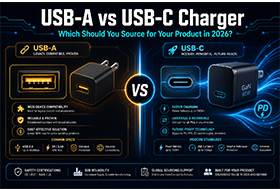
USB-A vs USB-C Charger: Which Should You Source for Your Product in 2026?