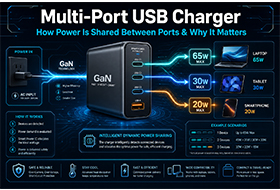
Multi-Port USB Charger: How Power Is Shared Between Ports and Why It Matters
Article Navigation
- Introduction
- The Problem Most Buyers Don't Know They Have
- How Multi-Port Charger Power Works: The Basics
- The Three Power Sharing Architectures
- How to Read a Multi-Port Charger Spec Sheet
- GaN and Multi-Port Charging
- Real-World Scenarios
- What to Specify When Ordering
- Frequently Asked Questions
- Contact
Multi-Port USB Charger: How Power Is Shared and Why It Matters
A charger with four USB ports and a "100W total output" rating sounds straightforward. Plug in four laptops, get 25W each. Plug in two laptops, get 50W each.
That is almost never how it actually works.
The way power is allocated between ports — and what triggers changes in that allocation when devices are added or removed — varies significantly between charger designs. Getting this wrong in a procurement decision means deploying chargers that throttle to frustratingly slow speeds the moment more than one device is connected. Getting it right means your users get fast, intelligent charging from every port, every time.
This guide explains how multi-port charger power sharing actually works, the three different engineering architectures behind it, and what to specify when sourcing for business use.
The Problem Most Buyers Don't Know They Have
Consider this common scenario: you purchase a 65W dual-port charger (1× USB-C PD + 1× USB-A) for your office. The spec sheet says: USB-C: 65W, USB-A: 12W.
What the spec sheet does not prominently state: when both ports are in use simultaneously, the USB-C port drops to 45W and the USB-A port drops to 12W — total output 57W, not 65W. Or in some designs: USB-C drops to 30W and USB-A stays at 12W — total 42W.
The advertised 65W is the maximum output of the USB-C port alone. The total simultaneous output is something else entirely, and it varies by design.
This is not deceptive marketing — it is the physical reality of shared power budgets. But it is frequently under-communicated, and it leads to one of the most common multi-port charger complaints: "My laptop charges slowly when my phone is also plugged in."
Understanding why this happens — and how different designs handle it — is the key to making the right sourcing decision.
How Multi-Port Charger Power Works: The Basics
Every charger has a power supply inside that converts AC mains input into the DC output delivered to connected devices. This power supply has a fixed maximum output capacity — the total watts it can produce simultaneously.
When a single device is connected, all available power flows to that port. When multiple devices connect, the charger must distribute power between them. The question is: who decides how that distribution works?
Three answers to that question produce three fundamentally different charger architectures.
The Three Power Sharing Architectures
Architecture 1 — Fixed Split
How it works: The charger's total power budget is divided into fixed allocations per port. Each port has a hard maximum that does not change based on what other ports are doing.
Example: A "65W" dual-port charger with fixed split might allocate: Port A = 45W maximum, Port B = 18W maximum. Total simultaneous = 63W. Neither port can exceed its allocation regardless of whether the other port is in use.
The real-world problem: Port A's 45W maximum is only available when Port B has a device connected that draws power. When Port B is empty, Port A can deliver up to 65W. But the charger cannot "loan" Port B's unused allocation to Port A — the split is fixed in the circuit design.
Buyer implication: A laptop connected to Port A gets 45W maximum even if nothing else is plugged in — until Port B is empty, at which point it gets 65W. The power a device receives depends on whether any other port is occupied, which is unpredictable in shared environments.
Where fixed split appears: Budget chargers, older multi-port designs, simple analog designs without microcontroller-based power management.
Architecture 2 — Dynamic Power Sharing (Intelligent Power Distribution)
How it works: A microcontroller monitors the power being drawn from each port in real time. When a new device connects, the controller negotiates with all connected devices (via USB PD communication on USB-C ports) and redistributes the total power budget dynamically.
Example: A 100W dual USB-C GaN charger with dynamic sharing:
- One device connected: full 100W available
- Two devices connected: microcontroller queries both devices' power requirements, allocates 65W to the high-demand device (e.g., laptop) and 35W to the lower-demand device (e.g., smartphone)
- High-demand device disconnects: full 100W redirects to remaining device within seconds
Why this is the correct architecture for most business applications:
- Maximum utilization of available power: No watts are wasted on unused allocations
- Device-appropriate charging: The charger delivers what each device needs, not an arbitrary split
- Transparent to users: Devices receive close to their rated fast charge speed regardless of what else is connected, as long as the total demand doesn't exceed the charger's capacity
- Graceful degradation: When total demand exceeds capacity, all ports are reduced proportionally rather than one port being starved
The technical requirement: Dynamic power sharing requires USB PD communication on USB-C ports. The charger and device negotiate power levels through the USB PD protocol's power data objects (PDOs). USB-A ports in multi-port designs typically have fixed allocations because USB-A does not support PD communication — dynamic sharing is only possible on USB-C PD ports.
Where dynamic power sharing appears: Mid-to-premium GaN chargers, quality multi-port desktop charging stations, professional-grade OEM charger designs.
→ How USB PD negotiation works
Architecture 3 — Independent Circuits
How it works: Each port has its own independent power conversion circuit and its own power supply. There is no shared power budget — each port delivers its rated output regardless of the other ports' load.
Example: A 4-port desktop charging station with independent circuits might have four independent 30W power supplies inside, each capable of delivering 30W simultaneously. Total maximum output: 120W simultaneously, all ports at full rated speed.
The trade-off: Independent circuits eliminate power sharing limitations entirely, but:
- The charger is physically larger (multiple power stages)
- Cost is significantly higher (multiple power conversion circuits)
- Heat management is more complex (multiple heat sources)
- Total power draw from the mains is additive — a 4× 30W independent circuit charger draws up to 120W from the wall
Where independent circuits appear: High-end desktop charging stations for commercial environments (airports, hotel lobbies, conference rooms), industrial multi-device charging solutions.
Buyer implication: If your use case requires guaranteed full-speed charging on every port simultaneously — for example, a charging cabinet that must fully charge 8 tablets overnight — independent circuits are the only architecture that guarantees this. For general office or hospitality use, dynamic power sharing is the better cost/performance balance.
How to Read a Multi-Port Charger Spec Sheet
Spec sheets for multi-port chargers frequently obscure power sharing behavior. Here is how to decode them:
Look for a multi-port simultaneous output table, not just per-port maximums.
A well-documented charger will include a table like:
| Configuration | Port 1 | Port 2 | Port 3 | Total |
|---|---|---|---|---|
| Port 1 only | 100W | — | — | 100W |
| Port 2 only | — | 100W | — | 100W |
| Port 1 + Port 2 | 65W | 35W | — | 100W |
| Port 1 + Port 3 | 65W | — | 30W | 95W |
| All ports | 45W | 30W | 20W | 95W |
If no such table exists, ask the supplier for it explicitly. A supplier who cannot provide simultaneous output specifications for all port combinations does not have a properly documented product — or does not want you to know the answer.
Red flag phrases in spec sheets:
- "Up to 100W total" — "up to" usually means single-port only
- "65W USB-C / 18W USB-A" listed separately with no simultaneous output spec
- "Smart power allocation" with no technical detail — could mean anything
- Total rated power does not add up across ports — suggests fixed split with intentional obfuscation
Green flag phrases:
- "Dynamic power sharing" or "Intelligent Power Distribution (IPD)"
- Simultaneous output table showing all port combinations
- "USB PD 3.0 with power negotiation on all USB-C ports"
- Independent circuit architecture explicitly stated for premium models
GaN and Multi-Port Charging: Why the Technology Matters
GaN (Gallium Nitride) chargers are not just smaller versions of traditional silicon chargers — their efficiency characteristics have a specific implication for multi-port designs.
In a multi-port charger, the total power budget is limited by the primary power conversion stage. Silicon-based designs at high power levels run hot enough that sustained multi-port operation at full capacity is thermally challenging — the design must either derate (reduce maximum output) at high ambient temperature or use bulky heatsinking.
GaN power stages run at 90–95% efficiency versus 75–85% for silicon. This means:
- Less heat generated at the same output power — the charger runs cooler under simultaneous multi-port load
- Higher sustained output — the charger can maintain rated output across all ports for longer without thermal throttling
- Smaller form factor at equivalent power — a 100W GaN multi-port charger is approximately the size of a 45W silicon equivalent
For multi-port chargers specifically, the GaN advantage is not just size — it is thermal headroom that enables sustained simultaneous multi-port performance that silicon designs at equivalent power cannot reliably maintain.
Real-World Scenarios: What Each Architecture Delivers
| Scenario 1: Hotel room with 2-port bedside charger (1× USB-C PD 65W + 1× USB-A 12W) | Guest with laptop + smartphone | Guest with smartphone only |
|---|---|---|
| Fixed split | Laptop: 45W / Phone: 12W | Phone: 12W (USB-A port unused capacity wasted) |
| Dynamic sharing | Laptop: 53W / Phone: 12W | Phone: 12W |
| Independent | Laptop: 65W / Phone: 12W | Phone: 12W |
Recommendation: Dynamic sharing or independent circuits. For a hotel context, most guests will connect both devices; fixed split's port interdependence creates inconsistent experience.
| Scenario 2: Office desk with 4-port USB charger (2× USB-C PD + 2× USB-A, 100W total) | All 4 ports occupied | 2 USB-C only |
|---|---|---|
| Fixed split | 30W + 30W + 12W + 12W = 84W | 45W + 45W = 90W (10W wasted) |
| Dynamic sharing | 40W + 30W + 15W + 15W = 100W | 65W + 35W = 100W |
| Independent | 25W + 25W + 12W + 12W = 74W | 25W + 25W = 50W (limited per port) |
Recommendation: Dynamic sharing. Maximizes utilization of total power budget; users with laptops get priority power allocation.
| Scenario 3: Charging cabinet for 8 tablets overnight (8× USB-C, 45W each required) | All 8 tablets charging simultaneously |
|---|---|
| Fixed split (360W total / 8 ports) | 45W each — meets requirement only if total budget = 360W+ |
| Dynamic sharing (360W total) | 45W each — meets requirement if no port exceeds allocation |
| Independent circuits (8× 45W) | 45W each — guaranteed, regardless of other ports |
Recommendation: Independent circuits or properly sized dynamic sharing. For guaranteed overnight full-charge of a fixed device fleet, independent circuits eliminate any risk of power contention.
What to Specify When Ordering a Multi-Port Charger
When writing a purchase specification or RFQ for a multi-port charger, include:
- Power architecture requirement State explicitly: "Dynamic power sharing (IPD) required" or "Fixed-split acceptable" or "Independent circuits required." Do not leave this implied.
- Simultaneous output specification Define the minimum per-port output when all ports are occupied: e.g., "USB-C Port 1: minimum 45W when all ports active, USB-C Port 2: minimum 30W when all ports active."
- USB PD version and PPS on USB-C ports Specify: "USB-C ports must support USB PD 3.0 with PPS." This enables smartphone adaptive fast charging on USB-C ports even in multi-device scenarios.
- USB-A fallback behavior Specify: "USB-A ports must maintain minimum 12W (5V/2.4A) output regardless of USB-C port load." This prevents USB-A ports from being starved when USB-C ports are under heavy load.
- Thermal requirement Specify: "Must maintain rated simultaneous output at 40°C ambient for minimum 4 hours continuous operation." This eliminates chargers that derate under sustained load.
- Total mains draw For fixed installation environments, confirm the maximum mains input current draw at full load to ensure the circuit can support the installation.
Shenzhen LvXiangYuan Technology Co., Ltd. designs and manufactures multi-port USB chargers with dynamic power sharing (IPD) across our GaN and PD product lines. Our multi-port designs use microcontroller-based power management to negotiate device requirements via USB PD and distribute the total power budget intelligently across all active ports.
We provide full simultaneous output specification tables for all multi-port products and can customize port configuration, total wattage, and power allocation priorities for OEM applications.
👉 //www.hechobo.com/pd-gan-charger-pd-gan-charger.html 👉 //www.hechobo.com/blog/usb-charger-buying-guide-for-businesses 👉 //www.hechobo.com/contact-us.html
Frequently Asked Questions
Q: If a charger is rated 100W total, can all ports use 100W simultaneously?
A: No — unless it uses independent circuits, each with its own 100W power supply (which would be extremely large and expensive). A single 100W power supply shared across multiple ports delivers 100W total across all ports combined. How that total is divided depends on the power sharing architecture.
Q: My laptop charges slowly when my phone is plugged into the same charger. Why?
A: Your charger is reducing the power to your laptop to share with your phone. This is normal behavior in fixed-split and some dynamic-sharing designs. If your charger supports USB PD dynamic sharing, the reduction should be small (e.g., 65W drops to 53W). If the reduction is dramatic (65W drops to 30W or less), the charger uses a fixed-split architecture not well matched to your usage pattern.
Q: Does using multiple ports simultaneously damage the charger?
A: No, for any properly designed charger. The power supply is rated for its total output across all ports. Drawing that total power simultaneously — whether through one port or four — is within the design envelope. Damage would only occur if total demand exceeds the charger's rated capacity for extended periods, which properly functioning protection circuits prevent.
Q: How do I know if a charger has true dynamic power sharing or just marketing language?
A: Ask for the simultaneous output specification table (all port combinations, not just single-port maximums). Ask specifically: "What output does Port 1 deliver when Port 2 is also active at full load?" If the supplier cannot answer this with a specific wattage, the charger does not have properly implemented dynamic sharing.
Q: Can a USB-A port participate in dynamic power sharing?
A: Not in the same way as USB-C PD ports. USB-A does not support the PD communication protocol, so the charger cannot negotiate with USB-A devices to determine their power needs. USB-A ports in dynamic-sharing chargers typically have a fixed allocation that is reserved regardless of actual USB-A device draw.
Q: What is the right total wattage for a multi-port office charger?
A: For an office desk charger expected to charge one laptop plus one to two smartphones simultaneously: 65W minimum (laptop: ~45W + phones: ~20W total), 100W recommended for comfortable headroom. For a shared workplace charging station serving multiple users with mixed devices: 100–140W with dynamic power sharing. Use our //www.hechobo.com/blog/charger-wattage-calculator-guide //www.hechobo.com/blog/65w-vs-100w-gan-wall-chargers.html for precise sizing.
LvXiangYuan Technology — Professional Power Adapter Solutions Since 2009 | //www.hechobo.com
Contact Information - HECHOBO
Company: Shenzhen LvXiangYuan Technology Co., Ltd. (HECHOBO)
Contact Person: Anita
Phone: 14775542090
Email: wm1@hechobo.com
HECHOBO | Professional OEM Power Adapter & Charger Manufacturer Since 2009 | //www.hechobo.com
Anker vs Chinese OEM Factory for Private Label Chargers