Does Fast Charging Damage Battery Life? The Engineering Answer
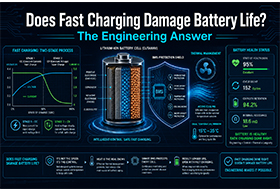
Does Fast Charging Damage Battery Life? The Engineering Answer
The short answer is: yes, to a degree — but the degree depends almost entirely on how fast charging is implemented, not simply on the fact that it is fast.
A well-designed fast charging system with a proper protocol, matched wattage, and good thermal management causes meaningfully less battery degradation than a poorly designed slow charger running hot. The question is not "fast or slow?" — it is "what determines battery degradation, and does your charger manage those factors correctly?"
This article explains the electrochemistry of battery aging, identifies the specific conditions that accelerate it, and gives a practical framework for evaluating whether a fast charging solution is genuinely battery-safe.
How Lithium Batteries Age: The Four Mechanisms
Lithium battery degradation — loss of capacity and increase in internal resistance over time — results from four primary electrochemical mechanisms. Understanding which fast charging practices affect which mechanism is the foundation of an honest answer to this question.
Mechanism 1: Lithium Plating
What it is: During charging, lithium ions move from the cathode through the electrolyte and intercalate (embed) into the graphite anode. If charging current is too high relative to the anode's ability to absorb lithium ions, or if temperature is too low, lithium ions instead deposit as metallic lithium on the anode surface — a process called lithium plating.
Why it matters: Metallic lithium deposits are electrochemically inactive (lost capacity) and can grow into needle-like structures called dendrites. Dendrites can penetrate the separator between anode and cathode, causing an internal short circuit. In severe cases this triggers thermal runaway.
Fast charging connection: High CC (Constant Current) charge rates accelerate lithium plating risk, particularly at low state of charge (0–20%) and at low ambient temperatures (below 10°C). This is why properly designed chargers include a pre-charge (trickle) phase at low SoC before engaging full CC charging, and why many BMS designs inhibit fast charging below 10°C.
Risk with poorly designed fast chargers: A charger that jumps immediately to full current at any SoC and any temperature — without pre-charge logic or temperature sensing — creates measurable lithium plating risk. Well-designed USB PD chargers paired with a properly implemented BMS do not exhibit this problem because the device manages charge rate based on its internal temperature and SoC.
Mechanism 2: Electrolyte Decomposition
What it is: The liquid electrolyte inside a lithium battery is chemically reactive. At elevated temperatures or at voltages outside the battery's stable operating range, the electrolyte undergoes decomposition reactions, forming a solid layer on electrode surfaces (the SEI layer — Solid Electrolyte Interphase). Progressive SEI growth consumes lithium ions and increases internal resistance.
Why it matters: Every charge cycle causes some SEI growth. High temperature and high voltage accelerate it significantly. A battery charged at 40°C degrades measurably faster than the same battery charged at 25°C.
Fast charging connection: Fast charging generates heat — both in the charger and inside the battery. Internal battery heat from high-current charging is the primary accelerant of electrolyte decomposition. This is the mechanism that PPS (Programmable Power Supply) addresses: by minimizing the voltage gap between charger output and battery voltage, PPS reduces internal resistive heating and slows SEI growth rate.
Mechanism 3: Cathode Structural Degradation
What it is: During charge/discharge cycling, lithium ions repeatedly insert and extract from the cathode material, causing volume expansion and contraction. Over hundreds of cycles, this mechanical stress causes microcracks in the cathode structure, reducing the active surface area available for ion intercalation and permanently reducing capacity.
Fast charging connection: Higher charge rates do not directly accelerate cathode structural degradation, but higher operating temperatures do. Since fast charging generates more heat, there is an indirect relationship. Thermal management — either through PPS voltage optimization or through device-level temperature-aware charge rate reduction — mitigates this.
Mechanism 4: Overcurrent and Overvoltage Events
What it is: A momentary overcurrent or overvoltage event — even brief — can cause localized lithium plating, electrolyte decomposition, or separator damage. These events are the acute failure modes, as opposed to the gradual degradation of the first three mechanisms.
Fast charging connection: This is the mechanism addressed by the USB PD negotiation protocol itself. A USB PD charger cannot deliver more voltage than the device requests — the negotiation determines output, and the charger adjusts to match. Overcurrent and overvoltage events from USB PD chargers, in properly functioning systems, are prevented by protocol design, not just by hardware protection circuits.
The Variables That Actually Determine Battery Impact
Armed with the four mechanisms, it becomes clear that battery degradation from fast charging is not a fixed quantity — it depends on five specific variables:
1. Charging temperature The single most impactful variable. A battery charged at 35°C degrades roughly 2× faster than the same battery charged at 25°C, regardless of charge rate. A well-designed device throttles fast charging when battery temperature exceeds threshold — typically 40–45°C for most BMS implementations.
2. Charge rate relative to battery capacity (C-rate) A 3,000mAh battery charged at 3A = 1C. Charging at 2C (6A) is more stressful than 1C, but the relationship is not linear — modern battery chemistries (NMC, NCA) are designed for sustained 1–2C charging without significant degradation. The issue is thermal, not mechanical, at these rates.
3. Voltage precision at end-of-charge Consistently overcharging by 50–100mV above the battery's rated maximum voltage (even briefly) causes measurable electrolyte decomposition and capacity loss. This is why charger output voltage accuracy (±1% or tighter) matters for battery-charging applications.
4. Low-SoC charge initiation temperature Charging a cold battery (below 10°C) at high current rates is the highest-risk scenario for lithium plating. A properly implemented BMS blocks fast charging below a temperature threshold — typically 0–10°C. A charger that delivers full current regardless of battery temperature is dangerous in cold environments.
5. Protocol quality: fixed-step vs PPS As covered in detail in our PPS Charging Guide, PPS minimizes internal heat generation by tracking battery voltage precisely, reducing the voltage-gap-driven heating that is the primary driver of electrolyte decomposition during fast charging.
What the Research Actually Shows
Several independent studies on fast charging and lithium battery longevity have produced consistent findings:
Finding 1: Properly implemented USB PD fast charging at 25–45W causes 10–20% more capacity loss after 500 cycles compared to slow (5W) charging at the same temperature.
This is measurable but moderate. A battery at 80% capacity after 500 fast-charge cycles versus 90% capacity after 500 slow-charge cycles — a real difference, but not catastrophic for a product with a typical 2–3 year consumer replacement cycle.
Finding 2: Temperature during charging is a stronger predictor of degradation than charge rate.
A battery slow-charged at 40°C ambient degrades faster than a battery fast-charged at 22°C. Thermal management — keeping the battery cool during charging — matters more than the wattage number.
Finding 3: PPS-based adaptive charging shows 15–25% better capacity retention at 500 cycles compared to fixed-step fast charging at equivalent wattage.
The voltage gap reduction from PPS provides a measurable real-world benefit, not just a theoretical one. This finding is consistent across published studies on adaptive charging protocols.
Finding 4: The highest degradation rates occur in the 0–20% and 80–100% SoC ranges.
Many device manufacturers address this by throttling fast charge speed at the top and bottom of the charge curve — the device may report "fast charging" while actually limiting current when nearly full or nearly empty.
Practical Implications for Product Designers and OEM Buyers
If you are designing a product with a bundled charger:
The battery's warranty and the product's longevity claim depend partly on the charger. A charger that operates outside the battery's thermal design point — through excessive wattage, poor voltage accuracy, or absence of thermal limiting — reduces the battery's effective service life and increases warranty return rates.
Specify:
- Output voltage accuracy ±1% or tighter
- PPS support if the battery management circuit supports it (reduces internal heating)
- Pre-charge (trickle) mode for low-SoC initiation
- Thermal protection that reduces charge rate if internal charger temperature rises
If you are evaluating fast charging for a device fleet:
Fast charging in a well-managed device fleet (reasonable ambient temperature, modern USB PD 3.0 + PPS chargers, device BMS with thermal limiting) causes acceptable real-world degradation. The productivity gain from faster device availability between uses typically outweighs the marginal increase in battery replacement frequency.
The risk scenario: old, uncertified chargers with poor voltage regulation operating at elevated ambient temperatures (e.g., sun-exposed retail environments or industrial settings). In these conditions, switch to properly certified USB PD chargers with accurate voltage output and thermal protection.
If you are sourcing lithium battery chargers for an integrated battery product:
The charger and BMS must be co-specified — the charger's CC current profile, CV termination voltage, and temperature sensing inputs must match what the BMS expects. A charger that provides accurate CV termination voltage (±0.5% or tighter for multi-cell packs) is the most important single factor in battery pack longevity.
→ Full lithium battery charger selection guide: How to Choose a Lithium Battery Charger
The Myth of "Overnight Slow Charging Is Always Better"
A common conclusion drawn from fast charging concerns is: "Always use slow charging overnight to preserve battery health." This is partially correct but requires qualification.
Where slow charging is genuinely better:
- At high ambient temperatures (above 35°C) — slow charging generates less heat
- For devices that will be left plugged in indefinitely (trickle charging a full battery is mildly stressful)
- For batteries at very low SoC (below 5%) in cold environments
Where the "slow is better" logic breaks down:
- A slow charger with poor voltage regulation at end-of-charge can consistently overcharge the battery by 100mV, which is worse for electrolyte health than a well-regulated fast charger
- Slow charging at a warm temperature causes more degradation than fast charging at a cool temperature
- Most modern device BMS implementations actively manage charge rate regardless of charger speed — the device may receive 30W and deliver only 10W to the battery during thermal throttling
The correct conclusion: Charger quality and thermal management matter more than raw charging speed. A well-designed USB PD 3.0 + PPS charger with accurate voltage output causes less battery damage than a poorly designed "slow" charger with ±5% voltage regulation.
How to Evaluate Whether a Fast Charger Is Battery-Safe
When sampling or evaluating a fast charger for battery-sensitive applications, these tests reveal quality:
Test 1: Output voltage accuracy at end-of-charge condition Connect to the device and measure charger output voltage during the CV phase (when the battery is nearly full). A quality charger maintains within ±1% of the negotiated voltage. Use a USB-PD tester or calibrated multimeter at the cable end.
Test 2: Device temperature during charging Measure device back-surface temperature at 15 minutes and 30 minutes into a full charge cycle starting from 10% SoC. A well-matched charger keeps device temperature below 38°C. Above 42°C consistently indicates either excessive wattage for the device, poor charger thermal design, or insufficient device-side thermal limiting.
Test 3: PPS operation verification Use a USB-PD protocol analyzer to confirm PPS mode is active during charging on PPS-compatible devices. PPS reduces internal battery temperature by 3–8°C compared to fixed-step charging at equivalent wattage — verifiable by comparing battery temperature between PPS and non-PPS chargers on the same device.
Test 4: Charge termination accuracy Check the charger's CV termination behavior: does current taper smoothly to C/20 or below before the charger declares charging complete? A charger that abruptly cuts off at high current without proper CV taper may be terminating early (undercharge) or late (mild overcharge). A proper charge cycle looks like smooth, gradual current reduction over the final 20–30% of the charge cycle.
Shenzhen LvXiangYuan Technology Co., Ltd. designs USB PD and GaN chargers with battery health as a core engineering criterion — not a marketing claim. Our PD charger designs incorporate:
- Output voltage accuracy ±1% across the full load range (verified in production test)
- USB PD 3.0 + PPS on all current models, enabling adaptive voltage tracking for compatible devices
- Pre-charge (trickle) mode for low-SoC initiation in lithium battery charger products
- Thermal protection circuits that reduce output power if charger temperature exceeds design limits
- CC-CV charging profile with proper current taper for integrated battery charger products
We provide voltage accuracy test data and thermal performance data for all OEM samples, allowing buyers to verify battery-safety claims before production commitment.
👉 View Our USB PD Charger Range
👉 Read: What Is PPS Charging and Why It Reduces Battery Heat
👉 Contact Us for Battery-Safe Charger Specification Consultation
Frequently Asked Questions
Q: Is it safe to fast charge my phone every day? Yes, with modern devices and quality certified chargers. Daily fast charging with a USB PD 3.0 + PPS charger and a device with a proper BMS causes moderate additional degradation compared to slow charging — typically 10–20% more capacity loss over 500 cycles. For most consumers replacing devices every 2–3 years, this is within the expected battery service life. The risk scenario is fast charging with uncertified chargers, at high ambient temperatures, or with old devices whose BMS no longer functions correctly.
Q: Does fast charging generate more heat in the battery? Yes — but how much depends on the protocol. Fixed-step USB PD charging generates more internal battery heat than PPS adaptive charging at equivalent wattage, because the voltage gap between charger output and battery voltage forces resistive heating inside the battery's charging circuit. PPS eliminates most of this gap by tracking battery voltage continuously, reducing internal temperature rise by 3–8°C compared to fixed-step charging.
Q: Will using a lower-wattage charger preserve my battery better? Not necessarily. A lower-wattage charger with poor voltage regulation (±5% tolerance) can cause more battery stress at end-of-charge than a higher-wattage charger with ±1% accuracy. Output voltage precision and thermal management matter more than raw wattage. A well-designed 65W charger is kinder to your battery than a poorly designed 10W charger that consistently delivers 50mV above the rated termination voltage.
Q: Should I avoid charging to 100% to preserve battery health? This is valid advice supported by electrochemistry — the SEI growth rate is higher at high SoC, so consistently charging to 80–90% extends cycle life. Many modern smartphones now include a charge limit feature (e.g., 85% limit) for exactly this reason. However, the difference in real-world terms over a 2-year device lifetime is modest for most users, and the inconvenience of limited charge capacity must be weighed against the benefit.
Q: Does wireless charging damage batteries more or less than wired fast charging? Wireless charging (Qi) is less efficient than wired — typically 75–85% efficiency vs. 92–95% for wired USB PD. The additional energy lost as heat during wireless charging is generated partly in the battery's vicinity, increasing thermal stress. At equivalent wattage, wireless charging tends to generate more battery heat than wired. High-wattage wireless charging (15W+) is therefore more thermally stressful than moderate wired fast charging. For battery longevity, wired USB PD charging at moderate wattage is preferable to high-wattage wireless.
Q: I'm designing a product with a 3,000mAh battery. What charger wattage is safe for battery health? For a 3,000mAh (3Ah) battery: a charge current of 1C = 3A. If the battery voltage is 3.7V nominal (single-cell), 1C charging = approximately 11W. A 15–18W charger (approximately 1.3–1.6C) is moderate and well within what modern battery chemistry handles reliably. Above 2C (6A, ~22W) begins to increase lithium plating risk for most standard lithium cells. For long product lifespan, specify a charger that charges at 0.5–1C for the battery pack — prioritize this over raw charge speed for battery-integrated products.
LvXiangYuan Technology — Professional Power Adapter Solutions Since 2009 | www.hechobo.com
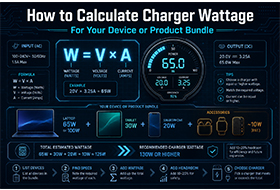
How to Calculate the Right Charger Wattage for Your Device or Product Bundle