USB-A vs USB-C Charger: Which Should You Source for Your Product in 2026?
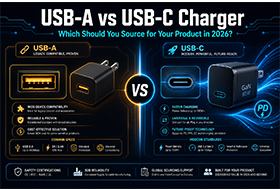
USB-A vs USB-C Charger: Which Should You Source in 2026?
If you are specifying a charger for a new product, equipping a workplace, or deciding on a port standard for the next three to five years of sourcing, USB-A versus USB-C is one of the most consequential decisions you will make — and it is rarely as simple as "newer is better."
USB-A has 25 years of installed base behind it. USB-C has regulatory mandates, fast charging protocols, and a clear technology trajectory in its favor. The right answer depends on your device, your market, your customer base, and your timeline.
This guide gives you the technical comparison and a direct sourcing recommendation, from the perspective of a manufacturer that supplies both.
The Short Answer (If You're in a Hurry)
Designing a new consumer product for EU/UK/US markets in 2026? Use USB-C. Regulatory direction, device ecosystem, and fast charging protocol support all point the same way.
Supplying chargers for a legacy device with USB-A output? Stay with USB-A for now, but plan your transition timeline.
Equipping a workplace or public charging station? Use a combination charger (USB-A + USB-C) to cover the full installed device base without requiring users to manage adapters.
Sourcing bulk chargers for a price-sensitive market where fast charging is not a selling point? USB-A remains viable and lower cost for basic 5W–12W applications.
For everything else, read on.
What Is USB-A? A Quick Recap
USB-A (also called Standard-A or Type-A) is the rectangular USB connector that has been the dominant charging and data port standard since USB 1.0 in 1996. It is unidirectional — only one orientation is possible when plugging in — and asymmetric in its power delivery role: the charger (host) has a USB-A female port; the cable has a USB-A male connector on one end.
USB-A charging power limits:
| Standard | Max Power | Notes |
|---|---|---|
| USB 2.0 default | 2.5W (5V/0.5A) | Original spec; now used only for minimal accessories |
| USB Battery Charging 1.2 | 7.5W (5V/1.5A) | Common on older chargers |
| Apple 2.4A | 12W (5V/2.4A) | Apple device standard; widely adopted |
| Qualcomm Quick Charge 2.0 | 18W | Variable voltage (5V/9V/12V); proprietary |
| Qualcomm Quick Charge 3.0/4.0 | 18–36W | Higher efficiency; still proprietary |
The ceiling: USB-A with Quick Charge 3.0 tops out at approximately 36W in practice. This is sufficient for smartphones but insufficient for most laptops, tablets above 10 inches, and an increasing number of power-hungry accessories.
What Is USB-C? What Changed
USB-C refers to the connector form factor — the small, oval, reversible connector introduced in 2014. It is a physical standard, not a protocol. A USB-C port can carry:
- USB 2.0 data (480 Mbps)
- USB 3.2 data (up to 20 Gbps)
- USB4 / Thunderbolt 4 (up to 40 Gbps)
- USB Power Delivery (up to 240W under PD 3.1)
- DisplayPort / HDMI video signal (Alt Mode)
The connector's reversibility is a practical improvement over USB-A, but the more significant change is what USB-C enables on the power side: the USB Power Delivery protocol.
What USB-C does not automatically give you: Just because a charger has a USB-C port does not mean it supports USB PD, PPS, or high wattage. A USB-C port without PD support delivers only 5V/3A (15W). Always check protocol support, not just connector type.
Power Delivery: The Biggest Practical Difference
This is where the gap between USB-A and USB-C becomes quantitative and decisive for most product specifications:
| Scenario | USB-A Maximum | USB-C (with PD 3.0) | USB-C (with PD 3.1) |
|---|---|---|---|
| Smartphone | 36W (QC 4.0) | 45W (PPS) | 45W |
| Tablet (10–13 inch) | 18W (limited) | 65W | 65W |
| Ultrabook laptop | Not viable | 65–100W | 100W |
| Gaming laptop | Not viable | Not viable | 140–240W |
| Multi-port (2 devices) | 12W + 12W max | 65W + 30W (intelligent split) | 100W+ split |
For any application requiring more than 36W of reliable, standards-compliant fast charging, USB-C with USB PD is the only path. USB-A cannot physically or electrically deliver it within the standard specification.
→ Full USB PD explanation: //www.hechobo.com/blog/what-is-usb-power-delivery.html
Protocol Support: Where USB-C Pulls Decisively Ahead
USB-A supports proprietary fast charging protocols (Qualcomm Quick Charge, Apple Fast Charge, Samsung AFC). Each requires the device to recognize the charger's handshake signal — incompatible charger/device combinations default to slow 5W charging.
USB-C with USB PD is an open, universal protocol maintained by the USB Implementers Forum. Any USB PD charger will negotiate intelligently with any USB PD device, regardless of brand. This universality is:
- Better for end users: One charger works at full speed with their iPhone, their Samsung, their laptop, and their Nintendo Switch
- Better for product designers: No proprietary licensing fees, no brand-specific handshake implementation, no compatibility matrix to maintain
- Better for regulatory compliance: USB PD is the protocol underlying the EU Common Charger Directive mandate
Additionally, USB PD 3.0's PPS (Programmable Power Supply) sub-feature enables continuously adjustable voltage, which reduces heat generation during charging and extends battery lifespan — a meaningful differentiator for premium product positioning.
Physical Durability and Connector Reliability
USB-A connectors are rated to approximately 1,500 insertion cycles under IEC 60512-9-3. In consumer use, this rarely matters — a home charger used twice a day reaches 1,500 cycles in two years. In commercial environments (hotel rooms, airport lounges, public charging stations) with dozens of daily insertions, it is more relevant.
USB-C connectors are rated to approximately 10,000 insertion cycles — a 6× improvement. The reversible design also eliminates the mechanical stress of incorrect insertion attempts, which are a common cause of USB-A port damage in high-traffic environments.
For workplace and public charging applications, USB-C's durability advantage is a legitimate procurement argument, not just a convenience feature.
The Regulatory Dimension: EU, UK, and Beyond
This is the factor that makes the USB-A vs USB-C decision partially time-sensitive for B2B buyers.
EU Common Charger Directive (Radio Equipment Directive 2022/2380/EU):
| Product Category | USB-C Mandatory From |
|---|---|
| Mobile phones, tablets, cameras, headphones, portable speakers, handheld gaming consoles | December 28, 2024 |
| Laptops | April 28, 2026 |
What this means for product designers: Any new consumer electronic product in the above categories sold in the EU after the applicable date must include a USB-C charging port and must support USB PD. Products designed around USB-A charging are non-compliant for EU market entry.
UK: Following the EU Common Charger Directive implementation, the UK is expected to align its regulations, though the exact timeline for UKCA-equivalent mandates continues to develop. Products designed for EU compliance will generally be acceptable in the UK.
United States: No equivalent federal mandate exists as of 2026, but the major US carriers and retailers increasingly require or prefer USB-C for device accessories, and major OEMs (Apple, Google, Samsung) have standardized their flagship devices on USB-C. The market reality is directionally aligned with regulation even without a mandate.
Practical implication: If your product will be sold in the EU or UK after 2024–2026 and falls into any of the listed categories, USB-C is not optional — it is a compliance requirement. Designing around USB-A for these markets is not a viable 2026 strategy.
Device Compatibility: What Your End Users Actually Have
Despite the regulatory and technical case for USB-C, a significant portion of the global device installed base still uses USB-A cables and micro-USB or Lightning connectors. The transition is not yet complete.
Estimated global device port mix (2026, approximate):
| Port Type | Share of Active Devices |
|---|---|
| USB-A (charging via micro-USB / Lightning cable) | ~40% |
| USB-C (without PD) | ~25% |
| USB-C (with PD support) | ~30% |
| Other / proprietary | ~5% |
This installed base reality has two implications:
For product bundles: If your product ships with a USB-C charger, your customers need a USB-C cable. This is now standard expectation for most consumer electronics; include the cable in the bundle specification.
For workplace / public charging: Pure USB-C deployments will leave a meaningful portion of users unable to charge without an adapter. A combination charger (USB-A + USB-C PD) is the pragmatic solution for the next 3–5 years until the USB-A installed base has sufficiently rotated out.
Cost Comparison: Unit Price, Certification, and Long-Term Economics
Unit price:
At equivalent wattage, USB-C PD chargers carry a modest unit price premium over USB-A equivalents — approximately 10–20% for comparable quality and certification. The gap narrows at higher wattages where USB-A options are technically limited.
Certification cost:
USB-C PD chargers require testing against USB PD protocol compliance (USB-IF testing) in addition to standard electrical safety and EMC certifications. This adds a one-time testing cost — typically USD 1,000–2,500 for USB-IF protocol compliance testing on top of CE/FCC costs. Amortized across any meaningful production volume, the per-unit impact is negligible.
Long-term economics:
The stronger economic case for USB-C is forward compatibility. A USB-A charger designed today will be technologically obsolete in the EU and increasingly in the US and UK within 2–4 years. A USB-C PD charger designed today supports the current device ecosystem and the next generation. Designing for USB-A now means likely re-tooling within one product generation.
When USB-A Still Makes Sense in 2026
USB-A is not dead — it remains the right choice in specific contexts:
- Accessories and peripherals with established USB-A ecosystems Keyboards, mice, gaming controllers, desk fans, and similar low-power accessories typically charge at 5W via USB-A. Switching to USB-C offers no functional benefit for these use cases and increases BOM cost unnecessarily.
- Price-sensitive markets where fast charging is not a purchase driver In markets where the primary customer need is "slow overnight charging" and unit price is the dominant purchase criterion, a USB-A charger at 5W–12W is technically sufficient and economically optimal.
- Industrial and embedded applications with fixed legacy connectors Equipment designed around USB-A service ports, industrial barcode scanners, or legacy medical devices with established USB-A charging infrastructure are not candidates for USB-C retrofit without a broader product redesign.
- Combination charger USB-A ports as secondary outputs In a multi-port charger where USB-C PD handles the primary (high-power) charging role, USB-A ports as secondary outputs for low-power accessories remain practical and cost-effective.
When to Choose USB-C — and Which Variant
If any of the following apply, USB-C is the correct choice:
- Product will be sold in the EU or UK in a mandated category after 2024
- Required output is above 18W
- Fast charging performance is a product marketing claim
- Product target customer uses a laptop, modern smartphone, or tablet as a primary device
- Product lifespan extends beyond 2027
Which USB-C variant:
| Application | Recommended Variant |
|---|---|
| Smartphone / tablet fast charging | USB-C with USB PD 3.0 + PPS |
| Laptop charging | USB-C with USB PD 3.0 (65–100W) |
| High-performance laptop / workstation | USB-C with USB PD 3.1 EPR (140–240W) |
| Multi-device workplace charger | USB-C PD 3.0 + USB-A combination |
| Budget / basic charging (no fast charge needed) | USB-C basic (5V/3A, 15W) — lower cost |
Side-by-Side Summary
| Dimension | USB-A | USB-C (with PD) |
|---|---|---|
| Max power (standard) | 36W (QC 4.0) | 240W (PD 3.1) |
| Protocol | Proprietary (QC, AFC) | Open standard (USB PD) |
| Universal fast charging | No — device-dependent | Yes |
| Connector durability | ~1,500 cycles | ~10,000 cycles |
| EU/UK regulatory compliance (2024+) | Non-compliant for mandated categories | Compliant |
| Unit price premium vs equivalent | Baseline | +10–20% |
| Forward compatibility (5-year horizon) | Declining | Strong |
| Best use cases | Accessories, legacy devices, low-power | Smartphones, tablets, laptops, new products |
Shenzhen LvXiangYuan Technology Co., Ltd. manufactures USB chargers across both port standards. Our current product range includes:
- USB-A Wall Chargers — 5W to 36W (QC 3.0), single and multi-port
- USB-C PD Wall Chargers — 20W to 140W, USB PD 3.0 with PPS, CE/FCC/RoHS certified
- GaN Combination Chargers — USB-A + USB-C PD multi-port, 65W to 140W total output
- Custom OEM configurations — specify your port mix, wattage, and plug type
For new OEM designs, we recommend starting with a USB-C PD specification and can provide samples of both port types for side-by-side evaluation.
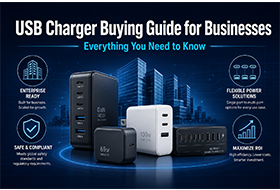
👉 //www.hechobo.com/pd-usb-c-charger-usb-pd-3.0-pps.html 👉 //www.hechobo.com/blog/usb-charger-buying-guide-for-businesses 👉 //www.hechobo.com/contact-us.html
Frequently Asked Questions
A: Not automatically. A USB-C port without USB PD support delivers only 5V/3A (15W) — slower than a USB-A port with Quick Charge 3.0 (18–36W). The speed advantage of USB-C comes from the USB PD protocol, not the connector itself. When comparing chargers, check protocol support, not just port type.
A: Not directly — the connector shapes are incompatible. You would need a USB-C to USB-A adapter, which is widely available but adds friction for end users. For product bundles, include the appropriate cable; do not assume customers will have adapters.
A: USB-A will remain in use for many years due to the enormous installed base of devices and accessories. However, for new product design, USB-A is a declining standard. The EU mandate, combined with OEM ecosystem shifts (Apple, Google, Samsung all on USB-C), makes USB-A a poor choice for new designs targeting 2026 and beyond.
A: The directive applies to devices — it mandates that covered devices must have a USB-C charging port. It does not directly mandate that standalone chargers must be USB-C, though the practical effect is that USB-C chargers are required to serve the mandated USB-C devices. Standalone charger regulations are addressed separately under the Ecodesign framework.
A: Products already on the market before the applicable mandate date are not required to be recalled or modified. New designs and new product launches in mandated categories after the applicable date must comply. If your product is in a mandated category and you plan a new generation or significant revision, design it for USB-C from the outset.
A: For 2026, a 2×USB-A + 2×USB-C PD configuration covers the widest device range for workplace deployment. As the USB-C installed base grows, a 1×USB-A + 3×USB-C configuration will become more appropriate — likely from 2027–2028 onward. The right split depends on your specific user population and device refresh cycle.
LvXiangYuan Technology
Professional Power Adapter Solutions Since 2009
Shenzhen LvXiangYuan Technology Co., Ltd.
Looking for OEM & ODM USB-A / USB-C GaN chargers? Contact us for datasheets, quotation and samples.
Website: //www.hechobo.com
Contact Page: //www.hechobo.com/contact-us.html
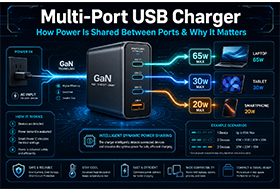
Multi-Port USB Charger: How Power Is Shared Between Ports and Why It Matters