Fast Charger Spec Sheet Decoder: What Every Number Actually Means
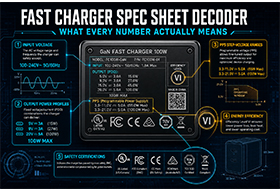
Fast Charger Spec Sheet Decoder: What Every Number Actually Means
A USB charger spec sheet contains 20–30 data points. Most buyers look at three of them — wattage, port count, and price — and ignore the rest. This is how misleading charger specifications go undetected, and how buyers end up with products that underperform in the field.
Every number on a charger spec sheet means something specific. Some are straightforward. Others are deliberately ambiguous or commonly misrepresented. This guide decodes them all — line by line — so you can read any fast charger specification accurately and spot the gaps that matter.
Section 1: Input Specifications
Input Voltage Range
What it says: 100–240V AC, 50/60Hz What it means: The charger accepts any mains voltage between 100V and 240V at either 50Hz or 60Hz. This is universal input — a single product works in any country without a voltage converter.
What to watch for: Some budget chargers specify 100–120V or 220–240V — single-region input. This is not immediately obvious from the marketing description. A charger labeled for "US market" with 100–120V input will fail or be damaged when plugged into a 230V European outlet. For any product targeting multiple markets, confirm universal input explicitly.
Input Current
What it says: 0.5A max or 1.5A max What it means: The maximum current drawn from the mains outlet at full load. Useful for calculating whether the installation's circuit can support multiple units simultaneously.
Quick check: Input power (W) ÷ Input voltage (V) ≈ Input current (A). A 65W charger at 90% efficiency draws approximately 72W from the wall. At 100V: 72W ÷ 100V = 0.72A. At 230V: 72W ÷ 230V = 0.31A. If the spec sheet shows significantly higher input current than this calculation predicts, investigate the efficiency claim.
Section 2: Output Specifications — The Most Important Section
Rated Output Power
What it says: 65W or 100W or 140W What it means (usually): The maximum output power from a single port when no other ports are in use.
What it often does not mean: The power available when multiple ports are simultaneously active. A "100W" charger with two USB-C ports may deliver 65W + 35W = 100W total when both are active — not 100W per port.
The critical question to ask: "What is the output from Port 1 when Port 2 is simultaneously loaded at its rated maximum?" If the supplier cannot answer this with a specific wattage, the charger's multi-port behavior is undocumented. Request the full simultaneous output table.
→ Full multi-port power sharing guide: Multi-Port USB Charger: How Power Is Shared
Output Voltage
What it says: 5V / 9V / 15V / 20V or 5V–20V What it means: The discrete voltage levels the charger can output. For USB PD chargers, these correspond to the fixed PDO (Power Data Object) profiles in the charger's firmware.
What to watch for:
- A charger listing only
5V / 9Vsupports USB PD 2.0 at best — it cannot deliver 15V or 20V, which limits it to 27W maximum (9V × 3A) - A charger listing
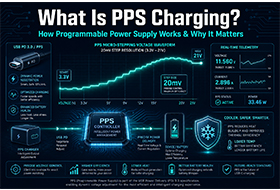
5V–20Vwith no discrete values may be describing a PPS range — clarify whether this is PPS variable voltage or just the span of fixed steps
Output Current
What it says: 3A or 5A or 3A max per port What it means: The maximum current the charger can supply at each voltage level. Combined with voltage, this determines maximum power at each PDO.
The calculation: 20V × 3A = 60W. 20V × 3.25A = 65W. 20V × 5A = 100W.
What to watch for: A charger claiming 20V / 5A = 100W output must have an E-Marked cable to safely carry 5A through a USB-C connector. If the charger ships without an E-Marked cable, maximum safe output via a standard USB-C cable is 20V × 3A = 60W. The 100W rating is only achievable with the correct cable.
Output Voltage Accuracy / Tolerance
What it says: ±5% or ±1% or (often) not stated What it means: How precisely the charger maintains its stated output voltage under varying load conditions.
Why this matters critically:
- For USB PD device charging (phones, laptops): ±5% is generally acceptable — the device's internal charging circuit manages the small variation
- For lithium battery direct charging: ±5% on a 12.6V (3S pack) termination voltage means the charger could deliver up to 13.23V — overcharging the pack with each cycle
- For CC-CV battery charger applications: specify ±1% or tighter
Red flag: A spec sheet that lists output voltage without a tolerance figure. Ask for it explicitly — if the supplier is evasive, the tolerance is likely ±5% or worse.
PDO (Power Data Object) Table
What it says:
Fixed PDO 1: 5V / 3A = 15W
Fixed PDO 2: 9V / 3A = 27W
Fixed PDO 3: 15V / 3A = 45W
Fixed PDO 4: 20V / 3.25A = 65W
PPS PDO:    3.3–21V / 0–3A = 65W max
What it means: The complete list of power profiles the charger can supply. This is the most technically complete representation of a USB PD charger's capability. A charger with only Fixed PDOs and no PPS PDO does not support PPS — regardless of what the marketing materials claim.
How to verify: Use a USB-PD protocol analyzer or tester (ChargerLAB POWER-Z or similar) to read the charger's actual PDO advertisement from the hardware. The tester displays the charger's firmware-level PDO list directly, bypassing any marketing documentation.
What to look for in the PDO table:
- All four standard voltage steps (5V, 9V, 15V, 20V) for full USB PD 3.0 coverage
- PPS PDO with a voltage range (e.g., 3.3–21V) for adaptive charging
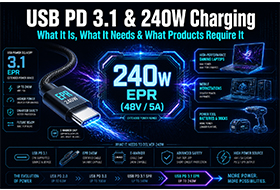
- EPR PDOs (28V, 36V, 48V) for USB PD 3.1 products
- Consistent maximum power across PDOs — a 65W charger should be able to deliver 65W at 20V/3.25A and a proportional amount at 15V, 9V
Red flag: A PDO table where the maximum power drops significantly at lower voltage levels — e.g., 65W at 20V but only 15W at 9V — suggests a power stage design limitation being obscured by the headline wattage.
Section 3: Efficiency
Conversion Efficiency
What it says: 92% or ≥90% at rated load What it means: The ratio of useful output power to total input power. A 65W charger at 92% efficiency draws 65W ÷ 0.92 = 70.7W from the wall and wastes 5.7W as heat.
The four efficiency measurement points that matter:
- 25% load (16.25W for a 65W charger): relevant for light-device charging and standby
- 50% load (32.5W): typical real-world usage for smartphone charging
- 75% load (48.75W): representative of mixed multi-port use
- 100% load (65W): full-rated continuous output
A charger rated "92% efficiency" may achieve that only at 50% load. At 100% load, efficiency may drop to 87%. At 25% load, it may be only 84%. Ask for the full efficiency curve across all four load points — not just the peak figure.
EU Ecodesign standard (Regulation 2019/1782): External power supplies sold in the EU must meet minimum active efficiency at multiple load points and maximum no-load power consumption. The current standard (Tier 2) requires approximately 87–90% efficiency at 100% load for products in the 49W–250W range. A charger below this threshold cannot receive CE marking under the Ecodesign directive.
What to watch for: "Up to 95% efficiency" is a peak claim at one operating point. For EU compliance and real-world performance comparison, request the efficiency values at 25%, 50%, 75%, and 100% load — the Ecodesign standard requires all four.
No-Load Power Consumption
What it says: <0.1W or <0.5W What it means: The power drawn from the mains when the charger is plugged in but no device is connected. This is the standby power draw.
Why it matters for buyers: For always-on workplace deployments (office desks, hotel room chargers), no-load power contributes to facility energy costs and heat generation. EU Ecodesign requires <0.5W no-load for compliant products; quality designs achieve <0.1W.
Section 4: Thermal and Environmental Specifications
Operating Temperature Range
What it says: 0°C to 40°C or -10°C to 50°C What it means: The ambient temperature range within which the charger maintains its rated output. Outside this range, the charger may throttle output (thermal derating) or fail.
What to watch for:
- Consumer chargers: 0°C to 40°C is the standard range and sufficient for most indoor environments
- Industrial / outdoor applications: Specify -20°C to 60°C minimum; confirm the charger does not derate at the temperature extremes within its rated range
- "Operating temperature" vs "Storage temperature": Storage temperature (which may be -20°C to 70°C) is not the same as operating temperature. A charger can survive storage at -20°C but may not function at rated output at -20°C
Maximum Surface Temperature
What it says: <70°C surface temperature at rated load or (often) not stated What it means: The maximum temperature of the charger's external housing during continuous full-load operation.
Why it matters:
- EU safety standard EN 62368-1 limits "Energy Source 2" (ES2) touch temperatures to 60°C for metal surfaces and 75°C for plastic surfaces in consumer applications
- A charger that runs above 60°C on its metal parts is borderline non-compliant and unpleasant to handle
- A charger running above 75°C on plastic parts under normal use may fail thermal compliance testing
Test this in sampling: Run the charger at full rated load in a 35°C ambient environment for 60 minutes. Measure the hottest point on the housing surface with an IR thermometer. Above 65°C on plastic: reject. Above 55°C on metal: flag for investigation.
Thermal Derating
What it says: Sometimes shown as a derating curve — output power vs. ambient temperature What it means: At elevated ambient temperatures, the charger reduces maximum output power to stay within thermal limits.
Why this matters for OEM buyers: A charger rated at 65W at 25°C ambient may only deliver 50W at 40°C ambient. For products deployed in warm climates or industrial environments, confirm the charger's rated output at the maximum expected ambient temperature — not just at laboratory conditions.
Section 5: Protection Features
A complete spec sheet should list every protection function with its trigger condition. Here is what each should say:
| Protection | What to Look for on Spec Sheet | Red Flag if Missing |
|---|---|---|
| Overvoltage Protection (OVP) | Trigger voltage (e.g., >22V cutoff) + auto-recovery | Any charger above 20W |
| Overcurrent Protection (OCP) | Trigger current (e.g., >3.5A cutoff) + response time | Any charger above 20W |
| Short-Circuit Protection (SCP) | Output cut + auto-recovery after fault clearance | Mandatory for all portable chargers |
| Over-Temperature Protection (OTP) | Trigger temperature (e.g., >85°C internal) + hysteresis | Mandatory for GaN designs |
| Input Surge Protection | Clamping voltage or TVS diode specification | Important for unstable grid markets |
| Reverse Polarity Protection | Stated explicitly | Lithium battery chargers only |
What "auto-recovery" means: After a protection event (e.g., short circuit), the charger automatically retries output after a defined interval (typically 1–5 seconds). Without auto-recovery, a tripped protection leaves the charger inoperable until physically power-cycled — a poor user experience.
What to request if not on the spec sheet: Ask for the protection circuit schematic or the specific IC used for protection functions. A supplier who names the IC (e.g., "Silergy SY6922 OVP controller") is giving you verifiable information. A supplier who says "we have full protection" without specifics is not.
Section 6: Certifications Listed
What it says: CE / FCC / RoHS / UL (or similar) What it means — and what it does not:
| Certification | What It Certifies | Does Not Certify |
|---|---|---|
| CE | Meets EU LVD, EMC, Ecodesign directives | Quality, durability, or country-specific requirements outside EU |
| FCC | Meets US EMC emission limits (Part 15) | Electrical safety (that's UL) |
| UL | Meets US electrical safety standard (UL 62368-1) | EU compliance |
| RoHS | Restricted hazardous substances within limits | Full chemical safety or REACH compliance |
| PSE | Meets Japan electrical safety law | Any other market |
What to verify: Request the actual certificate document — not the logo list on the spec sheet. Match the certificate number, product model, and issuing lab to the specific product you are ordering. Certificates are model-specific; a certificate for "Model XY-65" does not cover "Model XY-65A" unless explicitly stated.
→ Full certification verification guide: USB Charger Certifications Explained
Section 7: Physical Specifications
Dimensions and Weight
What it says: 58 × 30 × 30mm, 95g What it means: Straightforward — but verify against your packaging design before committing to production. A 1mm oversize can fail a packaging fit test; a charger 20g heavier than expected changes retail package weight and shipping cost.
Cable (if included)
What it says: USB-C to USB-C cable, 1m, 5A What to check:
- Is the cable E-Marked? (Required for USB PD above 60W)
- For USB PD 3.1 above 100W: is the cable EPR-rated?
- What is the conductor gauge (AWG)? Thinner conductors mean higher resistance and voltage drop under load — important for precision battery charging applications
- Is the cable strain-relief adequate? Evaluate by bending the cable at the connector junction 20–30 times — poor strain relief fails quickly in the field
The Red Flag Checklist: Spec Sheet Warning Signs
Use this when evaluating any fast charger from a new supplier:
Wattage claims:
- "Up to 100W" without specifying single-port vs. simultaneous — likely single-port only
- No simultaneous output table for multi-port products — power sharing behavior undocumented
- Wattage that does not match the PDO table (e.g., "65W" claimed but PDOs only support 9V/3A = 27W max)
Efficiency:
- Single efficiency number without specifying load point — usually peak efficiency, not real-world
- No Ecodesign tier mentioned for EU-market products — may not meet CE Ecodesign requirement
- No no-load power consumption figure — likely above 0.5W
Protocol:
- "PPS compatible" claim but no PPS PDO in the PDO table — verify with PD tester
- "USB PD 3.0" claim with only 5V/9V output profiles — USB PD 2.0 at best
- "Fast charging" claim without naming the protocol — meaningless
Protection:
- Protection features listed as a category without trigger specifications — cannot verify
- No over-temperature protection mentioned for GaN products — GaN requires OTP
- No auto-recovery specified for short-circuit protection — poor user experience in fault scenarios
Certifications:
- CE/FCC logos listed without certificate numbers — cannot verify
- Certification for a different model than the product being ordered
- Ecodesign compliance not mentioned for EU products — likely non-compliant
The Green Flag Checklist: Signs of a Transparent Manufacturer
These are the specification practices that indicate a supplier operating at production-quality standards:
- Full PDO table with all voltage/current profiles listed, including PPS PDO range if claimed
- Simultaneous output table for all multi-port combinations
- Efficiency figures at 25%, 50%, 75%, and 100% load points
- Output voltage tolerance stated explicitly (±1% or better for battery applications)
- Maximum surface temperature at rated load stated
- Protection features with trigger values (e.g., "OVP triggers at >22V, auto-recovery in 3 seconds")
- Thermal derating curve for products deployed above 25°C ambient
- Original certification documents available, with model numbers matching ordered product
- Component disclosure on request (GaN IC brand and part number, power controller IC)
Shenzhen LvXiangYuan Technology Co., Ltd. provides full specification documentation meeting every item on the green flag checklist for all OEM products:
- Complete PDO tables including PPS PDO ranges, available before sampling
- Simultaneous output tables for all multi-port products
- Efficiency curves at 25/50/75/100% load, measured per Ecodesign methodology
- Output voltage tolerance ±1% across full load range, verified in 100% production test
- Surface temperature data at rated load in 40°C ambient
- Original CE, FCC, and RoHS certificates with matching model numbers
- GaN IC and power controller IC disclosed on request for qualified OEM buyers
We publish this level of specification because buyers who evaluate us against this standard choose us. If you are comparing suppliers, apply this checklist to every candidate — including us.
👉 View Our Product Specifications
👉 Read Our OEM Buyer's Checklist — 35 Questions to Ask Any Supplier
👉 Request Full Specification Documentation and Samples
Frequently Asked Questions
Q: A charger says "65W" but I measured only 58W at the output. Is this a defect? Not necessarily — it depends on measurement conditions and tolerance. USB PD charger wattage ratings typically refer to the maximum continuous output under standard conditions (25°C ambient, nominal input voltage). At elevated temperature or extreme input voltage, output may derate slightly. More importantly, measure efficiency: if the charger is delivering 58W output from 65W input, that is 89% efficiency — potentially within spec. If it delivers 58W from 63W input (92% efficiency) but only outputs 58W instead of 65W, investigate whether the current limit is set lower than rated or whether the PDO is advertising a profile the charger cannot sustain.
Q: The spec sheet says "PD 3.0 compatible" but doesn't show a PDO table. How do I know what profiles it actually supports? Request the PDO table explicitly — every USB PD charger has one programmed in firmware. If the supplier cannot or will not provide it, use a USB-PD protocol analyzer (ChargerLAB POWER-Z or similar) to read the PDO advertisement directly from the hardware within 30 seconds of connecting. This bypasses any documentation entirely and shows exactly what the charger broadcasts.
Q: Is "92% efficiency" always better than "88% efficiency" for my application? At rated load, yes — less heat, lower energy cost. But verify the load point at which efficiency is measured. A charger achieving 92% at 50% load and 85% at 100% load is worse than a charger achieving 90% at 100% load for applications where continuous full-load operation is expected. Ask for efficiency at your actual operating load point, not the manufacturer's chosen measurement condition.
Q: Why do some chargers list "5V/3A, 9V/2A" — why does the current drop at higher voltage? This reflects the charger's constant power architecture. The power stage has a fixed maximum power budget. At 9V with 2A (18W) and at 5V with 3A (15W), the charger is operating near its designed power ceiling at each voltage. A charger listing "9V/3A" and "5V/3A" has either a higher power budget or a less constrained design at lower voltages. Neither is inherently better — evaluate total power (V × A) at your required operating voltage.
Q: The spec sheet lists operating temperature as 0°C to 40°C. Our installation environment reaches 45°C. Is this a problem? Yes — operating outside the rated temperature range means the charger's performance is not guaranteed. Ask the supplier for the thermal derating curve: what percentage of rated output does the charger deliver at 45°C ambient? A well-designed charger may deliver 85–90% of rated output at 45°C with thermal derating — which may be acceptable for your application. A poorly designed one may shut down entirely. Demand the derating curve before deploying in elevated-temperature environments.
Q: How do I know if a charger's protection circuit actually works, not just listed on paper? Test it during sample evaluation. For short-circuit protection: briefly connect a short across the output (using a resistor near 0Ω — do not short bare wires) and verify the charger cuts off within milliseconds, then recovers automatically within a few seconds. For OVP: use an adjustable load to draw maximum current while monitoring output voltage — it should remain stable within ±1% of rated. For OTP: run at full load in a warm enclosure (35–40°C ambient) for 2+ hours and verify output remains stable without shutdown. A supplier who discourages protection circuit testing during sampling is worth questioning.
LvXiangYuan Technology — Professional Power Adapter Solutions Since 2009 | www.hechobo.com
USB PD 3.1 and 240W Charging: What It Is, What It Needs, and What Products Actually Require It