USB PD vs Quick Charge: What's the Difference and Which Should You Use?
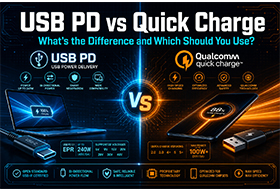
USB PD vs Quick Charge: What's the Difference and Which Should You Use?
Two chargers, both rated 65W, both labeled "fast charging." One uses USB Power Delivery. The other uses Qualcomm Quick Charge. For many devices, both work. For some, only one delivers full speed. For OEM product designers, the choice between them has implications beyond charging speed — it affects certification cost, device compatibility, licensing requirements, and long-term market positioning.
This article explains the technical and commercial differences between USB PD and Quick Charge, and gives a clear recommendation for which to specify in 2026.
What They Actually Are
Before comparing, establish what each technology is at its foundation:
USB Power Delivery (USB PD) is an open charging protocol standard maintained by the USB Implementers Forum (USB-IF) — the same body that governs the USB specification. It is royalty-free, publicly documented, and designed for universal compatibility across all device manufacturers.
Qualcomm Quick Charge (QC) is a proprietary fast charging protocol developed by Qualcomm and implemented exclusively in devices using Qualcomm Snapdragon processors or in chargers licensed by Qualcomm. It requires a license to implement in a charger, and full fast charging benefits are restricted to Qualcomm-ecosystem devices.
This distinction — open universal standard versus proprietary licensed protocol — is the foundational difference that drives every other comparison.
How Each Protocol Negotiates Power
Both USB PD and Quick Charge achieve fast charging by raising the voltage above the standard 5V USB baseline. Higher voltage at a given current = higher power (W = V × A). The protocols differ in how that voltage negotiation works.
USB PD: Structured Negotiation via PDOs
USB PD uses a formal negotiation process over the USB-C CC (Configuration Channel) pin. The charger broadcasts a set of Power Data Objects (PDOs) — a list of voltage/current combinations it can supply. The device selects the PDO that matches its requirements and the charger switches to that output.
Standard USB PD 3.0 PDO profiles:
- 5V / 3A (15W) — default
- 9V / 3A (27W)
- 15V / 3A (45W)
- 20V / 3.25A (65W)
- 20V / 5A (100W)
Additional PPS (Programmable Power Supply) range: continuously variable voltage from approximately 3.3V to 21V in 20mV steps, at continuously variable current — enabling precise adaptive charging.
Quick Charge: D+ / D- Line Signaling
Quick Charge (up to QC 3.0) uses the USB data lines (D+ and D−) to signal voltage requests — a fundamentally different approach that works with USB-A connectors and does not require the USB-C CC pin. The device signals a voltage request (5V, 9V, or 12V for QC 2.0; 3.6–20V in 200mV steps for QC 3.0), and the charger responds.
The architectural implication: QC 2.0/3.0 can operate over USB-A connectors, which is why older QC chargers commonly have USB-A ports. USB PD requires USB-C — the CC pin is physically absent in USB-A.
QC 4.0 and the Convergence
Qualcomm QC 4.0 (released 2017) was designed to be USB PD 3.0 compliant. A QC 4.0 device will negotiate power via USB PD protocol when connected to a USB PD charger, without requiring explicit QC support in the charger.
This convergence partially resolves the compatibility divide — for QC 4.0+ devices, a USB PD 3.0 charger provides fast charging at the device's full supported rate. However, QC 2.0 and 3.0 devices (still widely deployed) require explicit QC support for proprietary fast charge speeds.
Speed: How Fast Does Each Actually Charge?
Raw numbers for representative devices:
| Device | Protocol Used | Max Charge Rate | Charger Required |
|---|---|---|---|
| iPhone 16 Pro | USB PD | ~27W | USB PD 3.0, 30W+ |
| Samsung Galaxy S25 Ultra | USB PD + PPS | 45W | USB PD 3.0 + PPS, 45W+ |
| Google Pixel 9 Pro | USB PD | 30W | USB PD 3.0, 30W+ |
| OnePlus 12 (QC 5.0) | USB PD + proprietary | 80W+ | Proprietary SUPERVOOC charger |
| Xiaomi 14 | USB PD + PPS | 67W | USB PD 3.0 + PPS, 67W+ |
| MacBook Pro 14 | USB PD 3.0 | 96W | USB PD 3.0, 100W+ |
| Snapdragon device (QC 3.0) | Quick Charge 3.0 | 18W | QC 3.0 charger |
| Snapdragon device (QC 4.0+) | USB PD or QC 4.0 | 27–45W | USB PD 3.0 or QC 4.0 charger |
Key observation: Apple, Google, and all laptop manufacturers have standardized on USB PD. Samsung's top fast charging speed (45W Super Fast Charging 2.0) uses USB PD + PPS. Xiaomi's flagship uses USB PD + PPS at 67W. The only devices that genuinely require QC-specific support for full fast charging are older Snapdragon devices (QC 2.0/3.0) and some current budget-tier Android phones.
Device Ecosystem Coverage
This is where the practical difference becomes most visible for buyers sourcing for multi-device environments:
| Device Segment | USB PD Coverage | QC Coverage |
|---|---|---|
| All iPhones (12 and later) | ✅ Full fast charge | ❌ 5W only |
| Samsung Galaxy (S21+) | ✅ Full fast charge (PPS) | ✅ Fast (QC 2.0 compatible) |
| All MacBooks | ✅ Full speed | ❌ Basic 5W |
| Google Pixel (all) | ✅ Full fast charge | ❌ Basic |
| OnePlus / Oppo (proprietary) | ✅ Partial (USB PD fallback) | ✅ Partial |
| Qualcomm QC 3.0 devices | ✅ 18W (PD fallback) | ✅ Full fast (18W) |
| Qualcomm QC 4.0 devices | ✅ Full fast | ✅ Full fast |
| Nintendo Switch | ✅ 18W | ❌ Basic |
| Laptops (all brands) | ✅ Full speed | ❌ Basic / incompatible |
| USB-A legacy devices | ❌ Requires adapter | ✅ If QC-compatible |
The asymmetry is stark: USB PD covers Apple, Google, Microsoft Surface, all laptops, and Samsung at full speed. Quick Charge covers legacy Qualcomm Android devices at full speed, but delivers only basic 5W to Apple, Google, and laptops.
A charger with USB PD 3.0 + PPS as its primary protocol, plus QC 3.0 backward compatibility, covers the full device landscape — this is the specification that makes sense for universal chargers in 2026.
The Licensing and Cost Dimension
For OEM charger manufacturers and buyers, the licensing implications of Quick Charge matter:
USB PD: Royalty-free. Any manufacturer can implement USB PD protocol without paying Qualcomm or the USB-IF. Implementation requires a USB PD controller IC (readily available from multiple suppliers including Texas Instruments, CYPD, Richtek, and others). There is no per-unit licensing fee.
Quick Charge: Qualcomm charges a licensing fee to charger manufacturers who want to display the "Quick Charge" trademark and guarantee QC compliance. The fee structure is not publicly disclosed, but it adds a non-trivial cost at low volumes. At high volumes, per-unit cost becomes negligible — but it is a barrier for smaller OEM runs.
Practical implication for OEM buyers: If you are sourcing a charger for a product bundled with a non-Qualcomm device (iPhone, Google Pixel, any laptop), QC licensing adds cost with zero user benefit. Specify USB PD 3.0 + PPS and omit the QC trademark requirement. If your device runs Qualcomm Snapdragon with QC 3.0, QC support is worth the license cost for that device specifically.
Connector Compatibility
| Protocol | USB-A Compatible | USB-C Required | Notes |
|---|---|---|---|
| USB PD 2.0 / 3.0 / 3.1 | ❌ No | ✅ Yes | CC pin required; USB-A lacks it |
| Quick Charge 2.0 / 3.0 | ✅ Yes | Optional | D+ / D− signaling; works on USB-A |
| Quick Charge 4.0 / 4+ | ❌ Effectively | ✅ Yes | PD-aligned; USB-A technically possible but not practical |
This connector difference is the reason older QC chargers had USB-A ports — the QC protocol does not need USB-C. As the market transitions to USB-C and USB PD, this distinction is less relevant for new designs, but explains why USB-A QC chargers still exist in the installed base.
EU Common Charger Directive: The Regulatory Verdict
The EU's Common Charger Directive (Radio Equipment Directive 2022/2380/EU) mandates USB-C ports and USB PD compliance for covered consumer electronics sold in the EU from December 2024 (smartphones, tablets) and April 2026 (laptops).
The directive does not mandate Quick Charge support. It does not prohibit it either — a charger can support both USB PD (mandatory) and QC (optional addition). But for any product targeting the EU market in a mandated device category, USB PD compliance is not optional; Quick Charge is an add-on that may or may not be worth the licensing cost.
This regulatory mandate effectively makes USB PD the global baseline for new product designs, with Quick Charge becoming a supplementary protocol for specific device segments rather than an alternative.
Head-to-Head: Summary Comparison
| Dimension | USB PD 3.0 | Quick Charge 3.0 | Quick Charge 4.0+ |
|---|---|---|---|
| Standard type | Open (USB-IF) | Proprietary (Qualcomm) | Proprietary (aligned with PD) |
| Royalty fee | None | Yes (trademark license) | Yes |
| Max power | 100W (PD 3.0) / 240W (PD 3.1) | 18W | 27–100W |
| Connector | USB-C only | USB-A or USB-C | USB-C preferred |
| Apple devices | ✅ Full fast charge | ❌ 5W | ❌ 5W |
| Samsung Galaxy | ✅ Full (PPS) | ✅ Partial | ✅ Full |
| Google Pixel | ✅ Full | ❌ Basic | ❌ Basic |
| Laptops | ✅ Full | ❌ Incompatible | ❌ Incompatible |
| QC 2.0/3.0 legacy devices | ✅ 18W fallback | ✅ Full | ✅ Full |
| EU regulatory compliance | ✅ Compliant | ❌ Insufficient alone | ❌ Insufficient alone |
| PPS support | ✅ (PD 3.0+) | ❌ (QC 3.0) | ✅ (QC 4.0+) |
| OEM design complexity | Low | Medium (license process) | Medium |
The Recommendation: Which to Specify in 2026
For new product designs targeting broad market compatibility: → USB PD 3.0 with PPS as the primary protocol. No licensing fees, full coverage of Apple/Google/Samsung/laptops, EU compliant, forward-compatible with USB PD 3.1 EPR devices.
For chargers serving a mixed device environment including legacy QC 2.0/3.0 devices: → USB PD 3.0 + PPS as primary, QC 3.0 as backward-compatible secondary. Most current chargers in the mid-to-premium tier implement this combination. The QC 3.0 backward compatibility layer covers older Snapdragon devices without compromising USB PD performance for newer devices.
For chargers bundled specifically with Qualcomm QC 3.0 devices: → QC 3.0 as primary, USB PD as secondary. Only valid if your target device is specifically QC 3.0 (not 4.0+) and you have confirmed the device does not support USB PD. Increasingly rare for any device released after 2020.
For chargers bundled with Apple devices (iPhone / iPad / MacBook): → USB PD 3.0, 20–100W depending on device, no QC required. Apple does not support Quick Charge at any speed. Including QC in the specification adds cost with zero benefit for Apple-exclusive device bundles.
Shenzhen LvXiangYuan Technology Co., Ltd. manufactures PD wall chargers and GaN chargers with USB PD 3.0 + PPS as standard on all current models, with QC 3.0 backward compatibility available across the product range for mixed-device applications.
We provide full PDO specification tables and protocol compatibility documentation for all products, allowing OEM buyers to verify protocol support before sampling.
👉 View Our USB PD Charger Range
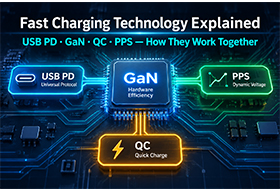
👉 Back to: Fast Charging Technology Explained
👉 Contact Us to Specify Your Protocol Requirements
Frequently Asked Questions
Q: Can a USB PD charger fast-charge a Quick Charge device? It depends on the QC version. QC 4.0+ devices are USB PD 3.0 compliant — a USB PD charger will deliver full fast charging speed. QC 2.0 and 3.0 devices will receive USB PD's standard 5V/3A (15W) output from a USB PD charger without QC support, since the QC handshake signal is not present. To deliver full QC 2.0/3.0 speed to these devices, the charger must explicitly support QC.
Q: Can a Quick Charge charger fast-charge an iPhone? No. iPhones use USB Power Delivery exclusively. A Quick Charge charger without USB PD support delivers only 5W (standard USB) to an iPhone, regardless of the QC wattage rating on the charger. For Apple devices, only USB PD delivers fast charging.
Q: Is it possible to have both USB PD and Quick Charge in the same charger? Yes — and most premium multi-protocol chargers do exactly this. A USB-C port implements USB PD 3.0 + PPS as the primary protocol; a QC compatibility layer handles devices that signal QC handshake. Some chargers also include a USB-A port with QC 3.0 for legacy devices. This configuration covers the full device landscape.
Q: Does USB PD replace Quick Charge? For new devices: largely yes. Apple never adopted QC. Google uses USB PD exclusively. Samsung's top fast charging (Super Fast Charging 2.0) is PPS-based USB PD. Qualcomm's own QC 4.0+ is PD-compliant. The market is converging on USB PD as the universal baseline, with QC persisting as a supplement for the legacy installed base.
Q: Which protocol should I specify for a corporate fleet charging solution? USB PD 3.0 + PPS, with QC 3.0 backward compatibility. Corporate fleets typically include iPhones, Android devices of various brands, and laptops — all of which benefit from USB PD. The QC compatibility layer ensures older Snapdragon devices in the fleet also receive fast charging. A single multi-port charger with this specification handles the full fleet without device-specific chargers.
Q: Will Quick Charge become obsolete? QC 2.0 and 3.0 are increasingly legacy protocols as the device market shifts to USB PD. QC 4.0+ is effectively a USB PD extension and will remain relevant as long as Qualcomm devices hold market share. For OEM charger design, designing around USB PD 3.0 as the primary standard future-proofs the product; treating QC 3.0 as a backward-compatibility feature rather than a primary specification is the right posture for any new design.
LvXiangYuan Technology — Professional Power Adapter Solutions Since 2009 | www.hechobo.com
Fast Charging Technology Explained: USB PD, GaN, QC, and PPS — What They Are and How They Work Together