USB PD 3.1 and 240W Charging: What It Is, What It Needs, and What Products Actually Require It
USB PD 3.1 and 240W Charging: What It Is, What It Needs, and What Products Actually Require It
For most of USB Power Delivery's history, 100W was the ceiling. At 20V / 5A, USB PD 3.0 could charge ultrabook laptops, tablets, and most smartphones at full speed — but gaming laptops, mobile workstations, and high-performance devices that previously required 130W–200W proprietary power bricks remained outside its scope.
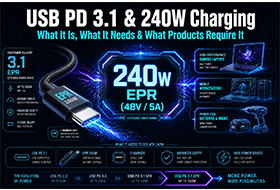
USB PD 3.1, published by the USB Implementers Forum in May 2021, changed this. By introducing the Extended Power Range (EPR), it raised the charging ceiling to 240W — enough to replace virtually every consumer and prosumer laptop power adapter with a single USB-C standard.
But 240W USB-C charging is not simply "USB PD 3.0 with a bigger number." It introduces new voltage tiers, new cable requirements, new safety considerations, and new certification implications. This guide explains all of them.
What USB PD 3.1 Actually Changes
USB PD 3.0 supports power delivery at five fixed voltage profiles plus the PPS variable range — all within a 20V / 5A ceiling (100W maximum).
USB PD 3.1 retains full backward compatibility with USB PD 3.0 and adds an Extended Power Range (EPR) tier with three new fixed voltage profiles:
| Profile | Voltage | Max Current | Max Power | Classification |
|---|---|---|---|---|
| SPR (Standard Power Range) | 5V / 9V / 15V / 20V | Up to 5A | 100W | USB PD 3.0 compatible |
| EPR Fixed 1 | 28V | 5A | 140W | USB PD 3.1 EPR new |
| EPR Fixed 2 | 36V | 5A | 180W | USB PD 3.1 EPR new |
| EPR Fixed 3 | 48V | 5A | 240W | USB PD 3.1 EPR new |
| EPR Adjustable (AVS) | 15–48V | Variable | Up to 240W | USB PD 3.1 EPR new |
The EPR Adjustable Voltage Supply (AVS) is the PD 3.1 equivalent of PPS — a continuously variable voltage range within the EPR tier, enabling adaptive charging above 100W.
Backward compatibility: A USB PD 3.1 charger operates in SPR mode (standard USB PD 3.0) when connected to a USB PD 3.0 device. EPR mode activates only when both the charger and device explicitly negotiate EPR capability. A laptop that only supports USB PD 3.0 connected to a 240W EPR charger will receive USB PD 3.0 power at its rated maximum — the higher voltage capability is simply not used.
The EPR Negotiation: How 240W Is Safely Established
EPR introduces a new negotiation phase called EPR Mode Entry that must succeed before any EPR voltage is applied. This additional handshake exists specifically because higher voltages (28V–48V) carry greater shock and arc risk if applied to an incompatible device or cable.
The EPR entry sequence:
- Charger and device complete standard USB PD negotiation (SPR mode, up to 100W)
- Charger advertises EPR capability in its source capabilities message
- Device sends an EPR Mode Enter request if it supports EPR
- Charger confirms EPR Mode Entry
- Charger advertises EPR PDOs (28V, 36V, 48V profiles)
- Device selects the appropriate EPR profile and charging proceeds
If either side does not support EPR — or if the cable is not EPR-rated — EPR Mode Entry fails and charging continues in SPR mode at up to 100W. No damage, no error — just no EPR benefit.
This staged entry protocol means a non-EPR device connected to an EPR charger always receives safe SPR-mode power. The EPR voltages are never applied without explicit mutual confirmation.
The Cable Requirement: The Most Common Oversight
This is where USB PD 3.1 deployments most frequently fail.
USB PD 3.0 allows up to 100W over a USB-C cable rated for 5A (an E-Marked cable with an embedded ID chip). Standard 3A-rated USB-C cables support USB PD up to 60W (20V / 3A).
USB PD 3.1 EPR requires a different cable entirely.
EPR cables must:
- Be rated for 5A current (mandatory for all EPR power levels)
- Withstand voltages up to 48V (standard USB-C cables are rated to 20V)
- Carry an EPR-capable E-Mark chip that specifically identifies the cable as EPR-rated
- The charger reads the E-Mark chip before enabling EPR mode — if the chip is absent or identifies the cable as SPR-only, EPR mode is blocked
Practical implications:
- An existing 100W USB-C cable (even an E-Marked 5A cable) will not enable EPR if its E-Mark chip is not EPR-rated
- A cable that looks identical to an EPR cable but lacks the correct E-Mark will silently limit charging to 100W
- For product bundles including a 140W+ charger, the bundled cable must be EPR-rated — otherwise the charger cannot deliver its rated power
When sourcing EPR chargers for OEM use, always request the bundled cable's E-Mark chip specification and confirm EPR rating explicitly. Do not assume a 5A cable is EPR-capable without verification.
What Devices Actually Need USB PD 3.1
Not every device benefits from EPR. The question is whether the device's power requirement genuinely exceeds 100W.
Devices that benefit from USB PD 3.1 EPR:
| Device Category | Typical Power Requirement | USB PD 3.0 Sufficient? | EPR Benefit |
|---|---|---|---|
| Ultrabook / thin laptop | 45–65W | ✅ Yes | No EPR needed |
| Standard laptop (15 inch) | 65–90W | ✅ Yes | No EPR needed |
| Premium laptop (MBP 14/16, Dell XPS 15) | 90–100W | ✅ Borderline | Marginal |
| Gaming laptop (mid-range) | 100–140W | ❌ Insufficient | ✅ 140W EPR |
| Gaming laptop (high-perf RTX 4080/4090) | 140–200W | ❌ No | ✅ 180–240W EPR |
| Mobile workstation | 120–180W | ❌ No | ✅ EPR required |
| Portable monitors (high-res) | 45–90W | ✅ Yes | No EPR needed |
| E-bike / scooter charger via USB-C | 100–200W | ❌ No | ✅ EPR viable |
The honest assessment: For the majority of devices in the consumer market — iPhones, Android phones, tablets, and laptops under 90W — USB PD 3.0 at 100W is fully sufficient. USB PD 3.1 EPR is a genuine requirement only for high-performance gaming laptops, mobile workstations, and future high-power devices.
For OEM buyers, this means: do not over-specify EPR. A 65W USB PD 3.0 charger bundled with an ultrabook delivers the right product. A 240W EPR charger bundled with a smartphone adds cost and size with no user benefit.
USB PD 3.0 vs USB PD 3.1: Specification Comparison
| Dimension | USB PD 3.0 | USB PD 3.1 |
|---|---|---|
| Maximum power | 100W (20V / 5A) | 240W (48V / 5A) |
| Fixed voltage profiles | 5V, 9V, 15V, 20V | + 28V, 36V, 48V (EPR) |
| Variable voltage (PPS/AVS) | PPS: 3.3–21V (20mV steps) | + AVS: 15–48V (EPR range) |
| Cable requirement (full speed) | E-Marked 5A cable | EPR E-Marked 5A cable (48V-rated) |
| Backward compatibility | — | Full PD 3.0 compatibility |
| EPR negotiation required | N/A | Yes — explicit EPR Mode Entry |
| Primary applications | Phones, tablets, ultrabooks, laptops | Gaming laptops, workstations, high-power devices |
| Charger physical size | Compact GaN designs available | Larger; thermal management more complex |
| Certification complexity | Standard | Higher — 48V safety standards apply |
Thermal and Safety Considerations at 240W
Operating at 48V introduces safety engineering requirements that do not apply at USB PD 3.0's 20V maximum.
Arc flash risk: At 48V, electrical arcs can sustain themselves more readily than at 20V or lower. The EPR cable and connector design must minimize arc risk at hot-plug events. This is addressed in the USB PD 3.1 specification through the EPR Mode Entry protocol (devices negotiate before any EPR voltage is applied) and through connector contact sequencing requirements.
Thermal design: A charger delivering 240W at 92% efficiency generates approximately 21W of waste heat — the equivalent of a small light bulb inside the charger housing continuously. Effective thermal management (heatsinking, airflow design, or GaN III platform efficiency) is essential for sustained 240W operation.
GaN platform requirement: Silicon-based power stages are not practical at 240W for consumer form factors. All commercially viable 140W+ USB-C chargers use GaN transistors. At 240W, GaN III (third-generation GaN) is the practical minimum to achieve thermal stability without fan cooling.
Certification: Chargers operating above 100W (EPR tier) require safety certification testing against standards that address higher-voltage operation. For CE marking, this means testing under EN 62368-1 at the full 48V operating condition. Expect longer test cycles and higher certification cost for EPR products compared to SPR equivalents.
OEM Sourcing Considerations for USB PD 3.1
If you are sourcing an EPR charger for OEM integration, these factors apply beyond standard USB PD charger evaluation:
1. Confirm genuine EPR capability via PDO readout An EPR charger must advertise EPR PDOs (28V, 36V, or 48V profiles) in its source capabilities message. Verify this with a USB-PD protocol analyzer before committing to production — a charger that only advertises SPR PDOs is USB PD 3.0, regardless of marketing claims.
2. Specify and test the EPR cable separately The charger's rated power is only achievable with an EPR-rated cable. If your product bundle includes the cable, specify the E-Mark chip's EPR rating explicitly. If the end user supplies their own cable, include a clear product communication that a standard USB-C cable limits charging to 100W.
3. Thermal validation at full EPR load At 140W–240W, thermal performance is more critical than at lower wattages. Request thermal test data at full rated EPR load in 40°C ambient, sustained for 2+ hours. A charger that throttles at full EPR load in a warm environment is not production-ready.
4. Certification scope for EPR tier Confirm that the certification (CE, FCC, UL) was tested at the full EPR operating condition — not just at the SPR (100W) level. A certificate that only covers up to 100W operation does not authorize EPR use in your market.
5. Market demand reality check USB PD 3.1 EPR chargers cost 40–80% more than equivalent USB PD 3.0 products at the same total wattage. Before specifying EPR, confirm your target device genuinely draws above 100W. An EPR charger for a device that peaks at 90W adds cost and size with no performance benefit for the end user.
The 140W Sweet Spot
In practice, the most commercially relevant USB PD 3.1 wattage tier for current products is 140W (28V / 5A) — not the maximum 240W.
Why 140W is the current sweet spot:
- Gaming laptops in the 90W–130W consumption range are the fastest-growing EPR use case
- 140W chargers are meaningfully more compact than 140W silicon equivalents, creating a genuine product differentiation opportunity
- 28V / 5A is safer and thermally simpler to design than 48V / 5A
- The E-Mark cable requirement for 140W is less demanding than for 240W
- Most current gaming laptop USB-C charging ports top out at 140W or less
240W (48V) is currently relevant primarily for the highest-performance gaming laptops (RTX 4090-class), mobile workstations, and emerging industrial applications. For most OEM buyers evaluating EPR for the first time, 140W is the appropriate starting point.
Shenzhen LvXiangYuan Technology Co., Ltd. manufactures USB PD 3.1 EPR chargers at 140W and above, using GaN III power stages for thermal stability at sustained full EPR load. Our EPR products advertise genuine EPR PDOs (28V / 36V / 48V) verifiable via PD protocol analyzer, with CE certification covering full EPR operating conditions.
We work with OEM buyers to determine whether EPR is the correct specification for their device and can provide comparative samples (USB PD 3.0 100W vs USB PD 3.1 140W) for real-device validation before production commitment.
👉 View Our High-Wattage GaN Charger Range
👉 Back to: Fast Charging Technology Explained
👉 Contact Us for EPR Charger Specification Consultation
Frequently Asked Questions
Q: Do I need a special cable for USB PD 3.1 240W charging?
A: Yes — a standard USB-C cable, even a high-quality E-Marked 5A cable rated for USB PD 3.0, will not enable EPR mode. USB PD 3.1 EPR requires a cable with an EPR-rated E-Mark chip that identifies the cable as capable of carrying up to 48V. The charger reads this chip during EPR Mode Entry negotiation — if the cable is not EPR-rated, EPR is blocked and charging proceeds at USB PD 3.0 maximum (100W). Always verify the cable's E-Mark specification, not just its current rating.
Q: Will a 240W USB PD 3.1 charger work with my USB PD 3.0 laptop?
A: Yes, fully and safely. USB PD 3.1 is backward compatible with USB PD 3.0. A 240W EPR charger connected to a USB PD 3.0 laptop negotiates standard SPR mode and delivers up to the laptop's rated USB PD power (e.g., 65W or 100W). EPR voltage (28V–48V) is never applied without explicit EPR Mode Entry confirmation from the device.
Q: What is the difference between EPR and AVS in USB PD 3.1?
A: EPR (Extended Power Range) refers to the overall USB PD 3.1 feature set that enables power above 100W, including fixed voltage profiles at 28V, 36V, and 48V. AVS (Adjustable Voltage Supply) is the EPR-tier equivalent of PPS — a continuously variable voltage range within the EPR band (15V–48V) that enables adaptive charging above 100W. AVS is to EPR what PPS is to SPR: the fine-grained, battery-friendly voltage control mode within the higher power tier.
Q: My gaming laptop's spec says "up to 140W USB-C charging." Do I need a 140W or 240W charger?
A: A 140W USB PD 3.1 charger (28V / 5A, EPR) is the correct specification. The 240W ceiling is the protocol maximum, not a product requirement. Matching the charger to your device's rated maximum (140W in this case) with a 15–20% safety margin means a 140W charger is appropriate — a 180W or 240W charger will also work but adds cost and size unnecessarily for this device.
Q: Is USB PD 3.1 the same as Thunderbolt 4?
A: No. Thunderbolt 4 is Intel's data transfer and display protocol that happens to use the USB-C connector. Thunderbolt 4 supports USB PD charging (up to 100W on the host side), but it is not the same as USB PD 3.1. A Thunderbolt 4 port does not automatically support EPR — check the device's specific USB PD version support separately from its Thunderbolt capability.
Q: Are USB PD 3.1 chargers safe to use?
A: Yes, when properly certified. The EPR Mode Entry protocol prevents high voltages from being applied to incompatible devices or cables. CE, FCC, and UL certification at the full EPR operating condition (tested at 48V) ensures the charger meets all applicable electrical safety standards. As with any high-power product, verify that the charger's certification covers the full EPR power level — not just the SPR (100W) tier.
LvXiangYuan Technology — Professional Power Adapter Solutions Since 2009 | www.hechobo.com
Shenzhen LvXiangYuan Technology Co., Ltd.
Contact: Anita
Email: wm1@hechobo.com
Mobile: 0086-14775542090
Anker vs Chinese OEM Factory for Private Label Chargers