What Is PPS Charging? How Programmable Power Supply Works and Why It Matters
What Is PPS Charging? How Programmable Power Supply Works and Why It Matters
PPS — Programmable Power Supply — appears on the spec sheets of most premium USB chargers sold today. It is listed alongside USB PD 3.0, usually without explanation. Most buyers either assume it means "better fast charging" in some vague sense, or ignore it entirely.
Neither response is correct. PPS is a specific technical feature with a specific engineering purpose, and understanding it changes how you evaluate charger quality and specify chargers for products and devices.
This guide explains what PPS is, why it exists, how it works at the electrical level, which devices benefit from it, and how to verify it in a charger specification.
The Problem PPS Was Designed to Solve
To understand PPS, start with the problem it addresses.
Standard USB Power Delivery (USB PD) delivers power at fixed voltage steps: 5V, 9V, 15V, and 20V. These are the only options the charger and device can negotiate. When a device wants to charge at, say, 25W, it requests the nearest available profile — typically 9V/2.77A (24.9W) or 5V/3A (15W).
Here is where physics creates a problem.
A lithium battery's voltage is not fixed — it rises continuously as charge accumulates, from roughly 3.0V (empty) to 4.2V (full) per cell. A 3-cell battery pack starts at about 9V and ends at about 12.6V.
When the charger delivers a fixed 9V to a battery pack currently sitting at 8.4V internal voltage, the battery management system (BMS) must bridge the gap. It does this through a process that inherently generates heat inside the battery — not in the charger, but in the battery's own charging circuit. The larger the gap between charger output voltage and battery voltage, the more heat is generated internally.
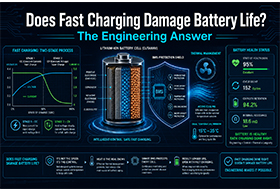
This internal heat is not visible from outside the device. It accumulates in the battery electrolyte and electrode materials, degrading them with each charge cycle. Fast charging at fixed high voltage, repeated hundreds of times, measurably shortens battery lifespan.
How PPS Solves It
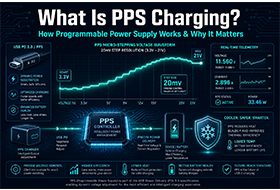
PPS (Programmable Power Supply) is a feature added to the USB PD 3.0 specification that enables continuously adjustable voltage output — not fixed steps, but a smooth voltage range that the charger can set to any value in fine increments.
PPS operating parameters (USB PD 3.0 specification):
- Voltage range: typically 3.3V to 21V (exact range defined per PPS PDO in the charger's firmware)
- Voltage adjustment granularity: 20mV steps
- Current adjustment granularity: 50mA steps
- Re-negotiation interval: the device can request a new voltage/current every 10 seconds during charging
With PPS, the charger no longer delivers a fixed 9V to a battery at 8.4V. Instead, the device's charging controller communicates the exact voltage the battery needs at this moment in the charging cycle — say 8.42V — and the charger adjusts its output accordingly. As the battery charges and its voltage rises to 8.8V, 9.2V, 10.0V, the charger tracks it precisely.
The result: The voltage gap between charger output and battery is minimized throughout the entire charge cycle. Internal heat generation in the battery is substantially reduced. Charging is faster (less energy wasted) and the battery experiences less cumulative thermal stress per charge cycle.
PPS vs Standard USB PD: The Electrical Difference Visualized
Battery voltage rise during a charge cycle:
The difference in heat generation is not marginal. Samsung's engineering data (published with their Adaptive Fast Charging specifications) shows that PPS-based charging reduces battery temperature rise by 3–8°C compared to fixed-voltage fast charging at equivalent wattage. Over a battery's 500–800 charge cycle lifespan, this temperature reduction translates to measurably better capacity retention at end of life.
Which Devices Support PPS
PPS requires both the charger (PPS-capable USB PD 3.0) and the device's charging controller to support the feature. On the device side, PPS compatibility is tied to the charging IC used by the manufacturer.
Devices with confirmed PPS support (partial list):
| Brand | Device Series | PPS Fast Charge Rate |
|---|---|---|
| Samsung | Galaxy S21 and later, Galaxy Z series | 25W (SFC) / 45W (SFC 2.0) |
| Xiaomi | Mi 10 and later, Redmi Note series | 33W–67W (depending on model) |
| OPPO / OnePlus | Select models with VOOC/SUPERVOOC via PPS | 30W–65W |
| Motorola | Edge series, Moto G Power series | 30W TurboPower PPS |
| Pixel 6 and later | 30W | |
| Lenovo / ThinkPad | Select USB-C charging laptops | Variable |
Devices that do not use PPS:
- All iPhones (use USB PD fixed-step; Apple's charging architecture does not implement PPS)
- All MacBooks (USB PD fixed profile; no PPS)
- Most Nintendo Switch models
- Most budget Android phones (QC 3.0 or lower, no PPS controller)
What happens when a PPS charger connects to a non-PPS device? The charger falls back to standard USB PD fixed-step negotiation. No damage, no incompatibility — just no PPS benefit. The charger works normally at whatever USB PD profile the device requests.
Does PPS Make Charging Faster?
This is the most common misconception about PPS. The answer requires nuance.
PPS does not increase the maximum charging wattage. A 45W PPS charger connected to a Samsung Galaxy S25 Ultra charges at 45W — the same wattage a 45W fixed-step USB PD charger would nominally attempt.
PPS increases effective charging efficiency. Because PPS minimizes internal heat generation in the battery, more of the power delivered actually goes into charging the battery rather than being lost as heat. The same 45W from a PPS charger charges slightly faster than 45W from a non-PPS charger because less energy is wasted thermally.
The more significant benefit is sustained charging speed. Without PPS, devices often throttle charging speed partway through the cycle (typically above 80% state of charge) to manage heat. With PPS, thermal management is better throughout — some devices maintain higher charging speeds deeper into the charge cycle before throttling.
Observed real-world difference: In controlled testing with PPS-compatible smartphones, the difference between PPS and non-PPS fast charging at equivalent rated wattage is typically 5–15% faster full-cycle charge time, with 3–8°C lower peak battery temperature. Neither difference is dramatic in a single session, but the cumulative battery health impact over hundreds of cycles is meaningful.
How to Verify PPS Support in a Charger Specification
PPS support must be explicitly stated in the charger's PDO (Power Data Object) specification. There are two types of PPS PDOs:
Standard PDO (fixed voltage):
PPS PDO (variable range):
A charger with genuine PPS support will list one or more PPS PDOs with a voltage range and current range, not just a fixed voltage/current pair.
How to verify when sampling:
- Request the full PDO table from the supplier — not just the marketing spec, but the firmware-level PDO list
- Use a USB-PD tester (ChargerLAB POWER-Z KM003C or similar) to read the charger's PDO advertisement directly from the hardware — this bypasses any marketing document and reads what the firmware actually broadcasts
- A charger marketed as "PPS-compatible" that shows only fixed voltage PDOs when tested with a PD tester is not genuinely PPS-capable.
PPS and Multi-Port Chargers
In a multi-port charger, PPS behavior applies per port — each USB-C PD port has its own PDO table, and PPS negotiation happens independently on each port.
Important consideration for OEM buyers: When two ports are active simultaneously, PPS operation can interact with the charger's power sharing logic. If Port 1 is in PPS mode tracking a battery's rising voltage and Port 2 connects a new device triggering power re-allocation, the PPS session on Port 1 must be temporarily interrupted while re-negotiation occurs. In well-designed chargers, this interruption is sub-second and imperceptible to the charging device. In poorly designed implementations, it can cause brief charging interruptions or PPS fallback to fixed-step mode.
When specifying a multi-port charger with PPS for a product bundle, ask the supplier specifically: "Does PPS remain active on all ports simultaneously when the total load is within rated capacity?" A manufacturer with proper implementation will answer affirmatively and be able to demonstrate it.
What to Specify When Ordering PPS-Capable Chargers
For OEM buyers sourcing chargers with PPS support, include these in your specification:
- PPS PDO range — Define the required PPS voltage range and maximum current. For most smartphone applications: 3.3–11V / 5A (55W PPS range) covers Samsung's adaptive fast charging. For higher-wattage applications: 3.3–21V / 3A (65W PPS range).
- PPS current adjustment granularity — Specify 50mA steps — this is the USB PD 3.0 standard. Coarser granularity (e.g., 100mA) is non-compliant and reduces adaptive charging precision.
- PPS re-negotiation response time — The device requests voltage updates approximately every 10 seconds. Specify that the charger must respond within the USB PD-specified communication window (typically <500ms) to maintain stable PPS operation.
- PPS operation under multi-port load — For multi-port products: specify that PPS shall remain active on all USB-C ports when total load is within rated capacity, without fallback to fixed-step mode.
- Verification via PD tester — Specify that sample validation shall include PDO readout via USB-PD protocol analyzer confirming PPS PDO presence and correct voltage/current ranges.
Shenzhen LvXiangYuan Technology Co., Ltd.
Shenzhen LvXiangYuan Technology Co., Ltd. implements USB PD 3.0 with PPS across all current PD wall charger and GaN charger models. Our PPS implementation covers the 3.3–21V range at fine-grained 20mV step resolution, with verified compatibility with Samsung Adaptive Fast Charging (25W / 45W), Xiaomi adaptive charging, and OPPO/OnePlus PPS-based charging.
We provide full PDO specification tables including PPS PDO ranges for all products, and accommodate PD tester verification during sample evaluation.
👉 //www.hechobo.com/pd-gan-charger-pd-gan-charger.html
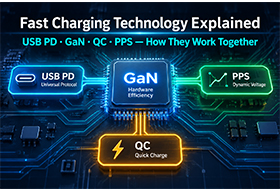
👉 //www.hechobo.com/blog/fast-charging-technology-explained.html
👉 //www.hechobo.com/contact-us.html
Frequently Asked Questions
Q: Is PPS the same as USB PD?
No. USB PD (Power Delivery) is the overall charging protocol standard that governs power negotiation between a USB-C charger and device. PPS (Programmable Power Supply) is a sub-feature within USB PD 3.0 that enables continuously variable voltage output. All PPS-capable chargers support USB PD, but not all USB PD chargers support PPS. PPS requires USB PD 3.0 or later.
Q: Does my phone support PPS?
Check your phone's official charging specification. If it lists "Adaptive Fast Charging," "Super Fast Charging 2.0," or charging wattage above 25W with a Samsung Galaxy, Xiaomi, OPPO, or Motorola flagship, it almost certainly uses PPS. iPhones and Google Pixels use USB PD without PPS. If unsure, connect a USB-PD tester between charger and phone — it will show whether PPS mode is active.
Q: Will a non-PPS charger damage my PPS-compatible phone?
No. A PPS-compatible phone connected to a non-PPS USB PD charger falls back to standard fixed-step USB PD charging. Charging proceeds normally at the standard fast charge rate — slower than with PPS, and with slightly more internal battery heat, but no damage. Battery degradation from fixed-step charging is a long-term cumulative effect, not an immediate harm.
Q: What is the difference between PPS and Qualcomm's QC 3.0 variable voltage?
Both achieve variable voltage output, but differently. QC 3.0 uses D+ / D− line signaling to adjust voltage in 200mV steps — coarser than PPS's 20mV steps. QC 3.0 operates on USB-A or USB-C with proprietary signaling. PPS operates exclusively on USB-C via the USB PD protocol. PPS provides finer voltage control (10× finer than QC 3.0) and is an open standard, whereas QC 3.0 requires Qualcomm licensing.
Q: Does a higher-wattage PPS charger charge faster than a lower-wattage one?
Up to the device's maximum accepted rate, yes. A Samsung Galaxy S25 Ultra accepting 45W via PPS charges faster from a 65W PPS charger than from a 25W PPS charger — the 65W charger can supply the full 45W the phone requests, while the 25W charger limits it to 25W. Above the device's maximum rate, additional charger wattage provides no speed benefit — the phone limits intake regardless.
Q: How do I confirm a charger genuinely supports PPS and is not just labeled as such?
Use a USB-PD protocol analyzer or tester (ChargerLAB POWER-Z KM003C, Fnirsi FNB58, or similar) connected to the charger output. The tester reads the charger's actual PDO advertisement. Genuine PPS support shows one or more PPS PDOs with a voltage range (e.g., 3.3V–11V) and current range. A charger without PPS shows only fixed voltage/current pairs. This test takes under 30 seconds and cannot be faked by labeling.
LvXiangYuan Technology — Professional Power Adapter Solutions Since 2009 | //www.hechobo.com
Shenzhen LvXiangYuan Technology Co., Ltd.
Contact: Anita
Email: wm1@hechobo.com
Mobile: 0086-14775542090
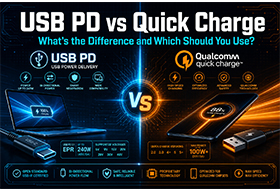
USB PD vs Quick Charge: What's the Difference and Which Should You Use?