E-Bike and Electric Scooter Charger Specification Guide: Voltage, Chemistry, Certifications, and OEM Selection
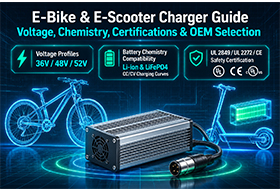
E-Bike and Electric Scooter Charger Specification Guide for OEM Manufacturers
The electric light vehicle market — e-bikes, electric scooters, electric mopeds, and cargo bikes — is one of the fastest-growing segments in consumer electronics and urban mobility. And charger selection is one of the most consequential decisions in the product development process: get it wrong, and the consequences range from extended charge times and shortened battery life to thermal events and regulatory non-compliance.
This guide is written for OEM engineers and procurement teams who need to specify a charger for a new e-bike or electric scooter product, or who are evaluating suppliers for an existing product line. It covers battery parameter-to-charger specification mapping, charging chemistry considerations, IP and environmental requirements, and the certification landscape for major markets.
The Fundamentals: How to Read a Battery Pack and Derive Charger Specifications
Every charger specification derives from the battery pack parameters. Before specifying a charger, you must know:
- Battery chemistry — determines charge voltage cutoff and CC-CV profile
- Pack voltage — determines charger output voltage (nominal and full-charge)
- Pack capacity (Ah) — determines appropriate charge current (C-rate)
- BMS communication — determines whether charger needs smart communication or is dumb CC-CV only
Step 1: Determine Pack Voltage from Cell Configuration
E-bike and scooter packs are configured in series-parallel combinations. The series count (S) determines pack voltage:
| Series Count | Chemistry: Li-ion (NMC/NCA) | Chemistry: LiFePO4 |
|---|---|---|
| Nominal voltage | 3.6–3.7V × S | 3.2–3.3V × S |
| Full charge voltage | 4.2V × S | 3.65V × S |
| Low cut-off voltage | 2.5–3.0V × S | 2.5–2.8V × S |
Common e-bike pack configurations:
| Pack Label | Series Count | Li-ion Nominal | Li-ion Full Charge | LiFePO4 Full Charge |
|---|---|---|---|---|
| 24V | 7S | 25.9V | 29.4V | 25.55V |
| 36V | 10S | 37V | 42V | 36.5V |
| 48V | 13S | 48.1V | 54.6V | 47.45V |
| 52V | 14S | 51.8V | 58.8V | 51.1V |
| 60V | 16S | 59.2V | 67.2V | 58.4V |
| 72V | 20S | 74V | 84V | 73V |
Critical specification point: The charger output voltage must match the full charge voltage of the pack — not the nominal voltage. A "48V" e-bike typically requires a charger with 54.6V output (for NMC chemistry) or 47.45V output (for LiFePO4). Specifying the charger by nominal pack voltage without clarifying chemistry leads to incorrect output voltage and either undercharging (reducing range) or overcharging (safety risk, warranty void).
Step 2: Determine Charge Current from C-Rate
Charge current is expressed as a C-rate multiplier of pack capacity:
- 0.5C charge: Safe, conservative, maximizes cycle life. Charge time: ~2 hours from empty
- 1C charge: Standard for most e-bike applications. Charge time: ~1 hour from empty
- 2C charge: Fast charge. Acceptable for some chemistries with appropriate thermal management. Charge time: ~30 minutes
- 3C+: Rapid charge. Requires active thermal management, premium cells, and battery-side acceptance confirmation
Example: A 48V 15Ah NMC pack (full charge voltage: 54.6V)
- 0.5C charge current: 7.5A → charger spec: 54.6V / 7.5A = 409W
- 1C charge current: 15A → charger spec: 54.6V / 15A = 819W
- 2C charge current: 30A → charger spec: 54.6V / 30A = 1,638W (requires high-power industrial charger)
For most consumer e-bikes and scooters, 2–5A charge current is the design target — balancing charge time (2–4 hours) with charger size, cost, and battery longevity. Higher C-rates require active battery cooling, premium cells rated for fast charge, and charger-battery communication — adding cost and complexity that most consumer products do not justify.
Step 3: Understand the CC-CV Charging Profile
All lithium chemistry chargers (Li-ion, LiFePO4, LiPo) use CC-CV (Constant Current — Constant Voltage) charging:
Phase 1 — Constant Current (CC): The charger delivers a constant output current (e.g., 5A) regardless of battery voltage. The battery voltage rises gradually as cells accept charge. This phase delivers approximately 70–80% of the pack's energy.
Phase 2 — Constant Voltage (CV): When battery voltage reaches the full-charge cutoff (e.g., 54.6V for a 48V NMC pack), the charger switches to constant voltage mode. Output voltage is held fixed at the cutoff voltage; current tapers as the cells approach full charge. Charging is complete when current falls below a threshold (typically 0.05C–0.1C — called the termination current).
What this means for charger specification:
- Output voltage regulation must be tight: ±0.5% or better at the CV setpoint. Loose voltage regulation leads to incomplete charging (if low) or overcharging (if high).
- Current limit must be accurate in CC phase: ensures C-rate target is met and cells are not stressed.
- Termination detection: quality chargers monitor current taper and cut off output when charge current falls below the termination threshold. Cheap chargers use a timer — this is unreliable and can overcharge cells that reach CV phase slowly.
Battery Chemistry: Li-ion (NMC/NCA) vs LiFePO4
The two dominant chemistries in e-bikes and electric scooters have fundamentally different charging parameters. This choice must be established before any charger specification is written.
| Parameter | Li-ion (NMC/NCA) | LiFePO4 |
|---|---|---|
| Cell nominal voltage | 3.6–3.7V | 3.2–3.3V |
| Full charge voltage | 4.2V/cell | 3.65V/cell |
| Charge voltage tolerance | ±25mV/cell | ±25mV/cell |
| Typical charge C-rate | 0.5C–1C | 0.5C–1C (some cells: up to 2C) |
| Cycle life (to 80% capacity) | 500–1,000 cycles | 1,500–4,000 cycles |
| Energy density | High (~250 Wh/kg) | Lower (~150 Wh/kg) |
| Thermal stability | Lower — requires BMS over-temp protection | Higher — more thermally stable chemistry |
| Low-temperature performance | Moderate — capacity reduces below 0°C | Poor below -10°C — requires heating |
| Market adoption (e-bike) | Dominant in consumer market | Growing in cargo bike, shared mobility |
Charger compatibility: An NMC charger (e.g., 54.6V for 48V NMC pack) cannot be used with a LiFePO4 pack of the same nominal voltage (47.45V) — the NMC charger will overcharge and damage the LiFePO4 pack. The chargers are not interchangeable even at the same nominal pack voltage. This must be clearly specified in both the charger and the product documentation.
Connector Standards for E-Bike and Scooter Chargers
Connector standardization is poor in the e-bike market — different manufacturers use different proprietary connectors, creating interoperability issues and after-market complications.
Common connectors:
| Connector Type | Common Usage | Notes |
|---|---|---|
| XLR 3-pin (male on charger) | Premium e-bikes, cargo bikes | Robust, locking, handles high current |
| DC barrel 5.5/2.1mm or 5.5/2.5mm | Budget e-bikes, scooters | Not rated for high current (max 5A recommended) |
| GX16 aviation (2-pin) | Mid-range e-bikes, Chinese market | Compact, locking, up to 10A |
| Anderson SB50 | Cargo bikes, high-power applications | High current rating (50A+) |
| JULET 3-pin / SM 2-pin | Scooter market | Common in Asian OEM production |
| Proprietary OEM connectors | Brand-specific e-bikes | Prevents third-party charger use — service consideration |
OEM recommendation: Avoid barrel jacks (5.5/2.1mm or 5.5/2.5mm) for charge currents above 3A — contact resistance at the barrel jack causes voltage drop and heating. For charge currents above 5A, use XLR, aviation, or Anderson connectors with appropriate contact current rating. For products targeting markets with after-market service expectations, choose a common connector standard (XLR or Anderson) over proprietary.
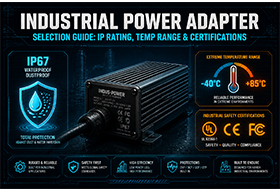
IP Rating Requirements for E-Bike Chargers
E-bike and scooter chargers are used in environments that differ significantly from consumer electronics:
- Stored in garages — temperature variation, humidity
- Used outdoors — rain exposure during plugging/unplugging
- Cargo bike and delivery applications — wash-down, heavy rain
- Shared mobility depot charging — industrial environment
IP rating selection by application:
| Application | Minimum IP Rating | Recommended |
|---|---|---|
| Consumer e-bike, indoor storage and charging | IP44 | IP54 |
| Consumer e-bike, outdoor charging | IP55 | IP65 |
| Cargo bike / delivery vehicle | IP65 | IP66 |
| Shared mobility depot (wash-down environment) | IP65 | IP67 |
| Outdoor charging station integration | IP65 | IP67 |
Note: The IP rating applies to the charger enclosure when the output connector is unmated. Most IP ratings are measured with the connector covered or mated — a charger rated IP65 may provide no protection on the connector port itself when unmated. For outdoor storage applications, specify a connector cover (dust cap) and verify IP testing was performed with the port uncovered if outdoor dust/moisture exposure is expected in the disconnected state.
→ For full IP rating reference, see: Industrial Power Adapter Selection Guide
Operating Temperature Requirements
E-bikes and scooters are used across a wide climate range — from Scandinavian winters to Middle Eastern summers. The charger must operate reliably across the intended market's temperature range.
Key temperature parameters to specify:
| Parameter | Typical Consumer Spec | Performance / Cargo Spec |
|---|---|---|
| Operating temperature | 0°C to 40°C | -20°C to 50°C |
| Storage temperature | -20°C to 60°C | -40°C to 70°C |
| Charging inhibit below | 0°C (via BMS, not charger) | -10°C (BMS inhibit for LiFePO4) |
| Thermal derating above | 40°C (full rated current) | 50°C (full rated current) |
Cold weather charging note: Lithium batteries — especially LiFePO4 — should not be charged below 0°C without pre-heating, as lithium plating on the anode can cause permanent capacity loss and internal short circuit risk. The charging inhibit function is typically handled by the Battery Management System (BMS), which communicates with the charger or simply disconnects the charge port when cell temperature is below the threshold. Specify your BMS's cold-inhibit behavior when selecting a charger — a charger that interprets a BMS inhibit signal (open circuit at charge port) as a fault and shuts down permanently requires a reset, which is a poor user experience in cold climates.
Safety Certifications by Market
European Union
The EU is the world's largest e-bike market and has the most comprehensive regulatory framework for e-bike chargers.
| Requirement | Standard | Notes |
|---|---|---|
| Low Voltage Directive | EN 62368-1 | Electrical safety — AC-to-DC power supply |
| EMC Directive | EN 55032 + EN 55035 | Emissions and immunity |
| Battery Regulation (2023/1542) | EU Battery Regulation | Applies to battery system; charger must be compatible with regulated battery |
| RoHS | EN 50581 | Restriction of hazardous substances |
| REACH | REACH Regulation | Chemical compliance for components |
| EN 15194 | EN 15194 (EPAC standard) | E-bike system standard — charger must meet charging system requirements |
EN 15194 is critical for EU market: This is the harmonized standard for electrically power-assisted cycles (EPAC — the EU classification for e-bikes with pedal assist up to 25 km/h). Clause 4.4 of EN 15194 addresses the charging system, including charger output voltage tolerance, termination behavior, and connector safety requirements. A charger with CE marking under EN 62368-1 alone is not sufficient for EN 15194 compliance — the complete e-bike system (including charger) must comply.
United States
| Requirement | Standard | Notes |
|---|---|---|
| UL Certification | UL 2271 (battery) + UL 2272 (e-scooter/e-bike system) | Increasingly required by retailers and jurisdictions |
| FCC | FCC Part 15 | EMC — applies to charger switching noise |
| UL 2594 | UL 2594 | For EVSE (higher-power charging stations) |
| CPSC | CPSC regulations | Consumer product safety; UL certification is the practical path to CPSC compliance |
UL 2271/2272 is becoming mandatory: Following multiple high-profile lithium battery fire incidents in New York City and other US cities, UL 2271 (lithium battery for light electric vehicles) and UL 2272 (personal e-mobility devices) are increasingly required by:
- Major US retailers (Amazon, Best Buy — product delisting risk without UL)
- Local fire codes (New York City Local Law 39 of 2023 — sales ban on non-UL-certified e-bikes/scooters)
- Insurance carriers (requiring UL certification for liability coverage)
The charger is a component within the UL 2271/2272 certified system. The charger itself must meet charger-specific requirements within the battery system standard.
Other Key Markets
| Market | Key Certifications | Notes |
|---|---|---|
| UK | UKCA + EN 15194 (retained post-Brexit) | UK conformity assessment required post-2023 |
| Canada | CSA / cUL | Aligned with US UL requirements |
| Japan | PSE (Diamond mark) | Mandatory for battery chargers sold in Japan |
| Australia | RCM | Mandatory; IEC 62368-1 basis |
| China (domestic) | CCC (GB standards) | For domestic China market; GB/T standards for e-bike battery systems |
→ Full certification reference: USB Charger Certifications Explained
BMS Communication: Dumb Charger vs Smart Charger
The interface between charger and Battery Management System (BMS) is a design decision that affects charging safety, user experience, and product complexity.
Dumb CC-CV Charger (No BMS Communication)
The charger delivers a fixed CC-CV profile. Safety is entirely handled by the BMS, which:
- Monitors individual cell voltages and temperature
- Disconnects charge input if any cell exceeds voltage or temperature limits
- Handles charge termination by disconnecting at pack-level full charge voltage
Advantages: Simpler charger design, lower cost, interchangeable between battery packs of the same voltage/chemistry.
Disadvantages: No cell-level optimization from charger side; charger cannot adapt to battery state (aged cells, partial charge). If BMS disconnects without the charger detecting it, the charger may fault and require reset.
Smart Charger (BMS Communication)
The charger communicates with the BMS via a communication protocol (UART, CAN bus, SMBus, or proprietary). The BMS reports:
- State of charge (SoC)
- Cell voltages and temperatures
- Charge current request
- Fault conditions
The charger adjusts output accordingly — implementing multi-stage charging profiles, responding to BMS charge current requests, and soft-starting based on BMS initialization.
Advantages: Better charge optimization, particularly for aged batteries; better user feedback (charge status via communication link); enables advanced features (cell balancing coordination, charge rate optimization by temperature).
Disadvantages: Charger is tied to BMS protocol — interchangeability is lost; higher charger cost; protocol documentation required from BMS supplier.
OEM recommendation: For consumer products (single battery pack + single charger), dumb CC-CV chargers are the mainstream choice — simpler, lower cost, adequate safety via BMS. For fleet/sharing applications (multiple charger models for same battery platform) or high-performance applications, smart charger communication pays off in operational efficiency and battery longevity.
Complete Charger Specification Template for E-Bike / Scooter OEM
Use this template when issuing an RFQ to charger suppliers:
CHARGER SPECIFICATION — [Product Name / Model]

1. BATTERY PARAMETERS
   Chemistry:            [ ] NMC  [ ] LFP  [ ] NCA  [ ] Other: ____
   Series configuration: ____S  ____P
   Nominal pack voltage: ____V
   Full charge voltage:  ____V (= 4.2V × S for NMC / 3.65V × S for LFP)
   Pack capacity:        ____Ah
   BMS type:             [ ] Dumb (CC-CV only)  [ ] Smart: Protocol: ____

2. CHARGER OUTPUT SPECIFICATION
   Output voltage:       ____V ± ____% (match full charge voltage)
   Charge current (CC):  ____A (= ____C rate)
   Termination current:  ____A (= 0.05C–0.1C recommended)
   Output connector:     [ ] XLR 3-pin  [ ] Aviation GX16  [ ] Anderson  [ ] Other: ____
   DC cable length:      ____m

3. CHARGER INPUT SPECIFICATION
   Input voltage:        [ ] Universal 100–240VAC  [ ] 100–120VAC  [ ] 200–240VAC
   Frequency:            50/60Hz
   Input connector:      [ ] IEC C14  [ ] IEC C8  [ ] Integrated blade: ____

4. ENVIRONMENTAL
   Operating temperature: ____°C to ____°C (full rated output)
   Storage temperature:   ____°C to ____°C
   IP rating:             IP____
   Altitude:              ____m

5. CERTIFICATIONS REQUIRED
   [ ] CE (EN 62368-1 + EN 15194 if EU e-bike)
   [ ] FCC Part 15
   [ ] UL 2271/2272 (US market)
   [ ] UKCA  [ ] PSE  [ ] RCM  [ ] KC  [ ] Other: ____
   [ ] RoHS  [ ] REACH

6. ADDITIONAL REQUIREMENTS
   [ ] Conformal coating (PCB)
   [ ] OEM branding / label
   [ ] Custom housing color
   MOQ: ____ pcs  Target unit cost: USD ____
   Sample lead time: ____ weeks  Mass production lead time: ____ weeks
Shenzhen LvXiangYuan Technology Co., Ltd. manufactures lithium battery chargers for e-bikes, electric scooters, cargo bikes, and light electric vehicle applications. Our e-bike charger range covers 24V to 72V pack configurations with NMC and LiFePO4 chemistry support, charge currents from 2A to 20A, and IP54/IP65 housing options for outdoor deployment.
We support CE (including EN 15194 system compliance documentation), FCC, UL 2271/2272 certification pathways, and RoHS/REACH compliance. Custom output voltage, connector, and cable configurations are available with standard MOQ.
👉 View Our Lithium Battery Charger Range
👉 Read: How to Choose a Lithium Battery Charger
👉 Read: Industrial Power Adapter Selection Guide
👉 Read: LiFePO4 Charger for Solar Energy Storage
👉 Contact Our Engineering Team to Specify Your E-Bike Charger
Frequently Asked Questions
Contact Us
Contact: Anita
Email: wm1@hechobo.com
Mobile: 0086-14775542090
LvXiangYuan Technology — Professional Power Adapter Solutions Since 2009 | www.hechobo.com
Desktop Power Adapter vs Wall Charger: How to Choose the Right Form Factor for Your Application