Industrial Power Adapter Selection Guide: IP Rating, Temperature Range, and Certifications
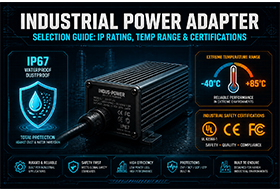
Industrial Power Adapter Selection Guide: IP Rating, Temperature Range, and Certifications
A power adapter selected for a consumer electronics product and a power adapter selected for an industrial installation share very little in common beyond the basic function of converting AC to DC. The operating environment, the failure consequences, the regulatory framework, and the procurement process are fundamentally different.
In industrial applications — factory automation, outdoor infrastructure, medical equipment, transportation systems, energy storage — a power adapter failure can halt a production line, compromise patient safety, or leave a public charging station offline. Selecting the right unit requires a different set of evaluation criteria than consumer or commercial charger procurement.
This guide covers the seven dimensions that define industrial power adapter selection: environmental protection, temperature performance, electromagnetic compatibility, mechanical durability, reliability engineering, safety certifications, and OEM integration requirements.
Why Consumer Power Adapters Fail in Industrial Environments
Consumer and commercial power adapters are designed for controlled environments: indoor, climate-regulated, low-vibration, clean air. The typical consumer spec is:
- Operating temperature: 0°C to 40°C
- Humidity: 20–80% RH, non-condensing
- Altitude: up to 2,000m
- No IP protection (open ventilation required for thermal management)
- MTBF: 50,000–100,000 hours (estimated)
Industrial environments routinely exceed every one of these parameters:
- Factory floors: 50°C+ ambient near heat sources, metal dust, cutting fluid mist
- Outdoor infrastructure: -30°C winters, condensing humidity, direct rain exposure
- Transportation: vibration, shock, wide voltage fluctuations from vehicle power systems
- Medical: EMC immunity requirements that exceed standard commercial specifications
- Hazardous locations: potentially explosive atmospheres (ATEX/IECEx requirements)
The failure mode in these environments is not dramatic. A consumer adapter deployed in a 45°C industrial enclosure runs at 100%+ thermal load continuously. Capacitors age at 2× the rate for every 10°C above rated temperature. A unit specified for 5-year MTBF at 25°C may fail in under 18 months in a 45°C installation — with no visible warning.
Dimension 1 — IP Rating: Environmental Protection
IP (Ingress Protection) rating, defined by IEC 60529, is a two-digit code describing the level of protection a product's enclosure provides against solid particle ingress (first digit) and liquid ingress (second digit).
IP Rating Decode Table
| First Digit | Solid Protection | Second Digit | Liquid Protection |
|---|---|---|---|
| 0 | No protection | 0 | No protection |
| 1 | >50mm objects | 1 | Vertical dripping water |
| 2 | >12.5mm objects | 2 | Dripping at 15° tilt |
| 3 | >2.5mm objects | 3 | Spraying water |
| 4 | >1mm objects (tools, wires) | 4 | Splashing water (any direction) |
| 5 | Dust protected (limited ingress) | 5 | Water jets |
| 6 | Dust tight (no ingress) | 6 | Powerful water jets |
| — | — | 7 | Temporary immersion (1m, 30min) |
| — | — | 8 | Continuous immersion (manufacturer-specified) |
Common IP Ratings in Industrial Applications
IP20: Standard indoor, controlled environment. No protection against dust or moisture. Suitable for enclosed equipment racks in clean, climate-controlled rooms only.
IP40: Protected against solid objects >1mm (tools, wires). No moisture protection. Minimum for factory floor control cabinets.
IP54: Dust protected + splash-proof. Suitable for factory floors with coolant mist, outdoor equipment in sheltered locations.
IP65: Dust tight + water jet resistant. The standard for outdoor installations, industrial machinery in wash-down environments, and most transportation applications.
IP67: Dust tight + temporary immersion. Required for equipment subject to flooding risk, agricultural equipment, or marine above-deck installations.
IP68: Dust tight + continuous submersion. Required for underground installations, diving equipment, and fully submerged applications.
Industrial power adapter selection rule: Match IP rating to the worst-case environmental exposure your installation will experience — not the typical condition. A roadside EV charging station may typically see rain, but must withstand high-pressure cleaning. Specify IP65 minimum; IP66 if pressure washing is part of the maintenance protocol.
IP Rating and Thermal Design Trade-off
Higher IP ratings restrict airflow, which creates a thermal management challenge. A consumer power adapter relies on convection through ventilation slots to dissipate heat. An IP65-rated adapter must manage the same thermal load within a sealed enclosure.
This trade-off is resolved through:
- Higher efficiency design — less waste heat to dissipate (GaN platforms achieve 92–95% efficiency, generating substantially less heat than silicon)
- Conduction cooling — heat transferred through the housing to the mounting surface rather than through airflow
- Derating — IP-rated adapters often specify lower maximum continuous output power than their non-IP equivalents at equivalent ambient temperature
When comparing IP-rated adapters, always check the rated output at your maximum ambient temperature — not just the headline wattage at 25°C.
Dimension 2 — Operating Temperature Range
Temperature range specification is the most commonly under-specified parameter in industrial power adapter procurement. "Operating temperature" has two critical sub-parameters that are often conflated:
Full-rated output temperature: The ambient temperature range within which the adapter delivers its complete rated output power without derating.
Survival temperature (extended range): The ambient temperature range within which the adapter operates at reduced output, with derating applied.
Temperature Range Categories
| Category | Full-Rated Range | Survival Range | Typical Applications |
|---|---|---|---|
| Commercial | 0°C to 40°C | -10°C to 50°C | Indoor offices, retail |
| Industrial standard | -20°C to 50°C | -40°C to 70°C | Factory automation, indoor industrial |
| Wide temperature | -40°C to 70°C | -55°C to 85°C | Outdoor infrastructure, transportation |
| Extreme | -55°C to 85°C | -65°C to 100°C | Military, aerospace, Arctic deployments |
Thermal Derating: What It Means in Practice
Most industrial power adapters specify a derating curve: above a certain temperature threshold (commonly 50°C or 60°C), maximum output power reduces linearly.
Example derating specification:
- Full rated output (100W) from -20°C to 50°C
- Derates linearly from 100W at 50°C to 60W at 70°C
- Above 70°C: shutdown
For an outdoor enclosure in a Middle Eastern climate where ambient can reach 55°C inside the cabinet, this adapter delivers only 90W — not 100W. Size your power budget accordingly, and verify the derating curve, not just the temperature range headline.
Cold-Start Performance
Low-temperature performance is often overlooked. Electrolytic capacitors — used throughout switching power supply designs — have significantly reduced capacitance at low temperatures. A power adapter that functions at -20°C does not necessarily provide full specification output at -20°C on cold start.
For applications subject to cold start requirements (transportation, outdoor northern deployments), ask specifically:
- What is the minimum cold-start temperature?
- Is there a warm-up period before full load can be applied?
- Are capacitors specified for low-temperature performance (105°C rated capacitors maintain better capacitance at cold temperatures than 85°C rated components)?
Dimension 3 — Electromagnetic Compatibility (EMC)
Industrial environments are electrically harsh. Variable frequency drives, large motors, arc welders, and switching equipment generate substantial electromagnetic interference. A power adapter that passes basic commercial EMC testing may fail within weeks in an industrial environment.
EMC for industrial power adapters has two sides:
Emissions (EN 55032 / CISPR 32)
The adapter must not emit electromagnetic interference that disrupts other equipment. Industrial power adapters are typically tested to Class A limits (less stringent than consumer Class B, but verified for industrial environments).
Immunity (EN 61000-4 series)
This is the dimension most buyers miss. Industrial EMC requires immunity testing against:
| Test | Standard | What It Simulates |
|---|---|---|
| ESD (Electrostatic Discharge) | IEC 61000-4-2 | Personnel touching equipment |
| Radiated Immunity | IEC 61000-4-3 | RF fields from nearby radio equipment |
| Electrical Fast Transient (EFT) | IEC 61000-4-4 | Switching transients on power lines |
| Surge | IEC 61000-4-5 | Lightning-induced surges on power lines |
| Conducted Immunity | IEC 61000-4-6 | RF interference conducted through power cables |
| Voltage Dips/Interruptions | IEC 61000-4-11 | Power supply instability |
| Magnetic Field Immunity | IEC 61000-4-8 | Strong magnetic fields near motors |
A CE-marked power adapter tested only for basic LVD and EMC emissions (the standard consumer pathway) may have no immunity testing at all. For industrial CE marking, the applicable standard is typically the Machinery Directive (2006/42/EC) or the Industrial EMC standard (EN 61000-6-2 for immunity, EN 61000-6-4 for emissions) — which requires the full immunity test battery above.
How to verify: Request the EMC test report and check which IEC 61000-4 series tests were performed. A commercial CE test report may show only EN 55032 emissions. An industrial-grade report shows emissions plus the complete immunity test matrix.
Dimension 4 — Mechanical Durability
Industrial power adapters are subject to mechanical stresses that consumer equivalents never encounter:
Vibration
Relevant for transportation (rail, road, marine), industrial machinery mounted on vibrating equipment, and HVAC systems. The applicable standard is typically IEC 60068-2-6 (sinusoidal vibration) or IEC 60068-2-64 (random vibration).
Key parameters to specify:
- Frequency range (Hz)
- Acceleration level (g)
- Test duration per axis
A transportation-grade adapter may need to withstand 5–50Hz vibration at 1.5g for 90 minutes per axis. A commercial adapter has no such testing and may experience solder joint fatigue or component loosening within months.
Shock
Relevant for equipment subject to dropping risk, impact during installation, or sudden deceleration events. IEC 60068-2-27 specifies shock testing (typically 50g, 11ms half-sine).
Altitude
At high altitude, reduced air pressure decreases convective cooling efficiency and increases the risk of electrical arcing. Standard commercial ratings typically apply to 2,000m altitude. Industrial deployments in mountain regions (data centers in Tibetan plateau, telecom infrastructure in Andes) may require altitude ratings to 4,000m or 5,000m, with corresponding derating applied.
Conformal Coating
In high-humidity or condensing environments, conformal coating on the PCB protects against moisture-induced corrosion and dendritic growth between conductors. Ask whether the power adapter's PCB has conformal coating and which standard it meets (IPC-CC-830 or equivalent).
Dimension 5 — Reliability Engineering (MTBF)
Mean Time Between Failures (MTBF) is the statistical measure of reliability. For industrial power adapters, MTBF is calculated using component-level reliability models (typically MIL-HDBK-217 or Telcordia SR-332) at a defined operating temperature.
Critical caveat: MTBF is calculated at a reference temperature — usually 25°C. At higher operating temperatures, actual MTBF degrades significantly following the Arrhenius equation: for electrolytic capacitors, MTBF roughly halves for every 10°C increase above rated temperature.
| Operating Temperature | Relative MTBF (indexed to 25°C) |
|---|---|
| 25°C | 100% |
| 35°C | ~70% |
| 45°C | ~50% |
| 55°C | ~35% |
| 65°C | ~25% |
What to ask suppliers:
- At what temperature is the stated MTBF calculated?
- What capacitor temperature rating is used (85°C or 105°C rated)? Higher-rated capacitors have substantially better longevity at elevated operating temperature.
- Is the MTBF figure calculated (from component datasheets) or demonstrated (from field data)? Demonstrated MTBF from field deployment data is more reliable.
Industrial benchmark: A quality industrial power adapter should specify MTBF > 500,000 hours at 25°C, using 105°C rated capacitors. Consumer-grade units typically specify 50,000–150,000 hours.
Dimension 6 — Industrial Safety Certifications
Industrial power adapters require a different certification pathway than consumer products. The applicable standards depend on the application domain:
General Industrial
| Certification | Standard | Market | Notes |
|---|---|---|---|
| CE (Machinery Directive) | EN 62368-1 + EN 61000-6-2/6-4 | EU | Industrial EMC standard, not consumer |
| UL Listed (Industrial) | UL 508 | USA | Industrial Control Equipment standard |
| CSA | CSA C22.2 | Canada | Often combined with UL |
| cULus | UL 508 + CSA | US/Canada | Combined mark |
Medical Applications
Medical power adapters face the most stringent certification requirements:
| Certification | Standard | Key Requirement |
|---|---|---|
| CE (Medical) | IEC 60601-1 | 2×MOPP (Means of Patient Protection) isolation |
| UL Medical | UL 60601-1 | US medical electrical equipment standard |
| Leakage current | IEC 60601-1-2 | <100μA (BF type) or <10μA (CF type) |
| EMC (Medical) | IEC 60601-1-2 | Immunity requirements for medical environments |
IEC 60601-1 certification is substantially more demanding than standard LVD/CE. The 2×MOPP requirement means double-layer isolation between input and output — protecting both the operator and the patient from electric shock. Leakage current limits are 10–100× lower than consumer standards.
→ Full article: Power Adapter for Medical Devices: IEC 60601 and Safety Requirements
Energy Storage and EV Charging
| Certification | Standard | Application |
|---|---|---|
| CE | EN 62368-1 + EN 61851 (EV) | EU EV charging equipment |
| UL 2594 | UL 2594 | US EV supply equipment (EVSE) |
| IEC 62133 | IEC 62133 | Lithium battery charger safety |
| UN 38.3 | UN 38.3 | Transportation of lithium batteries |
Hazardous Locations (ATEX / IECEx)
For deployments in potentially explosive atmospheres (oil and gas, mining, chemical processing):
- ATEX (EU): Directive 2014/34/EU, tested to EN 60079 series
- IECEx (International): IEC 60079 series
- Class I Division 1/2 (North America): UL/CSA certification for hazardous locations
ATEX/IECEx certification requires the power adapter to be either intrinsically safe (limiting energy below ignition threshold) or explosion-proof (containing any internal ignition within the housing). This is a specialized certification pathway distinct from standard industrial certification.
Dimension 7 — OEM Integration Requirements
Industrial power adapter integration involves mechanical and electrical interface considerations beyond consumer applications:
Mounting Options
| Mounting Type | Description | Typical Application |
|---|---|---|
| Open frame | Bare PCB, no enclosure | Integrated into equipment chassis |
| Chassis mount | Enclosed, screw-mounted | Equipment panel installation |
| DIN rail mount | Clips to standard 35mm DIN rail | Industrial control cabinets |
| Panel mount | Front-panel accessible connector | Industrial equipment front panels |
| External desktop | Separate unit with cable | Benchtop equipment, medical devices |
For industrial control cabinet installation, DIN rail mounting is the standard — it allows tools-free installation and removal and maintains standard spacing for other DIN-rail mounted components. Specify DIN rail compatibility explicitly if cabinet installation is required.
Connector and Cable Specifications
Industrial power connectors differ from consumer USB:
- IEC 60320 C14/C13 — standard AC inlet for equipment power supplies
- M12 circular connectors — IP67-rated, vibration-resistant, for mobile and outdoor applications
- Phoenix Contact / Weidmüller terminal blocks — for DIN rail and panel mount installations
- Molex / TE Connectivity industrial — for sealed internal connections
Isolation Requirements
Industrial power adapters typically specify:
- Input-to-output isolation voltage: 3,000VAC or 4,000VAC (higher than consumer 1,500VAC)
- Input-to-chassis isolation: 1,500VAC minimum
- Isolation class: Reinforced isolation for medical; basic isolation for most industrial
Higher isolation voltage provides better protection against line transients and is a requirement for many industrial safety certifications.
Output Ripple and Noise
Industrial and medical equipment is often sensitive to output ripple — high-frequency voltage variation on the DC output. Consumer adapters may specify ripple of 100–200mV peak-to-peak. Precision industrial and medical applications may require <50mV or <20mV. Specify maximum allowable ripple for your application.
Industrial vs Consumer Power Adapter: Specification Comparison
| Specification | Consumer / Commercial | Industrial Grade |
|---|---|---|
| Operating temperature | 0°C to 40°C | -20°C to 70°C (or wider) |
| IP rating | IP20 (unrated) | IP54–IP67 |
| MTBF | 50,000–150,000 hrs | 300,000–500,000+ hrs |
| Capacitor rating | 85°C | 105°C |
| EMC immunity | Not tested / Class B emissions only | Full IEC 61000-4 immunity suite |
| Vibration/shock | Not tested | IEC 60068-2-6/-27 |
| Safety certification | CE (LVD), FCC | UL 508 / IEC 60601 / ATEX |
| Isolation voltage | 1,500VAC | 3,000–4,000VAC |
| Output ripple | 100–200mV | 20–100mV |
| Conformal coating | No | Available / required for humid environments |
| MTBF temperature basis | 25°C | 25°C or 40°C (specified) |
How to Specify an Industrial Power Adapter: A Decision Framework
Work through these questions in sequence before issuing an RFQ:
Environmental:
- What is the maximum ambient temperature at the installation site (not room temperature — inside the enclosure)?
- Is the installation indoor, outdoor, or in a wash-down environment?
- What IP rating is required?
- Is condensing humidity possible?
- Are there vibration or shock requirements?
Electrical:
- What output voltage and current are required (calculate for worst-case load)?
- What input voltage range applies (single-phase, three-phase, vehicle supply)?
- What are the EMC immunity requirements (commercial, industrial, medical)?
- What is the maximum allowable output ripple?
- Is galvanic isolation required between input and output?
Reliability:
- What MTBF is required at the maximum operating temperature?
- What is the target service life?
- Is preventive maintenance (replacement schedule) acceptable, or must the unit run continuously for the service life?
Certification:
- Which markets is the equipment being sold into?
- Does the application fall under Machinery Directive, Medical Directive, ATEX, or another specific directive?
- Are there customer-specific certification requirements (e.g., Lloyd's Register for marine)?
Integration:
- What mounting method is required?
- What output connector type is specified by the equipment design?
- Is DIN rail mounting required?
Shenzhen LvXiangYuan Technology Co., Ltd. has supplied power adapters for industrial, commercial, and OEM applications since 2009. Our desktop power adapter range covers output voltages from 12V to 48V at power levels from 36W to 240W, with options for wide operating temperature range, conformal coating, and enhanced EMC performance for industrial environments.
We work directly with OEM engineering teams to define specifications, manage certification scope, and supply matched samples for integration testing before production commitment.
👉 View Our Desktop Power Adapter Range
👉 Read: USB Charger Certifications Explained
👉 Read: OEM Power Adapter Buyer's Checklist
👉 Contact Our Engineering Team for Industrial Specification Consultation
Frequently Asked Questions
Q: What IP rating do I need for an outdoor power adapter? For most outdoor installations in sheltered locations (under a canopy, inside a weatherproof enclosure), IP54 is the minimum. For direct rain exposure, IP65 is the standard requirement. For installations subject to high-pressure cleaning (e.g., food processing, car wash environments), IP66 or IP67 is required. For temporary submersion risk, IP67 or IP68. When in doubt, specify one IP tier higher than you expect to need — IP rating upgrades after product certification are expensive.
Q: How do I calculate the derating for a power adapter operating at 55°C ambient? Request the thermal derating curve from the supplier — this is a graph or table showing maximum output power versus ambient temperature. If the adapter derate from 100W at 50°C to 80W at 70°C (linear derating), at 55°C it delivers: 100W − (100W − 80W) × (55−50)/(70−50) = 100W − 5W = 95W. Always calculate available power at your maximum ambient temperature, not the adapter's rated maximum.
Q: What is the difference between UL 508 and UL 60950/UL 62368-1 for industrial power adapters? UL 508 is the Industrial Control Equipment standard — it applies to power supplies used as components within industrial machinery and control systems. UL 60950-1 (now superseded by UL 62368-1) applies to IT and audio/video equipment power supplies for end-user products. For a power adapter integrated into industrial machinery, UL 508 is the appropriate certification. For a standalone power adapter sold as a consumer product, UL 62368-1 applies. Many industrial adapters carry both marks.
Q: Does IEC 60601-1 certification apply to all medical equipment power adapters? IEC 60601-1 applies to power supplies used in medical electrical equipment that may have patient contact or be used in patient care environments. The specific sub-type depends on the degree of patient contact: B-type (body), BF-type (body floating), or CF-type (cardiac floating — the most stringent, with the lowest leakage current limits). Not all medical environments require the most stringent CF classification — consult IEC 60601-1 with your medical device regulatory team to determine the correct applied part classification.
Q: What does conformal coating actually protect against, and do I always need it? Conformal coating is a thin polymer layer (acrylic, silicone, polyurethane, or epoxy) applied to the PCB to protect against moisture, dust, chemical vapors, and dendritic growth between conductors. It is essential in high-humidity environments (>85% RH), condensing environments, coastal installations (salt air), and any application where chemical contamination is possible. It is not required for standard indoor industrial installations in controlled environments (below 70% RH, no condensation, clean air). Coating adds 5–10% to unit cost and is typically specified as an option rather than a standard feature.
Q: Can I use a standard desktop power adapter in an industrial control cabinet? Technically yes — but it is not recommended for demanding applications. A standard desktop adapter lacks EMC immunity testing, has no DIN rail mounting option, is rated for commercial temperature range only, and uses 85°C-rated capacitors that degrade rapidly above 40°C. For any control cabinet in a factory environment or outdoor enclosure, specify an adapter rated for the actual ambient temperature inside the enclosure (which can be 15–20°C above ambient due to internal heat sources) and with appropriate EMC immunity certification.
LvXiangYuan Technology — Professional Power Adapter Solutions Since 2009 | www.hechobo.com
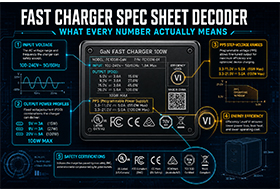
Fast Charger Spec Sheet Decoder: What Every Number Actually Means