Power Adapter for Medical Devices: IEC 60601-1 Requirements, Leakage Current, and What OEM Engineers Need to Know
Power Adapter for Medical Devices: IEC 60601-1 Requirements and OEM Selection Guide
Selecting a power adapter for a medical device is categorically different from any other power supply selection task. The stakes are different — a failing power adapter in a consumer product is an inconvenience; in a medical device, it can directly harm a patient. The regulatory framework is different — IEC 60601-1 imposes requirements that have no equivalent in consumer or industrial power supply standards. And the procurement process is different — your regulatory submission depends on the power adapter you choose.
This guide explains the IEC 60601-1 requirements that apply to external power adapters, how to translate those requirements into a supplier specification, and what to verify before integrating a power adapter into a medical device.
Why Standard Power Adapters Are Not Suitable for Medical Devices
A CE-marked, FCC-certified, UL 62368-1 listed power adapter meets every requirement for consumer and most industrial applications. It does not meet the requirements for medical devices.
The differences are specific and significant:
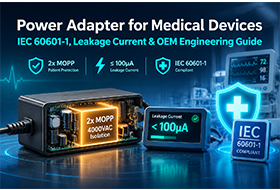
1. Isolation voltage: Standard power adapters specify input-to-output isolation of 1,500VAC (basic insulation). IEC 60601-1 requires a minimum of 4,000VAC (reinforced insulation, or 2×MOPP) for power adapters used with patient-connected devices.
2. Leakage current: Standard power adapters may have output leakage currents of 250–500μA — acceptable for consumer products, potentially lethal for a patient connected to a device via a conductive path. IEC 60601-1 limits leakage current to 100μA (BF type) or 10μA (CF type, cardiac floating — direct cardiac connection).
3. EMC immunity: Standard commercial EMC testing (EN 55032/55024) is insufficient for medical environments. IEC 60601-1-2 requires immunity to the full IEC 61000-4 test suite at higher severity levels, plus specific performance criteria for safety-critical equipment during and after each immunity test.
4. Dielectric strength: IEC 60601-1 dielectric strength testing is performed at higher voltages and for longer durations than standard consumer testing.
5. Creepage and clearance: Physical spacing between conductive paths (creepage and clearance distances) must meet IEC 60601-1 requirements — which are substantially larger than IEC 62368-1 requirements for equivalent working voltages.
None of these differences are minor. A standard power adapter cannot be "upgraded" to meet IEC 60601-1 through firmware changes or labeling. The differences are in the physical design, component selection, and PCB layout.
Understanding IEC 60601-1: The Core Standard
IEC 60601-1 (Medical Electrical Equipment — Part 1: General Requirements for Basic Safety and Essential Performance) is the international standard governing the safety of medical electrical equipment. The third edition (3.1) is the current version and is adopted by the EU, US (as ANSI/AAMI ES60601-1), Canada (CAN/CSA-C22.2 No. 60601-1), and most major medical markets worldwide.
For external power adapters used with medical devices, IEC 60601-1 applies in two ways:
Scenario A: The power adapter is a separate subassembly supplied with the medical device (e.g., an external power supply that plugs into the wall and connects to the device via a DC cable). In this case, the power adapter must itself comply with IEC 60601-1 and carry its own certification.
Scenario B: The power adapter is a listed accessory — a separately certified device whose certification is referenced in the medical device's technical documentation. The medical device manufacturer selects a pre-certified IEC 60601-1 power adapter and documents the selection in the design history file (DHF).
In both scenarios, the OEM engineer must understand the IEC 60601-1 requirements that apply to the power adapter to select correctly and document the selection appropriately.
The 2×MOPP Requirement: What It Means and Why It Matters
MOPP stands for Means of Patient Protection — a defined level of protection against electric shock for patients connected to medical electrical equipment.
IEC 60601-1 specifies that the connection between mains (AC input) and the accessible parts of the equipment (which may include the patient) must provide:
- 1×MOPP: One means of protection. Withstands 1,500VAC dielectric test (basic insulation). Acceptable for equipment with no patient connections.
- 2×MOPP: Two independent means of protection in series. Each must independently withstand 1,500VAC. Combined, the isolation withstands 4,000VAC dielectric test. Required for equipment with patient-applied parts (B, BF, or CF type).
What this means for power adapter selection:
A standard wall adapter provides basic insulation (1×MOPP) between AC input and DC output. When a patient touches the device powered by this adapter — through an electrode, a probe, or direct contact with a conductive surface — only one layer of protection stands between the patient and mains voltage.
A 2×MOPP power adapter provides reinforced insulation: two independent insulation barriers, each tested to 1,500VAC. If one barrier is compromised by a fault condition, the second barrier remains. The patient is never exposed to mains voltage through a single point of failure.
Specifying 2×MOPP: On the power adapter spec sheet, look for:
- Explicit statement: "2×MOPP compliant" or "Reinforced isolation per IEC 60601-1"
- Input-to-output isolation test voltage: ≥4,000VAC (2×MOPP = 2 × 1,500VAC, but tested at higher voltage due to safety factor)
- IEC 60601-1 certification from an accredited notified body (TÜV, SGS, Intertek, UL International)
Patient-Applied Part Classification: B, BF, and CF
IEC 60601-1 classifies the degree of patient protection required based on how the equipment contacts the patient:
| Type | Description | Max Leakage Current | Typical Applications |
|---|---|---|---|
| B (Body) | Equipment touches the patient but not directly connected to the heart | 500μA (normal) / 1,000μA (fault) | Hospital beds, examination lamps, non-invasive monitoring |
| BF (Body Floating) | Electrically isolated applied part in direct contact with the patient | 100μA (normal) / 500μA (fault) | ECG electrodes, pulse oximeters, blood pressure cuffs |
| CF (Cardiac Floating) | Directly or indirectly connected to the heart | 10μA (normal) / 50μA (fault) | Cardiac catheters, pacemaker programmers, intracardiac ECG |
The critical determination: Before specifying a power adapter, your medical device's applied part classification must be established. This is determined by how the device contacts the patient — not by the device category.
A device marketed as a "patient monitor" may have BF-type electrodes (100μA limit) or CF-type intracardiac leads (10μA limit) depending on the specific monitoring application. The classification is established in the device's risk analysis (ISO 14971) and must be consistent across all regulatory submissions.
For power adapter selection: The power adapter must support the leakage current limits of the most stringent applied part type in your device. If your device has both surface ECG electrodes (BF, 100μA) and intracardiac monitoring capability (CF, 10μA), the power adapter must meet CF leakage current limits.
Leakage Current: Types, Limits, and Measurement
IEC 60601-1 defines three types of leakage current, each with its own measurement method and limits:
Earth Leakage Current
Current flowing from the AC supply to earth through the protective earth conductor. Measured from the earth pin of the power inlet.
| Condition | Class I Equipment Limit |
|---|---|
| Normal condition | 5mA (supply frequency) |
| Single fault condition | 10mA |
Enclosure Leakage Current (Touch Current)
Current flowing from the accessible surfaces of the equipment to earth, measured when a person touches the enclosure. This is the leakage current that matters most for operator safety.
| Condition | Limit |
|---|---|
| Normal | 100μA |
| Single fault | 500μA |
Patient Leakage Current
Current flowing from the applied part (electrode, probe, sensor) to earth through the patient. This is the most critical measurement for patient safety.
| Type | Normal | Single Fault | Notes |
|---|---|---|---|
| B | 100μA | 500μA | — |
| BF | 100μA | 500μA | Applies to floating applied parts |
| CF | 10μA | 50μA | Most stringent — cardiac applications |
Measurement method: Leakage current is measured using a measuring network (patient measurement network — PMN) specified in IEC 60601-1, which simulates the impedance of a human body. The measurement includes both resistive and capacitive components of the leakage current.
What this means for power adapter specification: Specify maximum patient leakage current contribution from the power adapter at the DC output interface. For BF applications: <100μA at the DC output. For CF applications: <10μA. Ask the supplier for leakage current measurement data, not just a certification claim.
IEC 60601-1-2: EMC Requirements for Medical Environments
IEC 60601-1-2 (the EMC collateral standard to IEC 60601-1) specifies electromagnetic compatibility requirements for medical electrical equipment. The 4th edition (2014) is the current version and significantly increased immunity requirements compared to the 3rd edition.
What Changed in the 4th Edition
The 4th edition introduced a risk management approach to EMC: manufacturers must conduct a risk analysis to determine which immunity tests are applicable to their intended use environment and at what severity level.
Three defined environments:
| Environment | Description | Typical Immunity Level |
|---|---|---|
| Professional healthcare | Hospitals, clinics, surgical centers | Severity level 3–4 |
| Home healthcare | Patient home, ambulatory | Severity level 2–3 |
| Special environment | MRI rooms, ambulance, military | Application-specific |
Immunity Tests Required for Medical Power Adapters
| Test | Standard | Professional Healthcare Level |
|---|---|---|
| ESD | IEC 61000-4-2 | ±8kV contact, ±15kV air |
| Radiated Immunity | IEC 61000-4-3 | 10 V/m (80MHz–2.7GHz) |
| EFT (Electrical Fast Transient) | IEC 61000-4-4 | ±2kV power lines |
| Surge | IEC 61000-4-5 | ±1kV differential, ±2kV common mode |
| Conducted Immunity | IEC 61000-4-6 | 10 Vrms (150kHz–80MHz) |
| Power Frequency Magnetic Field | IEC 61000-4-8 | 30 A/m |
| Voltage Dips | IEC 61000-4-11 | 0%, 40%, 70% dips |
Performance criteria for medical equipment:
Medical equipment must not just survive these tests — it must maintain its essential performance during and after each test. "Essential performance" is defined for each device in the risk analysis and typically includes maintaining output voltage regulation within specification, maintaining patient leakage current below limits, and maintaining any safety-critical functions.
A power adapter for a general consumer product only needs to survive the immunity test without damage. A power adapter for a medical device must maintain its performance criteria throughout. This is a fundamentally higher requirement.
Certifications Required for Medical Power Adapters by Market
| Market | Certification | Testing Body |
|---|---|---|
| European Union | CE marking under Medical Device Regulation (MDR 2017/745) | EU Notified Body (TÜV, SGS, BSI, Intertek) |
| United States | 510(k) clearance or PMA (device), UL 60601-1 (power adapter) | FDA (device), UL/ETL (power adapter) |
| Canada | Health Canada device license, CAN/CSA-C22.2 No. 60601-1 | CSA Group or equivalent |
| Japan | PMDA approval (device), MHLW-approved testing (power adapter) | Registered testing body |
| China | NMPA registration (device), CCC or exemption (power adapter) | NMPA-designated lab |
| Australia | TGA inclusion (device), IEC 60601-1 compliance (power adapter) | TGA-recognized lab |
Important: In most major markets, the medical device manufacturer (not the power adapter supplier) is the regulatory applicant. The power adapter is documented as a component within the device's technical file or design history file. However, a pre-certified power adapter (with its own IEC 60601-1 certificate) substantially simplifies the documentation burden and is strongly preferred by regulatory affairs teams.
What to Specify When Sourcing a Medical Power Adapter
When writing a specification or RFQ for a power adapter for a medical device, include:
Electrical specifications:
- Output voltage and tolerance (specify tighter than standard: ±1% for precision medical applications)
- Output current and ripple (specify maximum ripple: <50mV p-p for most medical; <20mV p-p for precision diagnostics)
- Input voltage range (universal: 100–240VAC for international devices)
- Power factor correction (PFC): active PFC required for many medical markets above 75W
Safety specifications:
- IEC 60601-1 3rd edition (3.1) certification required
- Applied part type: B / BF / CF (specify your device's classification)
- Maximum patient leakage current: state the numerical limit (e.g., <10μA for CF)
- Isolation: 2×MOPP, reinforced isolation, 4,000VAC withstand
- Protection class: Class I (earthed) or Class II (double-insulated)
EMC specifications:
- IEC 60601-1-2 4th edition compliance
- Intended use environment: Professional Healthcare / Home Healthcare
- Radiated emissions: CISPR 11 Class B
- Conducted emissions: CISPR 11 Class B
- Immunity: Per IEC 60601-1-2 Table 4 (professional healthcare) or Table 5 (home healthcare)
Environmental:
- Operating temperature: specify your device's intended use environment
- Humidity: typically 30–75% RH (non-condensing) for hospital; wider for home care
- Storage temperature: typically -20°C to 70°C
- Altitude: 0–4,572m for aircraft-portable equipment
Documentation required:
- IEC 60601-1 3.1 test report from notified body or accredited laboratory
- IEC 60601-1-2 4th edition EMC test report
- Leakage current measurement data (earth leakage, enclosure leakage, patient leakage)
- Bill of Materials (BOM) with component certifications for key safety components
- Declaration of Conformity (DoC)
- Design documentation sufficient to support integration into medical device technical file
The Regulatory Integration Checklist
When integrating a medical power adapter into your device's regulatory submission:
Risk Management (ISO 14971):
- Applied part type determined from risk analysis
- Leakage current limits identified for each applied part type
- Power adapter selected with leakage current values below determined limits
- Risk of power adapter failure modes analyzed and mitigated
Technical Documentation:
- Power adapter IEC 60601-1 certificate referenced in technical file
- Power adapter IEC 60601-1-2 EMC test report referenced
- System-level EMC testing performed with power adapter installed in device
- System-level leakage current testing performed (not just component-level)
- Power adapter included in device's Essential Requirements checklist (EU MDR Annex I)
Design Controls (21 CFR 820 / ISO 13485):
- Power adapter specification documented in design inputs
- Power adapter qualification testing completed and documented
- Supplier qualification completed (audit or questionnaire per ISO 13485 §7.4)
- Change control process established for power adapter component changes
Critical note on system-level testing: Even when using a pre-certified IEC 60601-1 power adapter, system-level leakage current testing is required. The combination of power adapter and device may produce different leakage current than either component individually — stray capacitances and shared ground paths affect the measurement. Component-level certification does not substitute for system-level verification.
Red Flags When Evaluating Medical Power Adapter Suppliers
These supplier behaviors indicate insufficient medical-grade manufacturing capability:
- Cannot provide IEC 60601-1 test report (not just certificate): the test report shows actual measured values for leakage current, dielectric strength, and creepage/clearance — the certificate alone does not
- Certificate covers different model than the product being ordered: model-specific testing is mandatory; certificates are not transferable across models
- Certificate from non-accredited laboratory: the testing body must be an ISO/IEC 17025 accredited laboratory recognized by the relevant regulatory authority
- No IEC 60601-1-2 (EMC) test report: electrical safety and EMC are separate certifications; a supplier with IEC 60601-1 electrical safety but no IEC 60601-1-2 EMC test has an incomplete compliance package
- Patient leakage current not measured: some suppliers claim IEC 60601-1 compliance based on design review only, without actual leakage current measurement — this is insufficient for device regulatory submissions
- Cannot support change notification: if the supplier substitutes a component (transformer, capacitor, opto-isolator) without notifying you, the IEC 60601-1 certification may be invalidated without your knowledge
Shenzhen LvXiangYuan Technology Co., Ltd.
Supplies power adapters to OEM manufacturers in medical, industrial, and commercial applications. For medical device customers, we provide:
- Full IEC 60601-1 3rd edition (3.1) certification documentation on request
- Patient leakage current measurement data (actual measured values, not specifications only)
- IEC 60601-1-2 4th edition EMC compliance documentation
- Component-level BOM with safety-critical component certifications
- Change notification commitment for all specified components
- Supplier questionnaire responses compatible with ISO 13485 §7.4 supplier qualification requirements
We understand that regulatory submissions have timelines. We maintain documentation packages that can be provided to your regulatory affairs team without delay.
👉 View Our Desktop Power Adapter Range
👉 Read: Industrial Power Adapter Selection Guide
👉 Read: OEM Power Adapter Buyer's Checklist
👉 Contact Our Engineering Team for Medical Power Adapter Consultation
LvXiangYuan Technology — Professional Power Adapter Solutions Since 2009 | www.hechobo.com
Frequently Asked Questions
If your device has patient-applied parts (electrodes, probes, sensors that contact the patient), IEC 60601-1 certification is mandatory — not optional. A standard industrial or consumer power adapter cannot meet the leakage current limits or isolation requirements. If your device has no patient contact (e.g., a hospital administration workstation or laboratory equipment that never contacts patients), standard industrial certification (UL 62368-1, IEC 62368-1) may be acceptable — but confirm this determination with your regulatory affairs team and document it in your risk analysis.
Class I equipment uses a protective earth connection (three-pin plug) to provide safety against insulation failure — fault current flows to earth rather than through the user. Class II equipment uses double insulation instead of earth connection — two independent insulation barriers replace the earth conductor. For medical devices used in locations where earth ground may be unreliable (developing markets, older buildings), Class II (double-insulated) power adapters provide consistent protection regardless of earth quality. Both classes can comply with IEC 60601-1; the choice depends on the device's intended use environment.
Only if the USB-C PD charger carries IEC 60601-1 certification for the required applied part type (B, BF, or CF). A standard USB-C PD charger — even one with CE, FCC, and UL 62368-1 certification — does not meet IEC 60601-1 leakage current limits or isolation requirements. Using a non-IEC 60601-1 power source for a patient-connected device is a regulatory non-compliance and a patient safety risk.
A complete IEC 60601-1 3rd edition test including electrical safety and IEC 60601-1-2 EMC takes approximately 6–12 weeks at an accredited laboratory, depending on the lab's queue. Costs vary significantly by laboratory and product complexity — budget approximately USD 15,000–35,000 for a complete package (electrical safety + EMC + documentation). Some accredited labs offer pre-submission design reviews that can identify issues before formal testing, reducing the risk of first-submission failures.
In most regulatory frameworks, changing a component — even a pre-certified one — triggers a design change assessment. Under FDA regulations, this requires a design change analysis (21 CFR 820.30(i)) documenting whether the change significantly affects safety or effectiveness. Under EU MDR, significant changes require notified body review. At minimum, you must perform system-level leakage current verification with the new adapter and document the results. Consult your regulatory affairs team before making any power adapter substitution in a cleared or approved device.
IEC 60601-1 is the main electrical safety standard — it covers mechanical safety, electrical isolation, leakage current, dielectric strength, and protection against electric shock. IEC 60601-1-2 is the collateral EMC standard — it specifies electromagnetic emissions limits and immunity requirements for medical electrical equipment. Both are required for a complete medical device compliance package. A power adapter with only IEC 60601-1 electrical safety testing and no IEC 60601-1-2 EMC testing has an incomplete regulatory documentation package.
Industrial Power Adapter Selection Guide: IP Rating, Temperature Range, and Certifications