


GaN Charger vs PD Charger: Key Differences and Which One You Actually Need
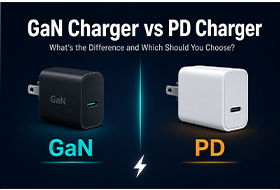
GaN Charger vs PD Charger: What's the Difference and Which Should You Choose?
If you've spent any time researching modern charging solutions, you've likely encountered both "GaN charger" and "PD charger" — sometimes used interchangeably, sometimes treated as entirely different products. The confusion is understandable, but the distinction matters, especially when you're making sourcing decisions for a product line or evaluating power adapters for your devices.
This guide cuts through the technical jargon to give you a clear, practical comparison — so you can make a confident decision.
What Is a GaN Charger?
How GaN Technology Works
GaN stands for Gallium Nitride, a semiconductor material that has fundamentally changed how power adapters are built. Traditional chargers rely on silicon as their core switching material. GaN replaces silicon as the transistor material inside the charger's power conversion circuit.
Because GaN semiconductors can switch electricity at much higher frequencies and handle higher voltages with less energy loss, the result is a charger that:
- Generates significantly less heat during operation
- Achieves higher power density — delivering more watts from a smaller physical size
- Maintains greater efficiency throughout the charging cycle
Key Advantages of GaN Chargers
| Feature | GaN Charger | Traditional Silicon Charger |
|---|---|---|
| Size | 40–50% smaller | Larger form factor |
| Heat output | Low | Moderate to high |
| Efficiency | 90–95% | 75–85% |
| Max power output | Up to 240W (GaN III) | Typically up to 65W |
| Cost | Higher (declining) | Lower |
The practical implication: a 65W GaN charger can be about the size of a standard wall plug, while a 65W silicon charger is noticeably larger and heavier. For consumer electronics brands and OEM manufacturers, this opens up entirely new product form factors.
What Is a PD (USB Power Delivery) Charger?
How USB PD Protocol Works
USB Power Delivery (USB PD) is a charging protocol standard — not a hardware technology. It was developed by the USB Implementers Forum (USB-IF) to allow USB-C connections to negotiate and deliver much higher power levels than standard USB charging allows.
Under the USB PD protocol:
- The charger and device communicate to determine the optimal voltage and current
- Power levels can be dynamically adjusted (from 5V/0.9A up to 48V/5A under PD 3.1)
- Both the charger and the device must support the same PD version to unlock full capabilities
Think of USB PD as the language the charger and device use to talk to each other. GaN is the engine that powers the charger itself.
PD Charging Standards: PD 2.0, PD 3.0, and PD 3.1
| Standard | Max Power | Key Feature |
|---|---|---|
| USB PD 2.0 | 100W | Introduced in 2012; supports fixed voltage profiles |
| USB PD 3.0 | 100W | Added PPS (Programmable Power Supply) for adaptive voltage |
| USB PD 3.1 | 240W | Extended Power Range; supports laptop and large device charging |
For most consumer and prosumer applications, USB PD 3.0 with PPS support is the current benchmark. PD 3.1 is increasingly relevant for laptop charging and industrial device applications.
GaN Charger vs PD Charger — Are They the Same Thing?
No — and this is the most important point in this entire article.
- A GaN charger describes the internal hardware — specifically the semiconductor material used in the power conversion circuit.
- A PD charger describes the communication protocol the charger supports — the standard it uses to negotiate power delivery with a connected device.
The two concepts are complementary, not competing. A charger can be:
- GaN only (uses GaN transistors but charges at fixed voltage — not common today)
- PD only (silicon-based charger supporting USB PD protocol)
- GaN + PD (most modern premium chargers) — uses GaN hardware AND supports USB PD protocol
In practice, the most capable and popular chargers on the market today are GaN PD chargers — combining compact hardware with intelligent power negotiation.
Head-to-Head Comparison: GaN vs PD Charger
| Dimension | GaN Charger | PD Charger |
|---|---|---|
| What it defines | Hardware technology | Charging protocol |
| Controls | Heat, size, efficiency | Voltage/current negotiation |
| Requires specific port? | No (can use USB-A or USB-C) | Yes — requires USB-C port |
| Device compatibility | Universal | Requires PD-compatible device |
| Combined version available? | ✅ GaN PD Charger | ✅ GaN PD Charger |
| Best for | Compact, high-power applications | Fast charging precision |
Which Type of Charger Is Right for Your Application?
Consumer Electronics
For smartphones, tablets, wireless earbuds, and laptops, a GaN PD charger delivers the best user experience: fast, safe, and compact enough for travel. Key specs to look for:
- USB PD 3.0 with PPS support
- Minimum 30W for smartphones, 65W+ for laptops
- Multi-port design with dynamic power distribution
Industrial / B2B Procurement
If you're sourcing chargers for resale, OEM integration, or branded product bundles, several additional factors apply:
- Certification requirements: CE, FCC, UL, RoHS, KC,PSE,UKCA,SAA — vary by target market
- Customization needs: Logo, cable configuration, plug type (US/EU/UK/AU/JP/KR)
- Volume pricing: Per-unit cost changes significantly at MOQ thresholds
- Lithium battery chargers require additional compliance for multi-cell packs (CC/CV profile, protection circuitry)
Working directly with a manufacturer — rather than through a trading company — typically offers better access to engineering customization and faster lead times.
What to Look for When Sourcing a GaN or PD Charger
Whether you're specifying a charger for a product BOM or placing a wholesale order, evaluate suppliers on these criteria:
- Protocol support: Does it truly support USB PD 3.0 with PPS, or is it a basic PD 2.0 design?
- GaN generation: GaN II or GaN III — the latter offers significantly better thermal performance
- Certifications: Verify certificates directly, not just from the supplier's marketing materials
- Multi-port power sharing: How does the charger distribute power when multiple devices are connected simultaneously?
- OEM capability: Can the manufacturer produce custom firmware, cable types, or housing colors at your required MOQ?
- Testing and QA: What QC process does the factory use? Is aging testing performed on each batch?
Why Source From an Experienced Manufacturer?
Sourcing chargers from a manufacturer with deep engineering expertise means you're not just buying a commodity product — you're gaining a technical partner.
Shenzhen LvXiangYuan Technology Co., Ltd. has been designing and manufacturing power adapters since 2009. With over 17 years of experience, we produce:
- USB Wall Chargers — standard and multi-port configurations
- PD Wall Chargers — supporting USB PD 2.0, 3.0, and 3.1
- PD GaN Chargers — compact, high-efficiency designs for premium consumer brands
- Desktop Power Adapters — for industrial and commercial equipment
- Lithium Battery Chargers — CC/CV profiles for single-cell and multi-cell packs
All products are manufactured in our own factory in Shenzhen, with full CE, FCC, and RoHS compliance. We support OEM/ODM customization including logo printing, packaging design, plug localization, and firmware customization.
👉 Explore Our PD GaN Charger Range
👉 Contact Our Engineering Team for a Custom Quote
Frequently Asked Questions
Q: Can a GaN charger also be a PD charger?
Yes. Most modern GaN chargers also support USB Power Delivery. When both technologies are combined, you get a GaN PD charger — smaller, more efficient, and capable of fast, intelligent charging.
Q: Is a PD charger safe for lithium batteries?
USB PD chargers are safe for devices with lithium batteries when the receiving device has a built-in BMS (Battery Management System) that regulates incoming power. For standalone lithium battery packs, a dedicated lithium battery charger with CC/CV profile and overcharge protection is recommended.
Q: What wattage GaN PD charger do I need?
For smartphones: 20–30W. For tablets: 30–45W. For laptops: 65–100W. For multi-device charging: 100–140W with dynamic power distribution.
Q: How do I verify a supplier's certification claims?
Request the actual certificate numbers and verify them on the issuing body's website (e.g., FCC ID Database, EU DOCONLINE for CE). A reputable manufacturer will provide original certificates without hesitation.
Q: What is the minimum order quantity for custom chargers?
MOQ varies by product type and customization level. For standard models, MOQ can be as low as 500 units. Custom designs typically require 1,000–5,000 units. Contact us for a specific quote.
LvXiangYuan Technology — Professional Power Adapter Solutions Since 2009 | www.hechobo.com